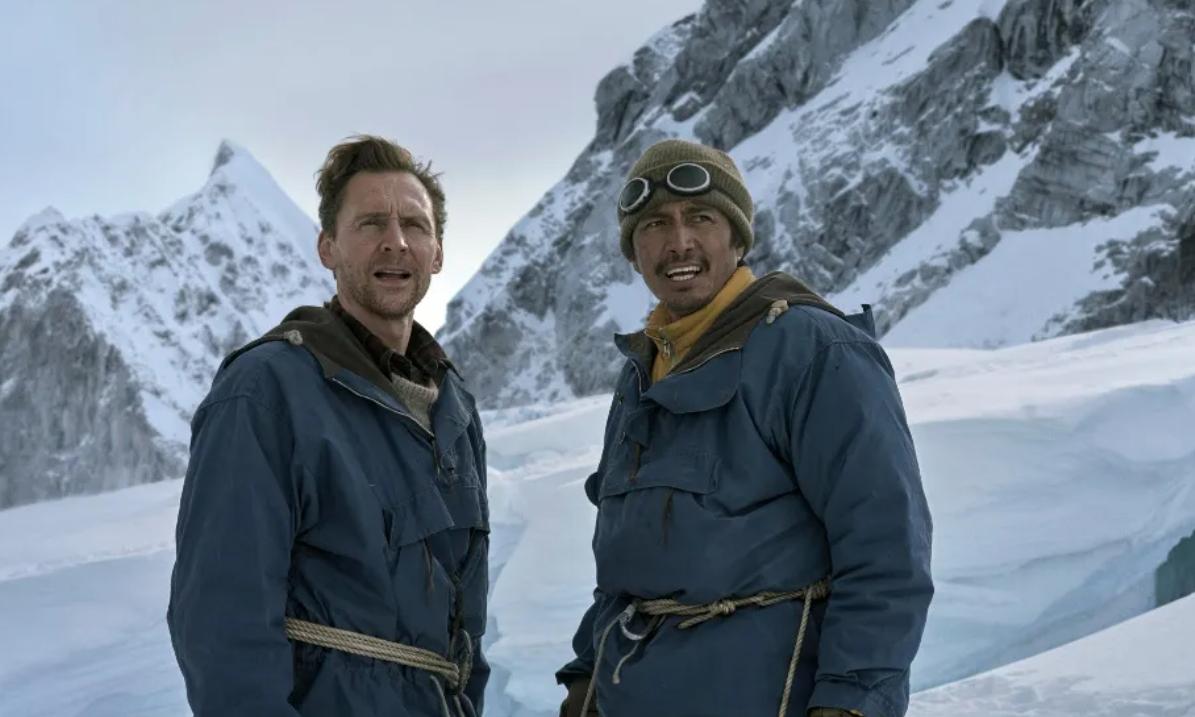
“They see mountains, we see ourselves,” Tenzing Norgay tells co-climber Edmund Hillary, as the two embark on their expedition to scale Mount Everest in 1953. Norgay’s observation is in response to the expedition leader, Colonel John Hunt’s call to lay siege to Chomolungma, which the British renamed Mount Everest after surveyor George Everest in 1865.
Chomolungma, which means “Goddess Mother of the World” in Tibetan, was revered by the locals but appropriated by the British as their mountain, one they needed to conquer as it had become a matter of nationalist pride. No one had ever made it to the top, despite eight previous British attempts.
A tale of conviction, courage and ambition, as well as the defiance to stand by one’s beliefs and, most importantly, forge a sense of belonging, Australian documentary filmmaker Jennifer Peedom’s Tenzing on Apple TV is a dramatic retelling of the historic 1953 expedition to conquer the seemingly unconquerable peak of Mount Everest.
The film opens in 1921, with a young Tenzing gazing at Mount Everest in wonderment and bowing down in reverence as it majestically straddles the border between Nepal and Tibet. At the base camp, he encounters the legendary George Mallory (Johnny Flynn), who was part of the early expeditions to scale the mountain. Tenzing literally steps into Mallory’s boots, putting his small feet into the discarded pair, little realising that he will one day set out to fulfil the man’s mission, which had become a global endeavour.
Caught between two worlds
We then meet 39-year-old Tenzing Norgay, played by Genden Phuntsok, a Chinese actor of Tibetan descent. When he corrects a foreign couple who mistake another peak for Mount Everest, he is admonished: what would a mere porter know?
The arrival of the stiff-upper-lipped British Colonel John Hunt (Willem Dafoe), leading his team, which includes the promising “Kiwi” New Zealander Edmund Hillary (Tom Hiddleston), could be the opportunity Tenzing has been waiting for. But once again, he finds himself caught in the intricate politics that have constantly shadowed his life. For Hunt, he is just a “Sherpa” helping the team navigate the high altitudes; he cannot be one of them. Among the Sherpas, too, he continues to be an outsider.
Peedom uses a series of cleverly intercut flashbacks to dramatise the human politics that have shadowed Tenzing’s life. His fascination with Chomolungma, and the yearning he describes in his autobiography “Man of Everest,” stem from a spiritual pull. But the mountain also represents an aspiration: a chance to earn acceptance among the local Sherpa community and, eventually, the British. A Tibetan Bhutia, Tenzing was an outsider among the Sherpas, who were the preferred ethnic group chosen by the British for frontline high-altitude climbs. He moves to Darjeeling, the epicentre of the Sherpa community. His marriage to Dawa Phuti, a local woman who shares his dream and encourages him, is another important chapter in his life that the film explores.
When Tenzing cajoles Colonel Hunt, insisting that he will join the expedition as part of the Everest team or not at all, we see a man who is scrupulously honourable and determined to claim his rightful place.
A bond forged on ice
It is his partnership with Hillary that becomes significant. The two form a connection, having much in common beyond their non-British identities. They both feel “happy and free” in the mountains. Their bond is central to the film as the two join the second summit team assigned by Hunt and emerge successful on May 29, 1953, becoming the first men to climb Everest. Though the media and popular culture have often contested who reached the summit first, the film shows Hillary telling Tenzing to go ahead, emphasising that they climbed together.
The appeal of the film, which is also Peedom’s masterstroke, lies in the way she makes you feel one with the story: the insurmountable icy peaks, the slippery and dangerous climbs, the struggle to breathe, and the constant awareness that one fall could leave you buried beneath the ice.
Peedom’s lens as a documentary filmmaker, and her fascination with the Himalayas, as seen in her previous films Mountain and Sherpa, come to the fore. She is uncompromising in her approach, bringing a sure sense of location, from the villages and mountain ranges to the vertiginous peaks. The skilful cinematography by Stefan Duscio makes the colossal icy peaks feel both reachable and unreachable.
Genden Phuntsok brings a quiet humility and an unyielding determination to excel to his portrayal of Tenzing. Tom Hiddleston skilfully captures the straight-shooting Edmund Hillary, a man unbowed by the British air of supremacy or stifled by false airs of superiority.
Man, mountain and belonging
Tenzing delivers a palpable adrenaline rush, capturing the formidable challenge of man against mountain. But beyond the physical feat, it is the story of a man who refuses to be diminished by the circumstances of his birth or the prejudices of those around him. In bringing Tenzing’s spiritual connection with the mountain, his courage and his partnership with Hillary to the fore, Peedom gives this mountaineering legend the recognition he deserves.