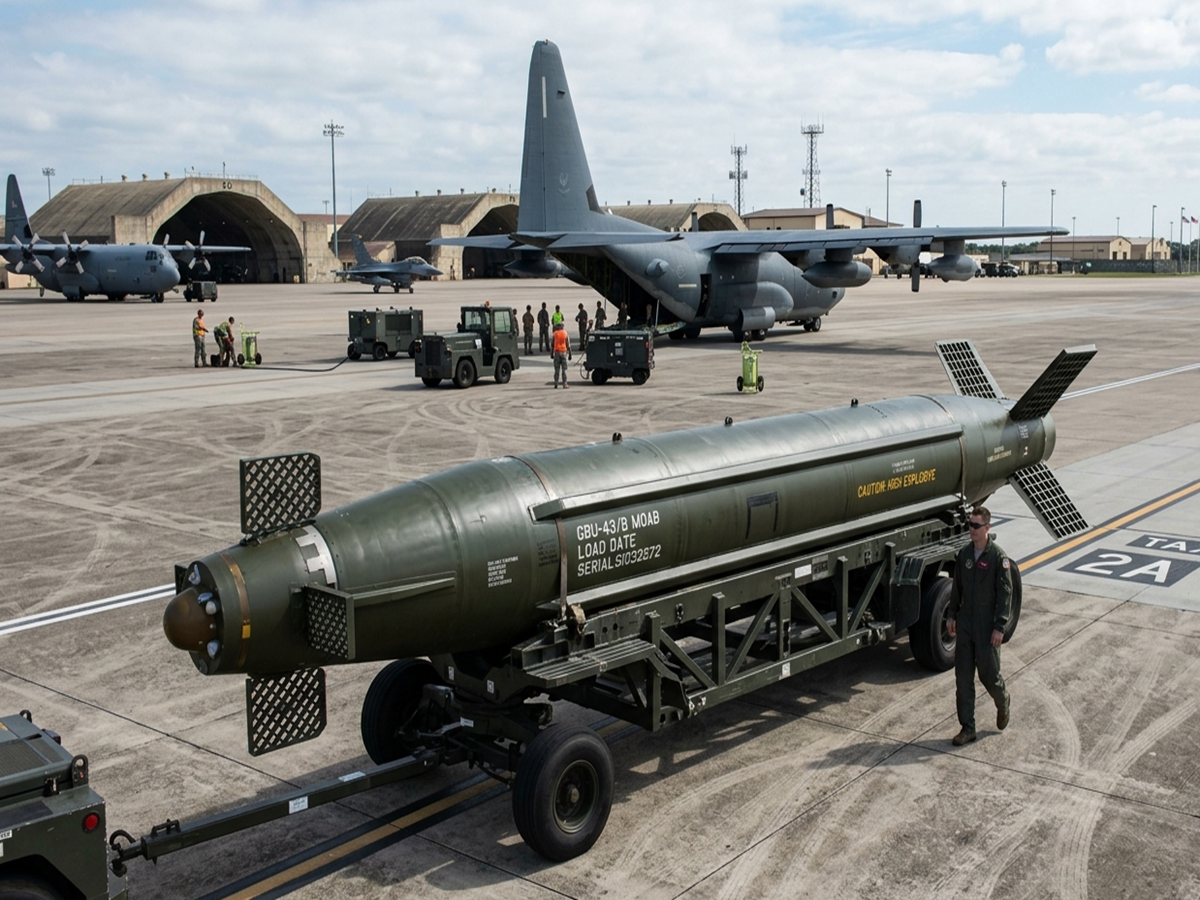
The United States is reportedly considering a powerful conventional weapon for potential future strikes against Iran. As the news has broken, it has raised concerns about a possible escalation of the ongoing conflict. This bomb is popularly known as the “Mother of All Bombs”. The GBU-43/B Massive Ordnance Air Blast Bomb, or MOAB, is the most powerful non-nuclear bomb in the US military’s arsenal.
According to a CNN report cited by Reuters on October 15, US military planners have developed options that could involve using the weapon against Iranian energy infrastructure and nuclear facilities. This attack will turn into reality if President Donald Trump orders renewed combat operations. However, the proposal remains under consideration, and the US has not confirmed that the bomb will be used against Iran.
The possibility has drawn attention because of the weapon’s enormous explosive power. Yet, despite its reputation, the MOAB is not a nuclear bomb, and its ability to destroy deeply buried nuclear installations remains uncertain.
What Is the ‘Mother of All Bombs’?
GBU-43/B Massive Ordnance Air Blast Bomb refers to a GPS-guided, air-delivered conventional weapon developed by the United States in the first decade of the 2000s. The term “Mother of All Bombs” is derived from its monstrous size and destructive power.
This weapon weighs around 9,800 kg or about 10 tonnes and is more than nine meters in length. In addition, the GBU-43/B bomb consists of a total weight of 8,500 kg of high explosives.
The MOAB is not a nuclear weapon that uses nuclear explosions or fallout from nuclear reactions but rather a conventional weapon that uses massive conventional explosives to create intense pressure waves that cause devastating destruction to exposed buildings and military installations in the vicinity.
It is typically dropped from a large military transport plane like the C-130 Hercules version of the plane. The name “MOAB” was derived from the saying “mother of all battles” by the former president of Iraq, Saddam Hussein, in the Gulf War in 1991.
How Much Destruction Can the MOAB Cause?
The MOAB was developed to explode just above the surface of the ground, generating an explosive shock wave instead of exploding upon direct contact with its target. This pressure wave can cause severe damage or even destruction of buildings, military hardware, cave mouths and any other exposed objects.
According to Colonel Nidal Abu Zeid, a military expert, interviewed by Al Jazeera, this weapon may cause damage or destruction to above-ground structures and positions within a one-kilometre radius, but this will depend on topography, nearby structures and the type of the target itself.
An explosion may also generate debris and create pressure waves that can be dangerous for personnel and structures far from the place where the bomb explodes.
Nevertheless, the destructive capability of this weapon should not be considered as a circle where everything is affected in an equal measure. Structures, hills, underground shelter facilities and other physical obstructions may affect the range and effect of the explosion.
Has the US Ever Used the Mother of All Bombs?
The United States used the MOAB in combat for the first time on April 13, 2017, during an operation against an Islamic State-Khorasan Province cave and tunnel complex in Afghanistan.
Afghan authorities reported that 94 ISKP fighters were killed in the strike. While officials said no civilians were harmed, local reports of civilian casualties were not independently confirmed. Reports also said that homes were destroyed in the affected area.
The Afghanistan operation demonstrated the bomb’s ability to deliver a devastating blast against exposed positions and cave-related targets. However, it did not establish that the weapon could destroy every type of underground military installation.
Could the MOAB Destroy Iran’s Nuclear Sites?
One of the biggest questions surrounding the reported US military plans is whether the MOAB could damage Iran’s heavily protected nuclear facilities.
Potential targets include underground installations such as the Fordow complex and a developing site at Pickaxe Mountain. These locations are believed to be protected by substantial layers of rock and other fortifications, making them difficult to destroy with conventional air strikes.
Although the MOAB can devastate structures above ground and near cave entrances, it was not specifically designed to penetrate deeply buried facilities. Its enormous explosive power does not automatically mean it can reach and destroy a target hidden beneath a mountain.
The US military has a separate weapon, the GBU-57 Massive Ordnance Penetrator, specifically designed to penetrate hardened underground targets before exploding. The MOAB and the GBU-57 therefore serve different purposes.
Military experts have questioned whether using the MOAB against Iran’s deeply buried nuclear infrastructure would achieve Washington’s stated objectives. Its deployment could cause extensive surface destruction without necessarily eliminating the underground facilities it is intended to threaten.
Why Is the Possible US Strike Raising Concerns?
The announcement about the MOAB use came against the backdrop of uncertainty regarding the further direction of the US-Iran confrontation. The utilisation of this extremely powerful weapon may be considered an escalation, especially if Iranian nuclear centres and energy installations become a target.
Moreover, experts have raised the issue of possible retaliation from Tehran. Iran threatened to attack regional information installations if the American strikes continue, as reported by Al Jazeera.
In the case of the US, the most important question is whether this powerful bomb will provide some military advantages or it will be a demonstration of power without bringing other results for the USA.
For now, this bomb is considered just one of the options that might be used by the United States in a new attack against Iran. The question is whether this powerful bomb can turn the tide in the war or it will only complicate the situation further.
Sudeep Singh Rawat is a Copy Editor at NewsX Digital with over five years of experience in digital journalism. He covers national and international news, with a focus on politics, crime, technology, public affairs, and trending topics. Before joining NewsX Digital, he worked with Business Standard, The Sunday Guardian, and other digital media organisations. His reporting focuses on breaking news, enterprise stories, and explainers that inform readers through accurate, balanced, and context-driven journalism.
The post What Is ‘Mother of All Bombs’? Not Nuclear, but Massively Destructive – US Weighs Using It Against Iran; What Havoc Could It Wreak? appeared first on NewsX.