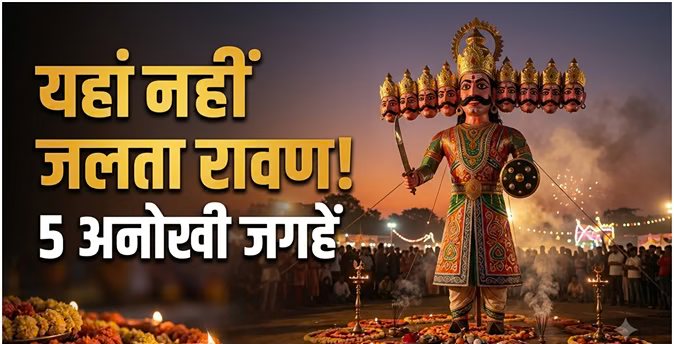
In the list of Sanatan culture and festivals, the festival of 'Vishal Vijay Dashami' i.e. Dussehra (Dussehra 2026) is celebrated with great enthusiasm and pomp all over India as a symbol of the victory of good over evil. In most parts of our country, grand fairs are organized on this auspicious occasion, fireworks echo in the sky and huge effigies of Ravana, Kumbhakarna and Meghnath are burnt. But do you know that there are some magical and historical places in India where there is no tradition of burning the effigy of Ravana, on the contrary, in some places Ravana is seen as a wise and revered character? Not only this, there is a part of the country where Dussehra is considered to be the longest folk festival in the world, lasting not just for one day but for 75 days. Let us know in depth from the eyes of a cultural and ground reporter what are these unique and surprising traditions of celebrating Dussehra in these different corners of India. Bastar's world famous 75-day Dussehra: Where Ravana is not burnt but Maa Danteshwari is worshipped. The Dussehra festival celebrated in the tribal dominated Bastar division of Chhattisgarh is considered unique across the world for its unique culture and long duration. While in the rest of the country, Dussehra ends with the killing of Ravana, in Bastar this festival continues for a total of 75 days. This huge festival begins with the new moon day of Shravan month and continues with various traditional rituals till the full moon day of Ashwin month. The biggest feature of this historical Dussehra of Bastar is that there is no tradition like burning of Ravana or staging of Ramlila. During this time, people of the tribal community take out a special Rath Yatra dedicated to their adored goddess 'Maa Danteshwari', in which Raja Pakhad and the umbrellas of local gods and goddesses participate. This 75 days long festival is such a wonderful confluence of tribal culture, folk dances, traditional faith and brotherhood that even foreign tourists come to see it. International Dussehra of Kullu, Himachal Pradesh: Where the valley is decorated with the meeting of Gods, Kullu Dussehra, situated in the beautiful valleys of Himachal Pradesh, has a separate and grand international identity in itself. Here the main festival of Dussehra officially begins from the day of Vijayadashami, which is celebrated with great pomp for the next seven days. Celebrated at Dhalpur ground in Kullu, this Dussehra begins with the grand Rath Yatra of Lord Raghunath. According to the tradition here, during this entire festival, hundreds of gods and goddesses of the valley are brought in palanquins to Dhalpur ground, where they pay obeisance to Lord Raghunath. Even in Kullu, there is not the common practice of burning Ravana which is seen in the plains of North India, rather this festival is celebrated here as a Mahakumbh of meeting of the gods, fairs, cultural programs and folk music. Story of Bisrakh village of Uttar Pradesh: Where Ravana is considered to be extremely knowledgeable and his effigy is not burnt. A village named 'Bisrakh' (Bisrakh Village) located near Greater Noida in Uttar Pradesh is considered to be the birthplace of Lankesh Ravana. According to religious beliefs, Ravana's father Rishi Vishrava had performed penance at this place and Ravana spent his childhood here. Due to this historical and mythological belief, the people of Bisrakh village consider Ravana as their local patriarch and great scholar. This is the reason why till date the effigy of Ravana has never been burnt on the day of Vijayadashami in this village. When people in the rest of the country are celebrating Ravana Dahan, the people of this village express condolence or perform puja for the peace and salvation of Ravana's soul. Local people believe that burning the effigy of a wise man like Ravana and a devotee of Shiva can be inauspicious for their village. Ritual of worship of Ravana and mourning by women in Mandsaur and Kanpur of Madhya Pradesh. A unique tradition of respect and reverence towards Ravana is also seen in Mandsaur district of Madhya Pradesh. According to mythology, Mandsaur (which was called Dashpur in ancient times) was the maternal home of Ravana's wife Mandodari. Due to this relationship, Ravana is given the status of son-in-law in many parts of Mandsaur. A huge idol of Ravana is installed here, where many people come to worship him on the day of Vijayadashami. Apart from this, there is an ancient temple of Ravana in Kanpur city of Uttar Pradesh which opens only once a year i.e. on the day of Dussehra. On this day, the local people go to Ravana's temple, light a lamp, perform his aarti and praise him for being a great scholar. Similarly, in Jodhpur, Rajasthan, there are some Brahmin families who consider themselves descendants of Ravana and perform Shraddha and Tarpan of Ravana on the day of Dussehra. This unique and cultural festival of India giving the message of unity in diversity is the beauty of India that here the same festival is celebrated in different states and cultures according to their ancient beliefs and folk tales. While on one hand the tradition of burning Ravana to give the message of victory of good over evil is the basis of Sanatan Dharma, on the other hand at some places Ravana's learned side and mythological history are also respected. This festival of Dussehra teaches us that behind every tradition there is some deep social or historical message hidden, which makes our great culture different and alive in the world.