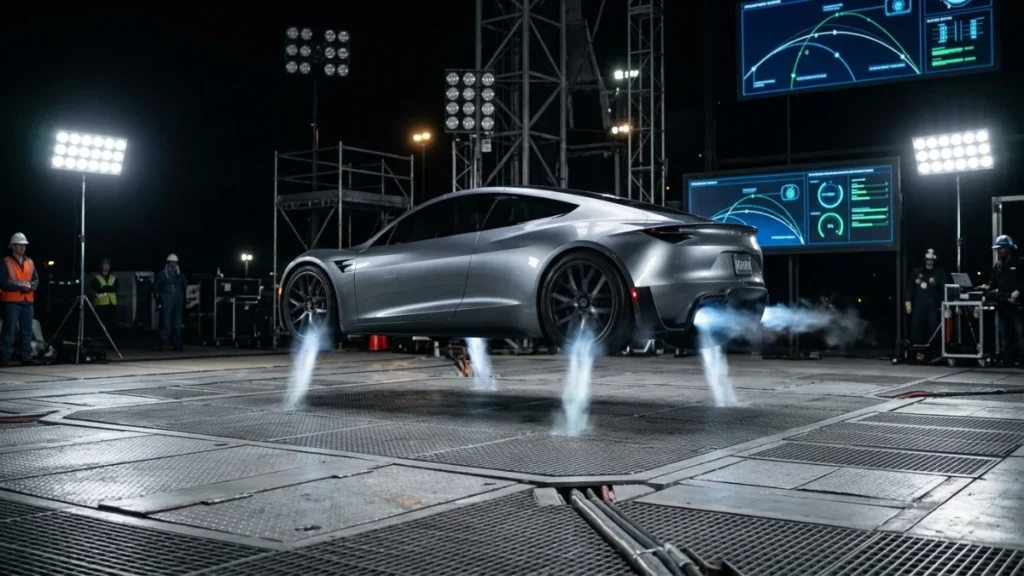
Tesla has reintroduced its iconic Roadster, first shown in 2017, in a completely new and sharp design after a long wait of 9 years. During the live demo, the company showed the car flying in the air, flipping and doing barrel roll stunts. Equipped with SpaceX’s thruster technology, the top model of this car can achieve speed from 0 to 60 mph (96.56 km/h) in just 0.59 seconds.
Tesla Roadster: Tesla’s new rocket car will fly in the air, will reach speed of 60 mph in just 0.59 seconds
3 variants: Performance, Thrust and Rocket
The company has announced the launch of the new Tesla Roadster in three different variants:
- Performance (2-Seater): This is the base variant meant to be driven on normal roads. It has active aerodynamics and multi-mode suction system. This car accelerates from 0 to 60 mph in less than 1.6 seconds.
- Thrust (2-seater): This is a race track-ready variant. It has cold-gas thrusters at the rear with a suction system. This model reaches 60 mph in less than 0.9 seconds (0.81 seconds in the demo).
- Rocket (1-seater): This is the most advanced model with perimeter cold-gas thrusters. This car is capable of moving forward and upward as well as rotating in the air. It accelerates from 0 to 60 mph in just 0.59 seconds.
SpaceX will perform stunts in the air using technology
According to Tesla, its thruster system generates 4 to 5 times more force than the friction (grip) of ordinary tires. In this, compressed gas is stored in carbon-fibre overwrapped vessels (COPVs) inside the car. The car performed several aerial maneuvers during the live show.
“This car is equipped with attitude-control thrusters and rear main thrusters, allowing it to fly like a rocket. It is fully capable of performing rolls in the air and many other complex stunts.”
— Elon Musk, CEO, Tesla
Speed, range and lightweight cabin
The Rocket model of the Tesla Roadster claims to have a top speed of more than 230 mph (370 km/h). At the same time, once fully charged, its driving range will be more than 300 miles (483 km).
To keep the weight down, its cabin has been provided with fixed ultrawhite seats with gray micro-suede detailing. Magnesium, titanium and carbon fiber have been used extensively in making car parts. The company aims to start its commercial production from 2028 and official booking has started.