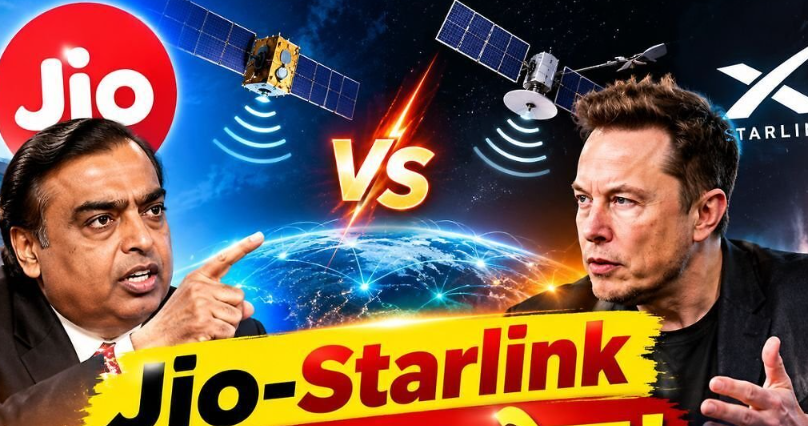
The ongoing war of words and policy between Reliance Jio Chairman Mukesh Ambani and the world’s richest businessman Elon Musk’s company Starlink regarding the upcoming Satellite Broadband Services in India’s telecom sector has now reached a very interesting turn. Recently, Starlink has given a direct and decisive answer to the strong statement given by Mukesh Ambani regarding the allocation of satellite spectrum and the demand for auction. SpaceX-owned Starlink has clarified that the purpose of satellite internet in India is not to compete with terrestrial telecom networks, but to provide high-speed internet to those inaccessible, hilly and remote areas of the country where installing traditional fiber or mobile towers is not technically and economically feasible. From the technical corridors of Lucknow, the capital of Uttar Pradesh, to Sanchar Bhawan in Delhi and among global investors, this rhetoric is being linked to the future of the Indian digital landscape.
This entire conflict started when domestic telecom giants like Reliance Jio and Bharti Airtel again strongly raised their old demands before the Central Government and the Telecom Regulatory Authority of India (TRAI). Mukesh Ambani-led Reliance Group argues that mobile operators in India have invested heavily in government auctions to the tune of lakhs of crores of rupees to acquire spectrum for 4G and 5G services. In such a situation, if foreign satellite broadband companies—like Starlink and Amazon’s Project Kuiper—are directly handed over spectrum through administrative allocation without any auction, it would be a grave injustice to the domestic companies and would be considered a blatant violation of the principle of ‘equal service, equal rules’ (level playing field). Jio has clearly demanded that open e-auction of all types of commercial spectrum should be conducted so that the government exchequer can get maximum revenue.
Starlink and Elon Musk’s global policy team have underlined the technical difference while presenting their stand on this stance of Reliance. Starlink has said in its response that as per the global standards of the International Telecommunication Union (ITU), satellite spectrum is never the exclusive or private monopoly of any one company. Once traditional mobile spectrum (Terrestrial Spectrum) is allocated to one company, it cannot be used by another company, whereas satellite frequencies can be shared by many global operators at the same time (Shared Spectrum). Starlink says that administrative allocation of satellite spectrum is the standard procedure in almost all developed and developing countries of the world. If a heavy auction model is imposed for this in India, it will greatly increase the cost of infrastructure, which will directly burden the pockets of the common Indian consumer and deepen the digital divide of the country.
Starlink has reiterated its commitment to India, saying that the real objective of their technology is to connect the country’s 140 crore citizens with world-class internet speed. The company claims that through their Low-Earth Orbit (LEO) satellites, rocket-like internet speeds of 100 to 200 Mbps can be provided with extremely low latency even in the most remote villages of India, hilly areas of Ladakh and North-East, islands, forests and disaster affected areas. Starlink in its statement indicated that their goal in India is not to snatch away urban consumers from Jio Fiber or Airtel broadband, but to connect crores of underprivileged citizens, rural schools, primary health centers and border posts with mainstream internet, which are still struggling with lack of connectivity decades after independence.
The Government of India has already made a clear provision in the recently implemented new Telecommunications Act that the allocation of satellite spectrum will be done through Administrative Allocation only and not through open auction. However, the responsibility of preparing the final formula as to how much fees, license fee and annual levy will be taken from the companies in lieu of this allocation has been entrusted to TRAI. TRAI is currently holding detailed consultations with various stakeholders, including telecom companies and global satellite operators. The central government believes that administrative allocation will enable faster start-up of services and attract foreign investment, while domestic telecom companies are adamant that the use of satellite services should be limited to backhaul or non-commercial purposes only and not to sell services directly to retail consumers.
This corporate conflict is going to have a direct impact on the country’s digital infrastructure and common consumers. If Starlink, OneWeb and Jio Satellite launch their full commercial services in India, India could become the world’s largest market for space-based Internet services. Providing high speed internet in rural areas will open new dimensions of digital education, tele-medicine, agri-tech and work-from-home. However, the biggest question will be regarding the cost of the service. If the regulatory framework remains balanced and the prices of the equipment (Starlink dishes) are kept favorable to the Indian market, this technology can completely change the picture of remote areas of the country. At present, all eyes are on the final rules of the Ministry of Communications and TRAI, which will decide in whose hands will be the control of this Internet descending from the sky.