6
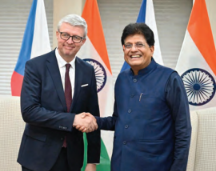
At a time when Europe is rethinking its trade partnerships, grappling with soaring energy costs and searching for a path to peace in Ukraine, Czech First Deputy Prime Minister and Industry and Trade Minister Karel Havlícek arrived in India with a clear message: the relationship between New Delhi and Europe has room to grow.
In an exclusive conversation with NewsX Foreign Affairs Editor Sukanya Saha, Havlícek discusses why India matters to Europe’s economic future, whether New Delhi can help bring Russia and Ukraine closer to peace, and how Europe should respond to Washington’s shifting trade and energy policies. He also shares his views on Ukraine’s NATO ambitions and the prospect of closer ties between Canada and the European Union.
Q. Bilateral trade has crossed $4 billion, but how do we take it to the next level? What, according to you, is the biggest outcome of this visit, so far?
A. Bilateral trade of $4 billion is a good level, but we can and must do more. The India-EU Free Trade Agreement, which is expected to be signed in the coming weeks or months, will create a market of 2 billion people. That’s an enormous opportunity. Czechia is an export-oriented, engineering-driven and highly industrialised economy, so there is huge potential for collaboration. I’m here not just to offer our products, but also to explore joint projects and investment opportunities in India. We know India’s economic strategy is built around Make in India. Our ambition is to build long-term ties through investment and joint ventures with Indian businesses. That’s why I’ve brought a business delegation with me.”
Q. When will the India-EU FTA become a reality? Negotiations have concluded, but businesses are waiting. When do you expect the agreement to enter into force, and what is holding up implementation?
A. The agreement is currently going through the ratification process. I hope it will be formally signed in November or December this year. That would send an extremely important signal to businesses and encourage greater collaboration with India. I’ve been working with India for 20 years, having come from the business sector, and I’ve seen the country’s remarkable growth over the past 10 to 15 years. India is not only the world’s most populous country but also a major force in research and development and new technologies. There’s tremendous potential here.
Q. Do you think Czechia risks being overshadowed by larger European economies in capitalising on the India-EU FTA? If not, then which Czech industries stand to benefit most from better access to the Indian market?
A. From India’s perspective, Czechia may be a small country, but we are a major industrial and engineering hub in Europe. We have strong capabilities in aircraft manufacturing, and we are among the few countries globally that can produce complete aircraft. I met India’s Civil Aviation Minister Kinjarapu Ram Mohan Naidu, and we discussed opportunities to develop and manufacture aircraft jointly with Indian companies. We also have a strong automotive and transport industry, producing cars, buses, trains and trams. Companies such as Volkswagen, Hyundai, Toyota, Mercedes, Iveco and Tata have a presence in Czechia, while Škoda Transportation is a major producer of trains. There is considerable scope for collaboration, including supplying components and trains to India. With Tata and Škoda expanding their presence, the opportunities are significant.
Q. European Commission President Ursula von der Leyen has proposed making Canada the EU’s first associate member. What would that actually mean, and could this model reshape Europe’s partnerships beyond its borders?
A. It may have come as a surprise, but the European Union is open to working with all important countries. Economies such as Germany, Czechia and France are highly industrialised and export-oriented, so why not collaborate more closely with Canada? The key question is what form this arrangement would take. If it means lower tariffs or tariff-free trade, that would be a positive step. Closer trade ties would benefit European producers and Canadian businesses alike.
Q. But it was after Donald Trump imposed tariffs on Canada that von der Leyen floated the idea of Canada becoming the EU’s first associate member. Could such an arrangement risk creating new trade frictions with the US, particularly over tariffs?
A. The US remains an extremely important partner for Europe, with trade between them roughly ten times greater than between Europe and Canada. We must strengthen transatlantic ties, but when the US puts up trade barriers, Europe has to look for new partnerships. That means working more closely with Canada, Latin America, India and other Asian countries. Europe has great people, universities and a rich history, but we are losing competitiveness, particularly because our energy costs are much higher than in the US. That’s the reality. If Europe wants to remain competitive, we must look beyond our borders and deepen cooperation with countries like India.
Q. Shifting focus to the Russia Ukraine conflict now, what would it take to achieve lasting peace between Moscow and Kyiv, and what role, if any, do you see for India in that process?
A. The war between Russia and Ukraine is a major tragedy, and it has been going on for more than four years. Russia is the aggressor, and we stand with Ukraine. At the same time, the sooner the war ends, the fewer compromises may be needed in the end. Any peace agreement must respect Ukraine’s interests. I believe India could play a very important role in this process, as Prime Minister Narendra Modi is one of the most respected leaders in the world. India is a global power, and I can see it playing a constructive role in bringing the parties closer to peace. India also inspires me, and there is enormous scope to strengthen our cooperation through trade and investment. PM Modi is one of the most respected and popular leaders in the world. I had the opportunity to meet him previously alongside my Prime Minister, and it was a remarkable experience. I am a great admirer of Prime Minister Modi, and it would be an honour to meet him again
The US is trying to push for a resolution, but Russia has yet to respond. I will be travelling to Ukraine with a business delegation for a month, where we plan to meet politicians, ministers, possibly President Zelenskyy, as well as Ukrainian entrepreneurs. This is a deeply sensitive issue for Czechia. Ukraine is our neighbour, and we share historical and linguistic ties. Around 500,000 Ukrainian refugees live in Czechia, and many are contributing to our economy, working across manufacturing and services. I hope Prime Minister Modi can play an important role as a mediator in bringing the sides closer to peace.
Q. Is Ukraine’s eventual NATO membership still on the table, and could it become part of a future peace settlement?
A. It’s not possible while the war is ongoing. It is a question that would have to be considered in the future.
Q. Speaking of the Iran crisis, there’s a joke that the landlocked Czech Republic is sending its “entire navy” to the Gulf. Jokes aside, why did Prague decide to stand with Washington on Hormuz, and what is the strategic objective?
A. Europe is facing a serious energy price problem. It is not necessarily a question of supply, but of cost. Gas prices in Europe are many times higher than in the US, pushing up electricity costs and hurting our competitiveness. European companies are moving production to the US, China and Asia, and we have to stop that. The war in Ukraine, the conflict in the Middle East, and the EU’s Green Deal all contribute to the pressure on energy prices. Europe needs to rethink its approach to reflect the changing global situation.
Q. Trump threatened India and China with 100% tariffs for buying Russian oil, but is now buying diesel from Moscow himself and rebuking Ukraine for striking Russian energy infrastructure. Meanwhile, India is pushing for a ceasefire initiative in the Black Sea region. Does this double standard undermine peace efforts and prolong the conflict in Ukraine? Also, whose side is Washington really on right now?
A. Czechia believes in maintaining strong partnerships with both the US and the European Union. President Trump is pragmatic and has tried to end the war in Ukraine, but Russia has yet to respond. Decisions like these must be discussed with European partners in advance. Europe is not an enemy of the US. It may be a competitor, but it is also a partner, and American decisions have a direct impact on us. Energy prices are already much higher in Europe than in the US, and we need to communicate these concerns to President Trump and his administration. I cannot predict what will happen next. Trump often makes announcements as part of a broader negotiating strategy, and the position may change within days. We must also remember that the EU has 27 member states and governments, so reaching a common position takes time. The US can make decisions much faster, and that difference must be understood.
Q. Beyond the meetings and negotiations, what experience or encounter during your visit has stayed with you the most?
A. I really love India. I come from a business background and have had the opportunity to export products to India, working with trading partners in Delhi, Kolkata, Chennai, Mumbai, Udaipur and Jaipur. It is an amazing and unique country, shaped by its philosophies, values, and strong trading traditions. India also has a remarkable global presence. Your people speak excellent English, Indian professionals are highly successful in the US and Europe, and your managers are making their mark in major international corporations. Your universities and talent have also built a strong reputation internationally. India is a country that inspires me. I see enormous potential for collaboration at the highest level, and I will do everything I can to strengthen our ties and promote mutual trade and investment.