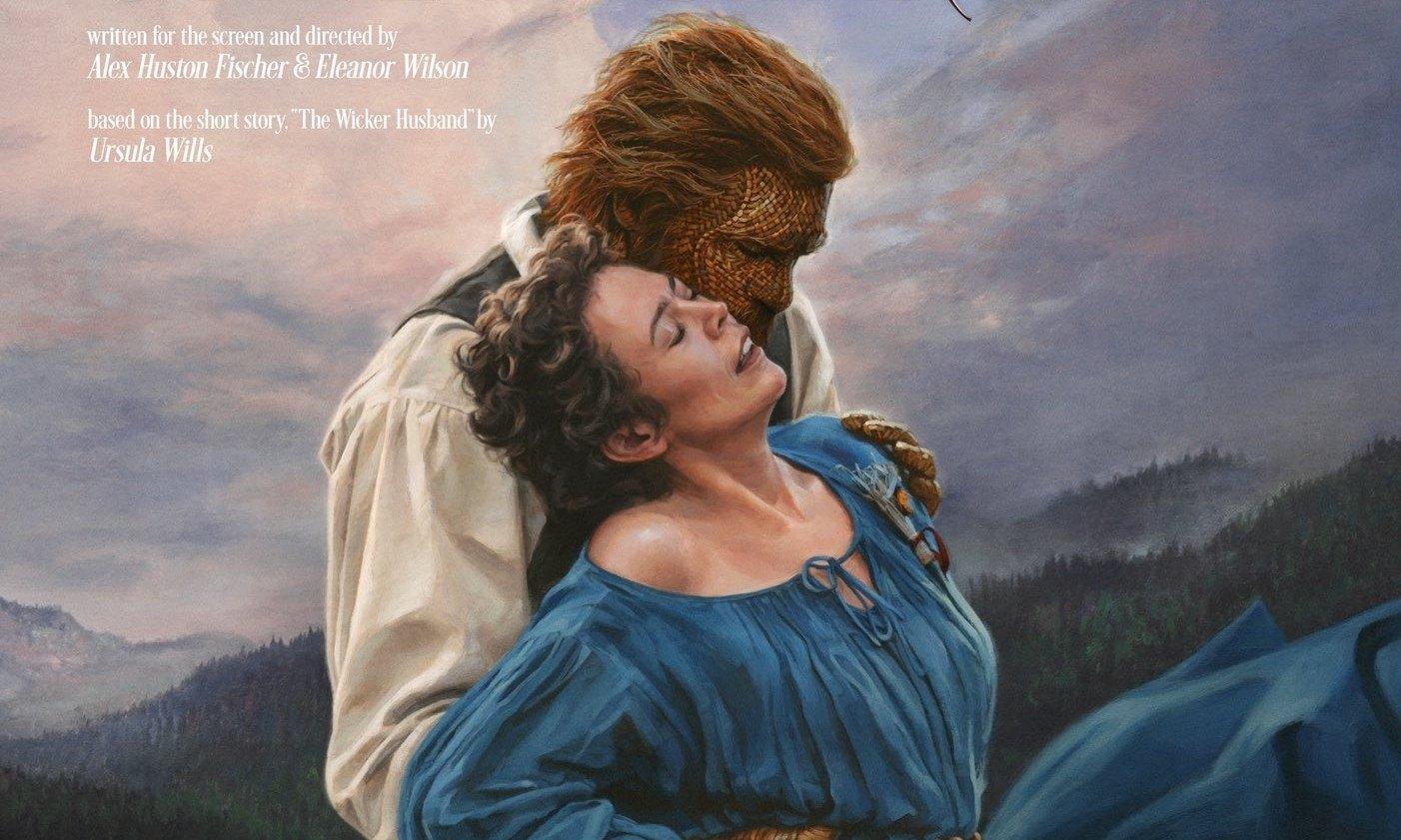
Alexander Skarsgård must be tired of being lusted over so often, but the task of becoming a man made of wicker is sure to have posed him a most unexpected challenge. Quite literally so, the Swedish actor is turned into the titular character in Alex Huston Fischer and Eleanor Wilson’s Wicker, where his tightly woven physicality fulfils all duties expected of him.
As one expects a Skarsgård to do, Wicker shows up in a remote medieval village as a mysterious stranger, beguiles the men and women with his appearance, and makes sweet love to Fisherwoman (Olivia Colman) day in and day out. No splinters felt in the act, though, thanks to the stellar prosthetic makeup managed by the Wētā Workshop, the people behind the Lord of the Rings movie series and many other landmark outings.
A village of patriarch
The fable-like setting of Wicker, the film, also ensures that this creature’s entry into the world happens with unquestioning acceptance. The nameless village is archetypal in its design; an intimate community where one’s business is everyone’s business, a small, fixed set of occupations (the innkeeper, the tailor, the doctor, the butcher, etc.), and gender roles being firmly defined. Except, the patriarchy is spelt out in the most intentionally simplistic ways.
Also read: Akka review: Radhika Apte, Keerthy Suresh rule the screen, but series falls short
The women are known not by their individual names, but by the vocations of their husbands – Tailor’s wife, Bottlewasher’s wife and so on – and the new brides are literally strapped with an elegant metal collar at the altar. Fisherwoman is the only one among them who goes by her own trade, perhaps the only benefit she receives from being ostracised.
The short story by British writer Ursula Wills, which inspired the film, prefers to call its protagonist “the ugly girl”, whereas the writer-director duo leaves that description to her bullying fellow townsfolk. The stench emanating from her tattered, full-of-fish-scales dress, the eyebrows unfairly meeting one another, the lopsided gait with which she walks (the short story says she was born with one leg taller than the other) – all this and more are duly highlighted by the men and women, as she walks about the market each morning to sell her wares.
It’s only the congenial and highly skilled basket-maker (Peter Dinklage, as a predictable casting choice) who shows up only once a month, who offers her respect and dignity, and it is he who also enchants her husband, the Wicker. “Mother nature provides, I merely augment,” says the basket-maker, unassuming about his ethereal powers that can create anything in his home secluded deep in the woods.
A folkloric charm
The charm and understated humour of Wicker emerges from this sense of suspended disbelief. The folkloric world is a wink-like construct that lends the film a staged personality, with the era-befitting costumes somehow complementing the quirky and curious mixed-race cast ensemble, as if it all were part of a post-modern theatre production.
Also read: The Social Reckoning review: Mark Zuckerberg indictment is ineffective and dated
Lol Crawley’s cinematography opts for a narrowed aspect ratio to further underline the whimsical nature of the telling, and Scottish composer Anna Meredith’s emphatic score – juggling between pensive, ambient and jaunty at once – too foregrounds the film’s sensibilities.
Desire and jealousy
Yet, the technical form of the film, as well as its tone, doesn’t take away the attention from the heart of the matter. Wicker is a film about desire, both carnal and emotional, and the narrative shifts nimbly between the two sides to paint a compelling portrait.
On the one hand, Fisherwoman and Wicker engage in lovemaking that breaks beds and broadcasts moans across the whole valley and beyond (“Is someone getting murdered?” asks a woman once, innocently). On the other hand, the rest of the townspeople can’t help but direct seething jealousy towards Fisherwoman, who now seems to have found both professional and personal independence.
So, when the women bemoan their men for living up to the new standards set by Wicker (he also knows how to compliment and care for his wife, aside from being great in bed), their rageful response is “He’s not natural; men are not like that!”
The cruel fire
And thus, as in any fable, the majority finds the outcast to be the root of the problem, with Wicker becoming a resource to kindle a cruel fire. The face of that ire is Tailor’s Wife (Elizabeth Debicki), who, although arguably the most beautiful, reliable and discerning in the town, is simmering in a dull existence that doesn’t allow her to be more than a wife and a mother. She has known Fisherwoman since they were both little, and on the face of it, she treats her better than anyone does. But appearances can be deceiving, and a fire is kindled after all.
Also read: Heart of the Beast review: Brad Pitt and canine pal’s brutal adventure hits home
Appearance is also the film’s operative word in a way, because Wicker makes a great case for what’s seen and what’s actually recognised. Fisherwoman’s existence was defined by her appearance and social standing, but with the golem-like Wicker now occupying her position as the misfit, does she extend to him the trust and acceptance she always yearned for? Or does he end up being an exotic creature, who is fancied but never valued?
Romance with restraint
Wicker is a breezy, unfussed film that approaches its poignancy with a feather-light touch, and this is both its biggest strength as well as its limitation. It is a romantic drama at its heart, laced with humour and wit, but the same unburdened quality sometimes comes at the cost of the emotional highs. It could be the overwhelming formal treatment of the film, or its slightly risk-averse storytelling, but what should have ideally been a romance with its share of twists and turns falls just a bit short of hitting that right note.
But these are just minor grievances, mind you, because the film has lots to offer, particularly in its more sensual, evocative moments. These are also its most tender and touching, and it helps that Colman and Skarsgård are perfectly in sync for a story that ought to be told with conviction and ease. Wicker is elevated by their natural chemistry, which ties everything together.