Thailand’s Department of Disaster Prevention and Mitigation (DDPM) under the Ministry of Interior on Nov. 2 advised residents to prepare emergency kits to cope with natural disasters and unexpected incidents.
The DDPM recommended that every household keep essential supplies ready to meet basic needs during the first 72 hours after a disaster or emergency. Its checklist covers six categories: medicine, food and at least 3 liters of water per person per day, communication tools such as a power bank and radio, documents and cash, hygiene items, and clothing.
Many people have raised questions about the advice.
On Pantip, a popular Thai online forum, users asked what threat they were packing against and where they were meant to go.
“They tell us to pack a bag, but what are we running from, and where to? I don’t know what to do,” one wrote. Another pointed out that there “isn’t even a bomb shelter near my home,” while a third said the agency “still has no plan at all for what we’re stocking up for, and what to do, step by step, when something happens.”
Others answered with jokes. The user without a shelter asked whether he could swap the backpack for a 15-kilogram rice sack, or simply pick up his built-in wardrobe and run, and whether a UFO was coming to take everyone to Mars or the moon.
“Most of our fridges can’t be hacked because they’re not connected to the internet. They’re not high-tech enough,” one YouTube viewer joked, a nod to the cyberattacks on European supermarket refrigeration systems that broadcaster Channel 7 cited as part of the backdrop.
Some commenters turned the advice into a jab at the government’s dealing over September’s historic floods, which swamped parts of Bangkok and central Thailand for days. One asked how authorities who struggled with floods would cope with a pandemic, a cyberattack or a riot.
Plenty of others shrugged, saying their households already keep more than three days of food. One Pantip user said his family buys instant noodles and canned fish by the case and drinking water 30 packs at a time. Another said he had kept rice, eggs and noodles at home ever since living through the 2011 floods and Covid-19, when he could find nothing on store shelves.
Residents interviewed by broadcaster Channel 7 complained that they had no spare money to stock up, saying they spend whatever they earn day to day and that pork prices had just gone up again. Some said they would not prepare at all.
The same complaint ran through comments under the broadcaster’s reports on YouTube. One viewer wrote that two liters of fuel and a meal used up a day’s wage, while another argued that stockpiling would only make retail tycoons richer and that preventing shortages was the government’s job.
Not everyone was sympathetic about these concerns. One of the most-liked comments under the Nov. 3 evening report needled an interviewee for never complaining about the price of lottery tickets, and another viewer said people grumble when the government stays silent and grumble again when it warns them.
|
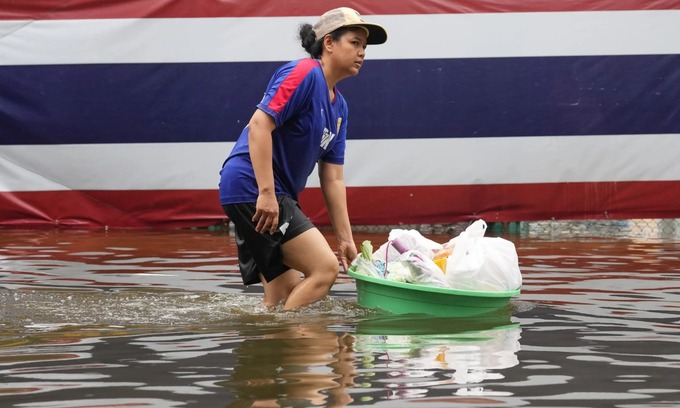
A woman pushes a basin of supplies through floodwaters in front of a Thai flag in Bangkok, Sept. 27, 2026. Photo by AP |
Nirat Pongsitthaworn, director-general of the Department of Disaster Prevention and Mitigation (DDPM), told reporters on Nov. 4 that the “survival bag” campaign targets disasters such as building collapses, widespread flooding and earthquakes, MGR Online reported.
“The 72-hour preparedness we hear about abroad comes from concerns about war. But in Thailand, there is no concern about war at that level,” he said.
He said DDPM had given the same advice “for a long time” but it got no attention until European countries issued warnings and “Thai society asked state agencies whether they had issued any.”
“If we stay quiet and don’t come out to repeat the warning, we will be blamed even more,” he said.
He said no emergency called for bulk buying, and that DDPM had coordinated with the Commerce Ministry’s Department of Internal Trade on restocking in case demand rose.
Business responses
In the northeastern city of Khon Kaen, a popular brand of canned fish had sold out at a Lotus’s store when officials inspected it on Nov. 4, while drinking water, instant noodles, rice and medicine remained on the shelves, Siam Rath reported, citing provincial commerce officer Nongnuch Udomkham. The store had started selling ready-made 72-hour bags, and most shoppers there told the newspaper they were not panicking.
Online, ready-made kits went on sale within days, one shared on Pantip priced at more than 1,000 baht (US$30) with extra discounts for the Nov. 11 shopping festival. Another user compared them to the pre-packed buckets Thais buy as offerings for Buddhist monks.
Gen. Chaiyapruek Duangprapat, secretary-general of the National Security Council (NSC), said after meeting government agencies and academics on Nov. 4 that Thailand sits on the outer ring of the Middle East crisis, Bangkok Biz News reported.
“If you want to stock up on food for your family, you can do some of that. But is it necessary? At this moment, probably not to that extent,” he said, adding that the council may eventually propose a national food reserve.
The bag advice came days after the NSC, in a statement released by the Defense Ministry on Oct. 29, denied a viral claim that it had told Thais to stockpile food and medicine for 72 hours, as the U.K., Japan and other countries urged their citizens to prepare for emergencies.
In South Korea, some people have spent millions of won assembling survival backpacks since the U.K. and Japan issued their guidance, with one social media user saying it cost 4 million won ($3,000) to put together bags for a family of five, Seoul Economic Daily reported on Nov. 4.