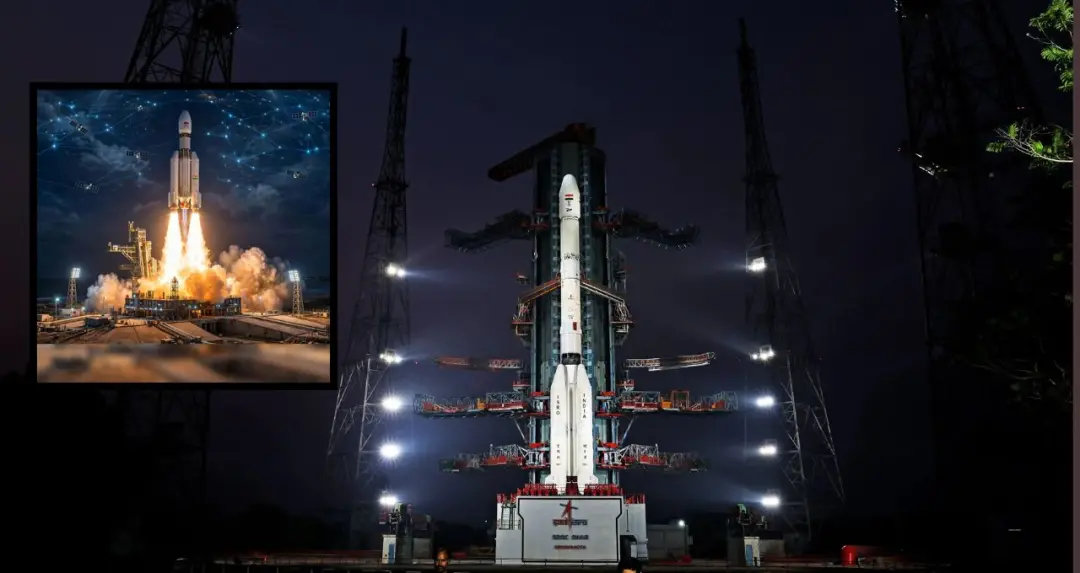
Indian Space Research Organization (ISRO) has successfully launched NVS-03 navigation satellite into space on GSLV-F18 rocket. The satellite is placed in a fixed transfer orbit. This is the second consecutive successful launch of the GSLV rocket after September. This achievement is expected to further strengthen India’s indigenous navigation system NavIC.
Second successful launch of GSLV in two months
The GSLV-F18 rocket was launched on October 30, 2026 at 11:51 pm from the Satish Dhawan Space Center in Sriharikota, Andhra Pradesh. The rocket delivered the NVS-03 navigation satellite weighing approximately 2,250 kg into the designated transfer orbit.
Earlier on September 4, 2026, the GSLV-F17 rocket successfully placed the EOS-05 satellite into orbit. There was a gap of only 56 days between these two launches.
GSLV-F18 was the 20th launch of this series of rockets. ISRO’s efforts towards conducting regular space missions on the GSLV rocket have gained momentum with two consecutive successful launches. In this, along with ISRO scientists, Indian companies making rockets and satellites also have an important role.
Success after technical problems
ISRO has faced technical challenges in the last few space missions. The launch of the NVS-02 satellite in January 2025 was successful, but due to a malfunction in its engine system, it was not possible to place the satellite in its final orbit.
Similarly, PSLV-C61 mission also could not be completed in May 2025. Then in January 2026, during the PSLV-C62 mission, there was a technical failure in the last part of the rocket’s third stage.
How will India benefit from NVS-03 satellite?
NVS-03 is the third satellite in India’s proposed series of five new generation navigation satellites. It is designed to improve the service of NavIC, the country’s indigenous navigation system.
NavIC provides positioning and navigation services in and around India. It can be used in transportation, maritime navigation, location-based services and other civil needs.
The NVS-03 satellite is equipped with an atomic clock developed in India. It also has L1 signaling facility. It will work with existing L5 and S-band signals.
The coverage of this satellite has been designed keeping in mind India and the surrounding area extending about 1,500 km from the country’s borders. This is expected to help in further improving NavIC service in the coming days.
Another success after four class changes
After launch, ISRO scientists performed four orbit changes to bring the NVS-03 satellite to the prescribed altitude. The space agency informed on November 4 that these four processes have been successfully completed.
The satellite then entered a geosynchronous orbit between approximately 35,765 km and 36,196 km. According to ISRO, the condition of the satellite remains normal.
However, reaching the assigned orbit and routine initiation of all navigation services are two separate steps. It also requires testing of satellite equipment and signals.
Now let’s look at satellite equipment testing
The success of GSLV-F18 is not limited to just one rocket launch. India is also making efforts to strengthen its navigation systems and enhance its indigenous capabilities in space technology.
The success of two consecutive GSLV missions will help ISRO and its industrial partners prepare for the future. Instrument testing of NVS-03 and its full active role in the NavIC system will now be monitored.