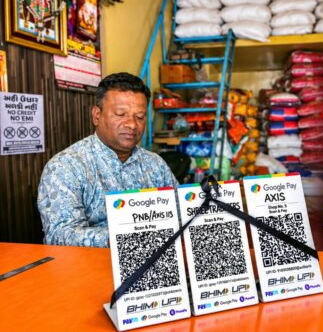
New Delhi: Millions of people in the country make digital payments every day through UPI apps including Google Pay, PhonePe, Paytm. Since most UPI transactions are free so far, people are using it in large numbers. However, now a new debate has started on whether UPI payments will always be free or not. The central government has clarified in the affidavit filed in the Supreme Court that no promise was made to the traders to continue the zero MDR (Merchant Discount Rate) system permanently.
The government has also mooted the possibility of levying MDR on some UPI merchant transactions above ₹2,000. However, it does not mean that all UPI payments made by common people will be charged. So let us know what is the government’s contention and which transactions will not attract charges.
What did the central government say in the Supreme Court?
In response to a public interest petition (PIL) filed by lawyer Anjan Dutta, the central government has submitted an affidavit in the Supreme Court. In this petition, the amended regime of MDR was termed as violation of fundamental rights.
However, the government has countered this contention saying that there was no official assurance given to merchants that UPI transactions would always be free or that the zero MDR regime would be permanent.
According to the government, the subsidy provided for continuation of the zero MDR system depends on the policy decision of the government and available financial resources.
No infringement of the fundamental rights of traders
The central government has argued in court that the amended regime of the MDR does not impose any undue restrictions on the fundamental right of traders to carry on business.
The government says that the Constitution does not guarantee that every facility connected with trade should always be free. If a charge reduces a trader’s profit, it cannot be considered as an infringement of copyright.
The government has also said that traders will not be able to pass on the burden of MDR to consumers.
Why charges on UPI transactions above ₹2,000?
According to the government, the system of zero MDR on P2M (Person to Merchant) UPI transactions up to ₹2,000 has been retained to avoid additional financial burden on small merchants and general retail transactions.
However, arrangements can be made to levy a nominal MDR charge on some merchant transactions above ₹2,000.
The government argues that merchants have a greater ability to bear such costs than large-value transactions.
Banks were given a subsidy of ₹ 8,730 crore
The central government has told the court that UPI payments being free does not mean that there are no costs involved. Digital payments incur costs for processing, technology and security.
Due to the zero MDR regime, this cost burden has been borne by way of subsidy provided by the government.
According to the government, a total incentive of ₹8,730 crore has been given to banks for zero MDR transactions from FY 2021-22 to 2024-25.
The government says a sustainable financial model is essential for the long-term sustainability of the digital payment system, strengthening cyber security and technology development.
Which UPI transactions will not incur MDR charges?
As per the arrangement introduced by the government, most normal UPI transactions will not be affected. Exemption from charges is provided in the following categories.
1. Person to Person (P2P) Transactions
No matter how much money one person sends to another person, MDR will not be charged on it.
2. Relief to small traders
Small traders receiving up to ₹1 lakh per month through UPI QR code will be exempted from the proposed charges.
3. Merchant payments up to ₹2,000
The zero MDR regime on P2M transactions up to ₹2,000 will continue.
NPCI also gave an important clarification
The National Payments Corporation of India (NPCI) has also stated in its affidavit submitted to the Supreme Court that the revised MDR regime will not affect all UPI transactions.
According to NPCI, only a small portion of P2M transactions will be affected by this arrangement, while around 96 percent of transactions will remain unaffected.
General UPI users need to worry?
The central government’s arguments in court do not mean that every UPI payment will now have to be charged. Zero MDR on person-to-person transactions and merchant payments up to ₹2,000 has been discussed.
However, the government has endorsed the possibility of applying MDR on some merchant transactions of large value. Hence, everyone will be keeping an eye on the changes in digital payment rules in the future.