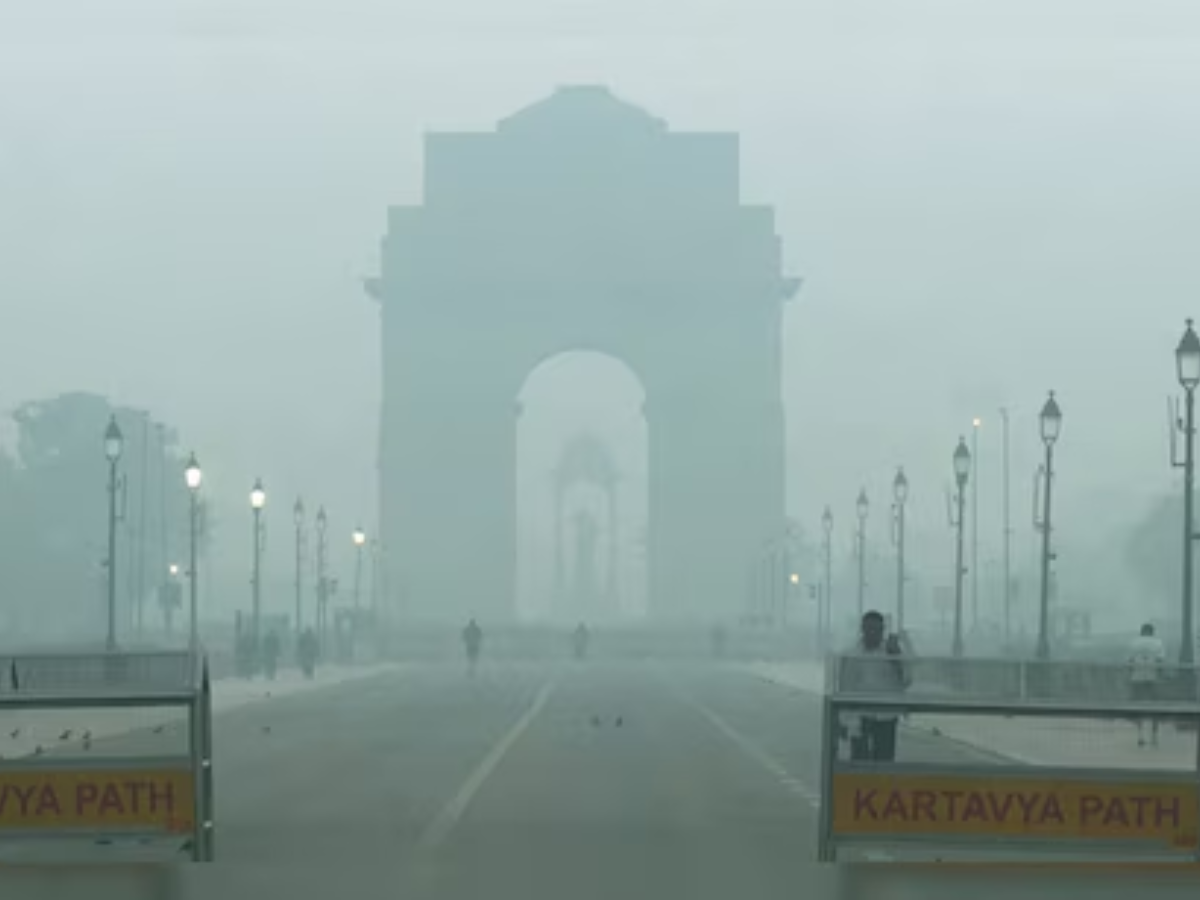
Delhi woke up on Friday to a thick, choking haze. At 8 am, the city’s overall Air Quality Index (AQI) stood at 389 in the “very poor” category, according to the Central Pollution Control Board (CPCB). Several pockets of the capital slipped into the “severe” zone, residents spoke of burning eyes and laboured breathing, and a political row over stubble burning flared up again.
A Morning Wrapped in Smog
The city’s air did not improve overnight. Early in the day, when traffic was still thin, the smog was already heavy enough to make people uneasy. For many residents, the first breath of the morning came with discomfort rather than relief.
The Severe Zones
CPCB data showed the worst readings in several parts of the city. IIT Delhi and Rohini each recorded an AQI of 474. Punjabi Bagh followed at 465, RK Puram at 443, ITO at 422, Firoz Shah Road at 420 and India Gate at 403.
Other areas stayed in the very poor range. Aya Nagar recorded 393, Chandni Chowk 391, IGI Airport Terminal 3 385, and Anand Vihar and Akshardham 359 each.
GRAP-II Measures on the Ground
Under Stage II of the Graded Response Action Plan (GRAP), municipal authorities deployed truck-mounted water sprinklers around India Gate to settle dust. Such measures aim to keep pollution from worsening further, though they cannot clear the haze on their own.
What the Weather Says
The India Meteorological Department (IMD) recorded a minimum morning temperature of 17.8 degrees Celsius, with mainly clear skies. Shallow fog is forecast over the next four days, followed by fog or mist in the early hours of November 10 and 11. Such conditions can hold pollutants close to the ground.
Voices From the Street
Resident Sarvesh described a city struggling to breathe. “It’s causing a lot of problems,” he said, adding that even with little traffic the pollution made breathing hard and made him anxious. He spoke of heavy smog that felt like the middle of January, and a burning sensation in the eyes.
Nemichand Sharma, 71, saw the crisis as the result of years of unchecked urbanisation and administrative apathy. He said development had brought a huge rise in pollution and alleged that governments were doing little on the ground to end it.
The Stubble Burning Row
The blame game also continued. On Thursday, Delhi Environment Minister Manjinder Singh Sirsa accused Punjab Chief Minister Bhagwant Mann of misleading people over paddy harvesting and stubble burning. Speaking at the Integrated Command and Control Centre (ICCC) in Shastri Park, Sirsa said stubble burning in Punjab had contributed significantly to Delhi’s worsening air. He claimed that, going by the Punjab government’s own data, 77 per cent of the stubble had already been burnt, and that Mann had wrongly said harvesting had not begun. Mann’s side of the argument is not part of the information available here.
What Happens Next?
With fog and mist expected, will the AQI drop out of the very poor range or deepen into severe across the city? Will authorities move to a higher GRAP stage if readings do not ease? And will the political argument over stubble burning turn into action that clears the air? For now, Delhi waits, and breathes with difficulty.
Also Read: Where Is My Salary?’ Bihar Government Employee Turns to Begging Outside Office in Unique Protest Over 8 Months of Unpaid Wages
Khushi Patel is a Senior Sub Editor at NewsX, covering automotive, technology, Lifestyle, entertainment, and mainstream news. She previously worked as a Copy Editor at Times Network and has written automotive editorial content, including comparison pieces, for TimesDrive.
The post Delhi Chokes at AQI 389: GRAP-II Measures Underway as IIT Delhi, Rohini Record Severe 474, Residents Complain of Breathing Difficulties Amid Toxic Smog appeared first on NewsX.