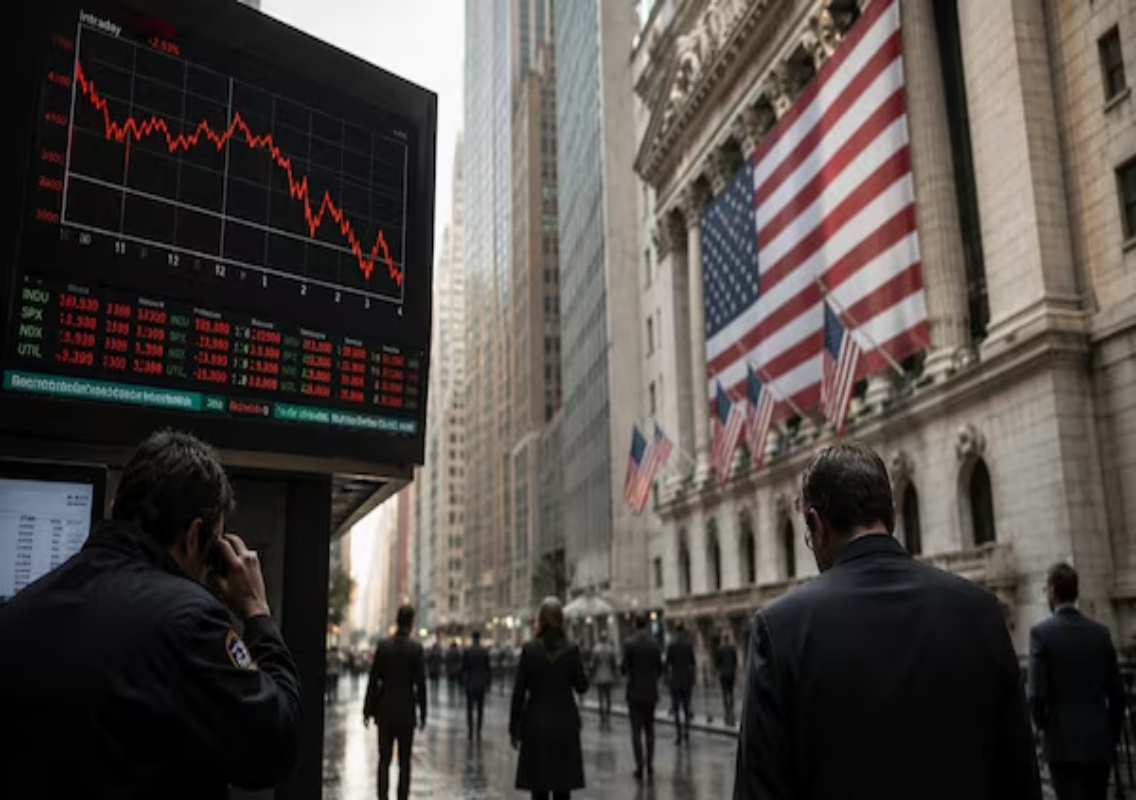
Global financial markets experienced sharp volatility on Friday, November 6, 2026, as Wall Street suffered its worst single-day drop in 19 months, erasing an estimated $2.5 trillion in market value from the Nasdaq 100.
The sell-off spilled over into Asian markets as investors grew anxious over potential Democratic legislative oversight on artificial intelligence infrastructure, power consumption, and data center regulations following the U.S. midterm elections.
While Indian equity markets opened lower in tandem with global peers, Dalal Street executed a dramatic intraday turnaround. Driven by aggressive foreign institutional buying, the S&P BSE Sensex erased morning losses to surge over 1,600 points to close at 81,028.02, while the NSE Nifty 50 reclaimed the psychological 25,000 mark. The explosive single-day recovery added over ₹1 lakh crore to Indian equity market capitalization.
Why India Decoupled from the Global Market Sell-Off
Financial analysts and market data highlight four core drivers insulating Indian equities from the global technology rout:
1. Limited Direct Exposure to Global AI Trade
Unlike U.S. indices heavily weighted toward mega-cap AI hardware, semiconductor, and data center infrastructure providers, Indian benchmarks carry minimal direct exposure to high-valuation AI hardware chains. Conversely, traditional IT services providers—including Infosys, TCS, and HCL Technologies—saw buying interest as global investors sought defensive technology plays at reasonable valuations.
2. Aggressive Return of Foreign Institutional Investors (FIIs)
Following months of persistent net capital outflows, foreign institutional investors returned to Indian equities with record intensity:
- Record Daily Inflow: Provisional exchange data showed FIIs executed net purchases worth nearly ₹15,000 crore on Thursday alone—marking their single largest single-day net purchase in nearly six years.
- Rotational Capital: As global asset managers trimmed overstretched U.S. tech positions, rotational capital flowed directly into under-allocated emerging markets like India.
3. Cooling Crude Oil Prices & Macro Relief
India’s heavy reliance on imported energy means crude movements directly impact fiscal balances. Recent drops in Brent crude below $100 per barrel—fueled by expectations of diplomatic de-escalation in West Asia following U.S. political developments—provided a major macro tailwind for domestic equities, even as prices hovered near $100 late Friday.
4. Earnings Support in Large-Cap Leaders
Strong Q2 corporate earnings provided fundamental backing to the rally. Auto major Mahindra & Mahindra surged following a 25% increase in Q2 consolidated net profit, while heavyweights Titan, Bharti Airtel, TCS, and Infosys anchored the benchmark advance.
Large-Caps Drive Gains as Broader Market Lags
Despite the headline index surge, the pre-Diwali rally remained concentrated among blue-chip stocks:
- Broader Market Underperformance: While frontliners zoomed, small-cap and mid-cap indices traded lower, with the Nifty Smallcap 250 and Nifty Midcap 100 lagging the main indices.
- Selective Accumulation: Analysts note that institutional investors are demonstrating strict selectivity, favoring well-capitalized large-cap balance sheets over indiscriminate broader market buying.