Once a backwater where fishing was the only source of income, Ansar’s village of Botubarani has turned into a tourism destination for those keen to interact with the whale sharks, which are the world’s largest fish species.
“I have a more relaxed job now and the income is fairly good,” said Ansar, after feeding the whale sharks with shrimp on the beach.
Ansar, who earns up to 3 million rupiah ($167) a month, far more than the 400,000 rupiah he formerly made as a fisherman, is one of roughly 80 villagers benefiting from the tourism boom, by offering boat rentals, diving services, and use of drones.
|
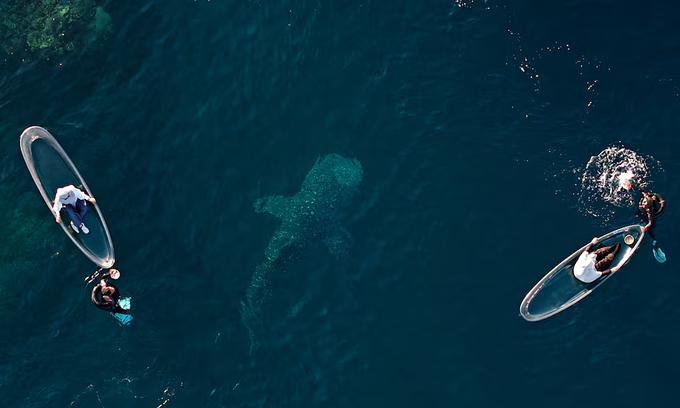
A drone view shows tourists sitting on transparent boats beside a whale shark while a guide swims nearby carrying bait at Botubarani Beach in Bone Bolango Regency, Gorontalo Province, Indonesia, July 30, 2026. Photo by Reuters |
Video clips depicting a cluster of about a dozen whale sharks appearing together in 2016 sent the village viral on social media platform Facebook.
“It’s a very big animal, so it’s really an exceptional experience,” said 55-year-old Dutch tourist Renee Westerbeek, after snorkelling with the fish.
Westerbeek, accompanied by his wife and two children had specifically chosen the province of Gorontalo, home to Botubarani, to get close to the whale sharks.
“I don’t know another place where you can do that.”
Feeding ground
Whale sharks have appeared off the beach for decades, said Wahab Matoka, 73, a regional tourism leader, but the Facebook posts popularised them.
Tourists often refer to them by the nickname Serli, an abbreviation of the Indonesian words “sering terlihat” or “often seen”.
Botubarani offers a feeding ground for whale sharks throughout their life cycle, said Sukirman Tilahunga, head of a monitoring team set up by the fisheries ministry.
Usually young males below 30, the whale sharks range in length between 4 m and 6 m (13 ft and 20 ft). They can live up to 100, growing to much as 18 m (60 ft) in length, with dark or blue-grey skin that bears a unique pattern, Sukirman added.
The whale sharks are an endangered species, say naturalists, with environmental group Konservasi Indonesia estimating a population of 699 across the eastern islands of the archipelago.
Despite their name, whale sharks are not whales and breathe through gills, environmental group WWF says on its website, while blue whales, the earth’s largest animals, are lung-breathing mammals that can grow to as long as 100 ft (31 m).
Conservation concerns
While tourism is a boon for the villagers, others worry about the impact on wildlife.
Constant feeding can disrupt natural behaviour and pose health risks for the whale sharks, said Iqbal Herwata Putra of Konservasi Indonesia.
“Limits help ensure people and wildlife can coexist,” he said.
Authorities have attempted to cut back feeding activities.
Sukirman has developed a solar-powered marine attractor that uses light to attract plankton and the tiny fish critical for the diet of whale sharks.
For Ansar, what matters is that the animals stay.
“If the whale sharks are fed, it benefits the villagers,” he added.