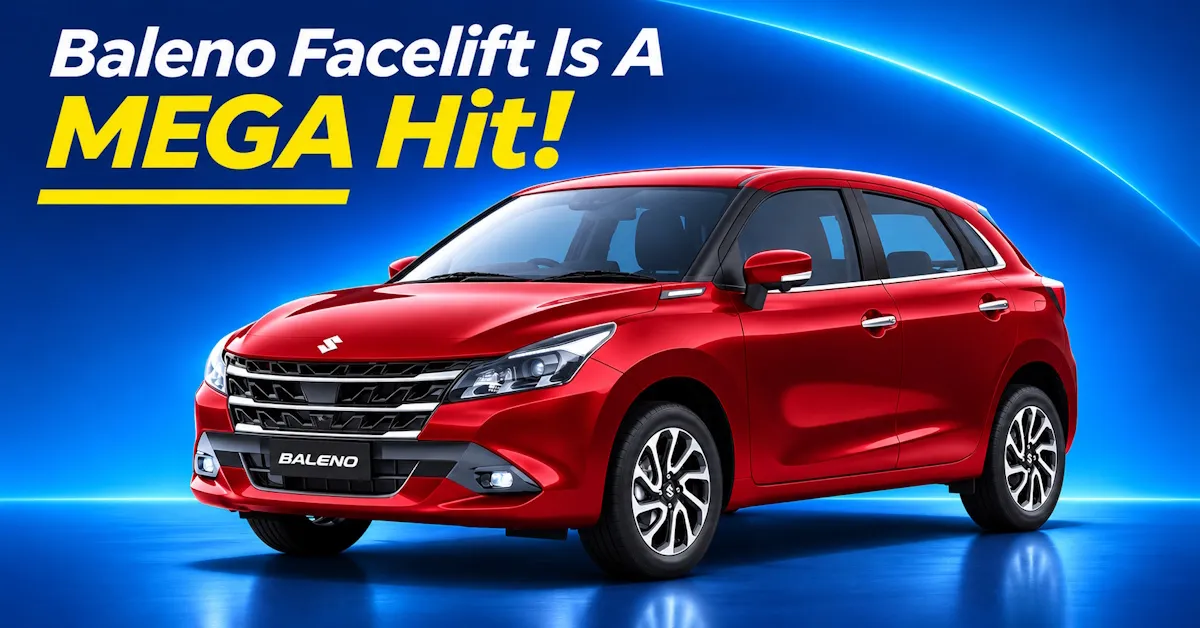
Maruti Suzuki has sold around 50,000 units of the updated Baleno within two months of its September 5 launch. At the same time, buyers of the refreshed Brezza face a waiting period exceeding three months, despite the company raising production. Maruti’s sales head Partho Banerjee confirmed both figures as the manufacturer prepared for Diwali deliveries.
The two cars tell an interesting story about current demand. The Baleno shows that a well-equipped hatchback can still sell in large numbers, while the Brezza’s extended waiting period demonstrates how difficult it is for Maruti to keep up with orders for popular compact SUVs. The company says it has approximately 2.5 lakh pending vehicle bookings across its range, not just for these two models.
Selling 50,000 cars in roughly two months works out to an average of 25,000 a month. Maruti has not released a variant-wise breakdown for this period, so the figure does not show how many buyers selected the more expensive ADAS-equipped version or the CNG variants. It also should not be confused with the company’s combined October passenger-car category sales.

The facelift arrived with a revised front bumper and grille, a different three-cylinder petrol engine and more equipment. Maruti replaced the older 1.2-litre four-cylinder unit producing around 90hp with the Z12E 1.2-litre three-cylinder engine also used in the Swift and Dzire. It develops approximately 83 Bhp and 112 Nm, with five-speed manual and AMT gearboxes. The reduction in peak power is accompanied by better certified fuel economy.
Maruti quotes 23.80 Kmpl for the manual and 24.77 Kmpl for the AMT. A factory-fitted CNG version is also available, with a claimed 33.61 km/kg. These are official test figures; how the car behaves with passengers and air-conditioning in city traffic will matter more to an owner than the last decimal place.
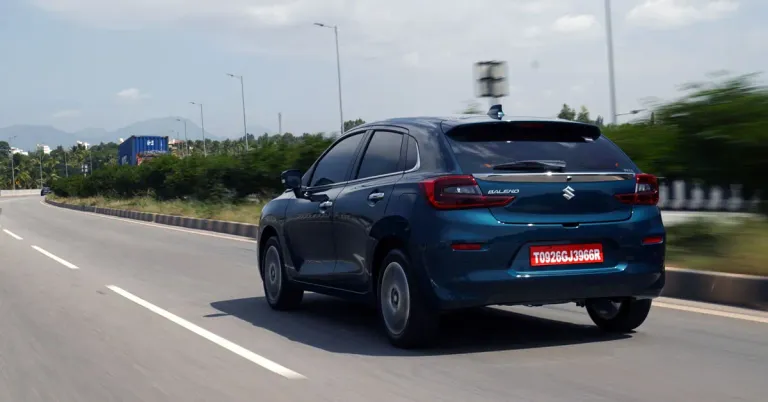
The facelift adds useful equipment, including ventilated front seats, but buyers need to choose the right variant. Ventilated seats are available on the higher Alpha and Alpha (O) trims, while Level 2 ADAS is restricted to the Alpha (O). The ADAS package includes functions such as adaptive cruise control, lane-keep assistance and automatic emergency braking.
The entry Sigma version does not suddenly acquire those features because the facelift advertises them. The range starts at about Rs 6 lakh, ex-showroom, while the top Alpha (O) automatic approaches Rs 10 lakh. That is a substantial spread in a hatchback range and explains why checking the equipment on the exact variant matters.
The Baleno competes with the Hyundai i20 and Tata Altroz. Buyers who prefer a conventional hatchback for easier parking and a lower purchase price still have choices, even as manufacturers devote more of their new launches to SUVs.

Banerjee says the Brezza has a waiting period of more than three months despite increased output. He also said that October volumes crossed 22,000 units. In a separate festive sales update, Maruti said the Brezza had crossed 70,000 sales over the previous two months and still had a sizeable order backlog.
The updated Brezza offers a 1.0-litre Boosterjet turbo-petrol engine alongside the familiar 1.5-litre petrol and a factory-fitted CNG option. Maruti previously said the new turbo variant accounted for more than 40% of initial bookings. The underbody CNG cylinder layout is another practical change because it preserves more usable luggage space than a conventional cylinder sitting across the boot.
A three-month-plus waiting period is a company-level indication, not a guaranteed delivery date for every variant, colour and city. A dealer with available stock may deliver sooner, while a popular specification could take longer. Buyers should obtain a written estimate rather than assume all Brezzas have the same queue.
Maruti’s average daily production rose from around 9,100 vehicles in the first quarter of FY2027 to 9,600 in the second quarter and 10,100 in October. Even after that increase, dealer inventory stood at only 12 days at the end of October. That is little room to absorb unexpected demand or fulfil every requested variant immediately.
The wider sales figures underline the scale of demand. Maruti dispatched 1,00,877 mini, compact and midsize passenger cars in October, up 18.4% year-on-year. Utility vehicle volumes rose 26% to 97,787. Its total domestic passenger vehicle dispatches reached 2,12,384, up 20.5%.