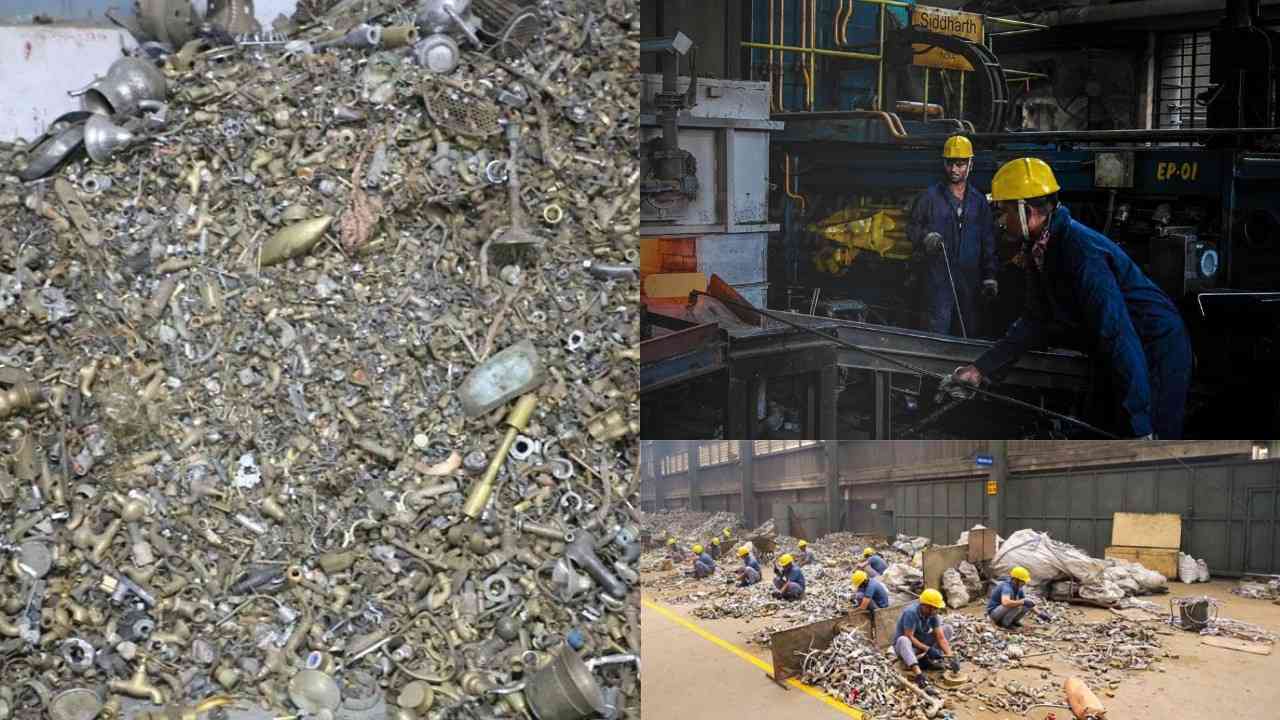
If you have gone to the market to buy brass utensils or raw materials in the last few years, you must have felt the huge rise in prices. According to data, in the last 5 years (2021 to 2026), the prices of brass in India have increased by about 98.8% i.e. almost double. The main reason for this tremendous rise is the huge rise in the prices of copper and zinc in the international and Indian markets. Since brass is prepared by mixing copper and zinc, the prices of brass utensils have also started skyrocketing as these raw metals become expensive.
Jamnagar in Gujarat is the largest brass manufacturing center in India. About 90% of the country's brass requirements are met there. About 6,000 to 7,000 small and micro industrial units here manufacturing auto parts, electrical fittings, valves and hardware consume 600 to 700 tonnes of metal scrap every day. However, the biggest compulsion of this industry is that to run it, about 70% of the raw material has to be met from scrap imported from abroad.
Also read: Former Videocon owner Venugopal declared bankrupt, how did he get into debt?
How did prices increase in 5 years?
Making brass by mixing new copper and zinc is very expensive, so Indian manufacturers make do by melting old brass, utensils, scrap from ship breaking industry and foreign 'honey scrap'. But now rising prices of scrap abroad, losses due to impurities and changes in international rules are becoming a big challenge for this entire sector. If we look at the average base rate of brass (scrap/raw material) at the end of every year from 2021 to 2026, the bullish picture is clearly visible.
At the beginning of 2021, the price was Rs 420 per kg, whereas in 2026 the current price has gone up to Rs 835 per kg. There has been a direct increase of Rs 415 per kg in the last 5 years. According to this increase, there has been a huge difference of 98.81% in the price of brass by 2026 as compared to 2021.
How much scrap does India use?
According to the Copper Vision Document of the Ministry of Mines and the report of 'International Copper Association India', India imported about 3.10 lakh tonnes of copper scrap in the financial year 2023-24. It is registering an increase of 10% every year. According to the data of financial year 2024-25, there was supply of 5.34 lakh tonnes of copper scrap and 2.52 lakh tonnes of brass scrap in the country.
Out of this, 3.69 lakh tonnes of brass scrap was melted directly in local furnaces to produce new products. It is clear from these figures that there is a huge market for recycling in India but the modern capabilities to refine poor quality scrap in the country are still limited.
Also read: Stock market up, bank-IT shares rise; Know the prices of gold and silver
According to UN trade data, India is mainly dependent on countries like Saudi Arabia, US, Germany, UK, Colombia and UAE for imports of copper and copper-alloy scrap. According to Jamnagar Factory Owners Association, every month around 500 containers of brass scrap reaches Jamnagar alone from abroad (America, Europe and Gulf countries).
Why are brass utensils becoming expensive?
Brass is not a single metal, rather it is made up of a mixture of approximately 60 to 70 percent copper and 30 to 40 percent zinc. At present, the price of copper in the global commodity markets remains near its highest level. Due to increase in the cost of raw materials, casting of brass and manufacturing of utensils has become very expensive, which is directly impacting the budget of common buyers.
Small manufacturers face two major problems due to excessive dependence on 'honey scrap' and old scrap coming from abroad. First, imported scrap is often adulterated with aluminium, iron and other metals. It costs more to sort and clean it. Secondly, due to impurities in the scrap, new metal has to be mixed separately to make brass of the correct grade. This increases metal loss and the rejection rate increases due to poor quality of finished goods.
Also read: Gold and silver became cheaper on Dhanteras, what is the condition of the share market?
The European Union is going to impose a strict ban on scrap exports to non-OECD countries from May 2027. In case the scrap supply from Europe stops or becomes expensive, the brass industry of Jamnagar may face a serious crisis of raw material. In normal circumstances, brass made from scrap is cheaper, but if there is more adulteration in the scrap, then due to its sorting and rejection, it proves to be as expensive as new brass.
If India has to reduce its dependence on foreign scrap, mere collecting of scrap will not be enough. For this it is necessary to take four steps. First, proper collection of scrap of old utensils, taps, auto parts and electrical goods at household level. Second, to create modern centers to classify brass, copper and bronze into different categories (like the METALAB Testing Center built in Jamnagar). Third, according to the Mines Ministry, to increase the capacity to refine scrap instead of melting it directly and fourth, to keep the domestic recycling chain ready as a backup in case foreign supplies stop.