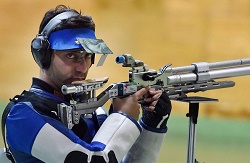
On 11 August 2008, at the shooting range hall in Beijing, Abhinav Bindra fired the final shot of the 10m air rifle final needing something special. He scored 10.8. It gave him gold with a total of 700.5 and made him the first Indian to win an individual Olympic gold medal, ending a wait that stretched back to the country’s first Games.
Name: Abhinav Bindra Born: 28 September 1982, Dehradun | Sport: Shooting | Event: 10m air rifle
A range at home
Bindra was born in Dehradun into a Punjabi Sikh family. He was introduced to shooting as a boy, and his parents went as far as building a shooting range at the family home so he could train every day. He was educated at The Doon School in Dehradun and St. Stephen’s School in Chandigarh, and later completed a degree in business administration at the University of Colorado Boulder.
His first coach, Lt Col J.S. Dhillon, laid the technical foundation. Over the years he worked with a string of foreign specialists, most notably the German coach Gaby Bühlmann, and spent long spells training in Germany.
A teenager on the big stage
Bindra was 15 when he competed at the 1998 Commonwealth Games in Kuala Lumpur, the youngest participant there. Two years later he was the youngest member of India’s team at the Sydney Olympics, where he scored 590 in qualifying and finished 11th, outside the final. In 2001 he won bronze at the World Cup in Munich with a junior world record of 597 out of 600, and he received the Arjuna Award in 2000 and the Khel Ratna for 2001 before he was 20.
At the 2002 Commonwealth Games in Manchester he won pairs gold and individual silver, the start of a long run of medals at the Games.
Athens, injury and a world title
At Athens 2004 he qualified third for the final with 597 but shot the lowest final score of the eight finalists, 97.6, and finished seventh. A back problem troubled him through this period, and it raised doubts about whether he could last at the top.
The answer came at the 2006 World Championships in Zagreb, where he won the 10m air rifle title despite the injury. It was India’s first gold at the World Shooting Championships, and it convinced Bindra himself that an Olympic gold was within reach. He also won pairs gold and individual bronze at the Melbourne Commonwealth Games that year.
Beijing 2008
China’s Zhu Qinan, the defending champion shooting in front of a home crowd, was the favourite in Beijing. Bindra scored 596 in qualifying to make the final. In the final he never dropped below 10.0 on any shot, and his 104.5 was the best final round in the field. Going into the last shot he was level with Finland’s Henri Häkkinen. Bindra’s 10.8 settled it, while Häkkinen’s last shot dropped him to bronze. Zhu took silver with 699.7, Häkkinen bronze with 699.4.
The response at home was huge. Governments, sports bodies and companies announced cash awards and gifts, and in 2009 he received the Padma Bhushan. In 2011 he was made an honorary Lieutenant Colonel in the Territorial Army, and the same year he published his autobiography, A Shot at History: My Obsessive Journey to Olympic Goldwritten with Rohit Brijnath.
The later years
Bindra kept competing at a high level for eight more years. He won pairs gold and individual silver at the 2010 Commonwealth Games in Delhi, and team silver at the Asian Games in Guangzhou the same year. At London 2012 he scored 594 and finished 16th in qualifying. In 2014 he won individual gold at the Commonwealth Games in Glasgow and two bronzes, team and individual, at the Asian Games in Incheon.
His last Olympics, Rio 2016, came close to a second medal. He reached the final with 625.7 in qualifying and finished fourth after losing a shoot-off for bronze. He announced his retirement on 5 September 2016.
Administrator and Olympic Order
Bindra’s influence in the sport grew after he stopped shooting. He was a member of the ISSF Athletes Committee from 2010 to 2020 and its chair from 2014. In 2018 he received the ISSF Blue Cross, the federation’s highest honour, and was appointed to the IOC Athletes’ Commission.
Through the Abhinav Bindra Foundation he has worked to bring sports science and high-performance support to Indian athletes, and in 2020 he launched a sports medicine and research institute in Bhubaneswar. In 2024 he carried the Olympic torch ahead of the Paris Games, and at the 142nd IOC Session in Paris he was awarded the Olympic Order, the IOC’s highest award, becoming the first Indian to receive it.
Career record and honours
- Olympic Games: gold, 10m air rifle, Beijing 2008 (700.5); 4th, Rio 2016; 7th, Athens 2004; also competed at Sydney 2000 and London 2012
- ISSF World Championships: gold, 10m air rifle, Zagreb 2006
- Commonwealth Games: gold (pairs) and silver (individual), Manchester 2002; gold (pairs) and bronze (individual), Melbourne 2006; gold (pairs) and silver (individual), Delhi 2010; gold (individual), Glasgow 2014
- Asian Games: silver (team), Guangzhou 2010; bronze (team and individual), Incheon 2014
- ISSF World Cup: bronze, Munich 2001, with a junior world record of 597
- Arjuna Award: 2000
- Khel Ratna: 2001
- Padma Bhushan: 2009
- ISSF Blue Cross: 2018
- Olympic Order: 2024, the first Indian recipient
- Member, IOC Athletes’ Commission, from 2018; chair, ISSF Athletes Committee, from 2014