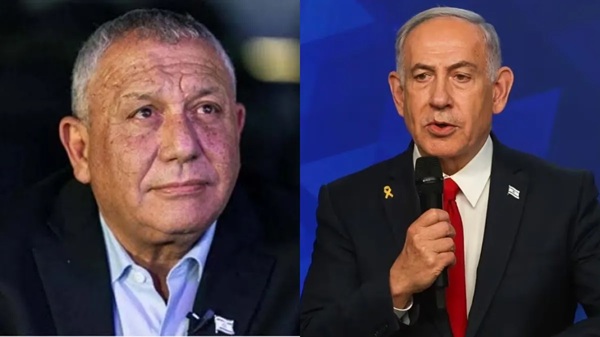
Jerusalem. Amid the ongoing political tussle over the formation of a new government in Israel, President Isaac Herzog has decided to give opposition leader Gadi Eizenkot the first chance to form the government. This is being considered a political setback for current Prime Minister Benjamin Netanyahu. The President will formally invite Eysenkot to form the government at a function to be held at Rashtrapati Bhavan on Sunday, November 8 at 5 pm local time. After this they will get 28 days to prepare the alliance. If needed, the President can also give additional time of 14 days.
In the recent elections held in Israel, Netanyahu's religious-nationalist coalition did not get a majority in the parliament despite being the largest political faction. To form a government, the support of at least 61 MPs in the 120-member Knesset is required. At present no alliance has this number. In such a situation, talks regarding alliance between different parties are likely to intensify in the coming days.
67 MPs supported Aizenkot's name
The post of President in Israel is mainly ceremonial, but he plays an important role in deciding which leader is given the first chance to form a government after the elections. President Herzog spoke with representatives of all parties elected to the Knesset before making the decision.
During this period, 67 MPs recommended the name of Gadi Eizenkot for the post of Prime Minister, while 46 MPs supported Netanyahu. A group of seven MPs did not recommend the name of any candidate. After the completion of the consultation process on November 5, the President had said that he would hold further talks with the party leaders and assess the possibilities of forming the government. After this, the decision to give responsibility to Eizenkot was announced on 7 November.
However, getting the support of 67 MPs does not mean that Eysenkot has the necessary majority to form a government. This support gives them the opportunity to form coalitions in the first place. Now they will have to build consensus among parties with different ideologies.
Netanyahu's Likud largest party, but far from majority
In the elections, Netanyahu's Likud party won 27 seats and became the largest party in the parliament. Despite this, his alliance got only 53 seats, which is eight less than the majority figure.
On the other hand, Eysenkot's Yashar Party won 21 seats. Along with them, the four-party Jewish alliance has a total of 48 seats. The two parties representing Israel's Arab minority community together got 19 seats. During talks with the President, both these parties also supported Eysenkot's name.
Three ways in front of Aizenkot to form government
Eysenkot has several options for forming a government, but each path will require political compromise. The first option is to form a minority government with outside support from Arab MPs. Another path could be to reach a compromise with ultra-Orthodox Jewish parties that have so far traditionally sided with Netanyahu.
The third option is to form a national unity government with the Likud party. However, this path is also not easy. Eysenkot has made it clear several times that he will not join the Netanyahu-led government. At the same time, there are differences of opinion among his potential allies regarding support for Arab parties and the role of ultra-Orthodox parties.
Four conditions placed before allies
Eysenkot has put forward four major conditions for potential allies to join the government. He says that the allies should consider Israel as a Jewish, democratic, liberal and equality based country. Also respect the values stated in Israel's Declaration of Independence.
His second major condition is to support military or national service for all citizens. In addition, allies will have to recognize Hamas as a terrorist organization and support efforts to eliminate its military and governing ability in Gaza.
Due to these conditions, alliance talks may become more complicated. If Eysenkot fails to form a government within the stipulated time, the President can give a chance to another leader. Even after that, if the government is not formed, then the MPs can put forward the name of some other candidate. Israel has about 100 days for the entire process. In case a government is not formed during this period, re-elections can be held in the country.
Netanyahu appealed to form a national unity government
After Eysenkot got the first chance, Netanyahu has appealed to form a national unity government. However, he has opposed a government that depends on the support of Arab parties.
Netanyahu alleged that efforts are being made to hastily form a government which, according to him, will have the support of parties supporting terrorism. He said that such a government would not be effective for Israel's security and action against Hamas. Netanyahu claims that a government dependent on the support of Arab parties would not be able to ensure the safety of Israeli soldiers.
Who is Gadi Eizenkot?
66-year-old Gadi Eizenkot is a former Israeli military chief. He entered politics in 2022. He briefly joined Netanyahu's wartime cabinet following the Hamas attack on October 7, 2023, but later defected from the government and returned to the opposition.
Since then he has been critical of the government's handling of the Gaza war and its security policies. Eysenkot has made it clear that he will not join the Netanyahu-led government. One of his sons and two nephews also died in the Gaza war.
During the election campaign, he highlighted his military experience and presented himself as an alternative to Netanyahu on security issues. He has also been critical of violence against people living in Israeli settlements in the Palestinian territories. In addition, he has opposed the policies of Netanyahu's right-wing allies—National Security Minister Itamar Ben-Gvir and Finance Minister Bezalel Smotrich. Due to their statements and actions regarding Palestinians, some western countries have also imposed sanctions on these two leaders.
The mathematics of the alliance rests on the support of Arab parties.
The role of Arab MPs has become important in the formation of the new government in Israel. Eysenkot has ruled out forming a formal coalition with Arab parties. In such a situation, it is difficult for them to get direct majority on the basis of these 19 seats. However, these parties have supported his name for the post of Prime Minister, giving him his first chance to form the government.
Netanyahu has described support for Arab parties as a threat to Israel's security. At the same time, Arab leaders allege that the policies of Netanyahu and his right-wing allies discriminate against the Arab community. Meanwhile, anti-Netanyahu parties are exploring the possibilities of a new coalition and are also talking to those parties with whom earlier an agreement was considered difficult.
Yisrael Beytenu party leader Avigdor Liberman has also softened his longstanding opposition to working with ultra-Orthodox parties. He has expressed his desire for agreement on the issue of military service of the people of this community. This has intensified the discussion on the possibilities of a new alliance among anti-Netanyahu parties. However, Eysenkot still stands by his demand for mandatory military or national service for people from the ultra-Orthodox community.
What will happen next now?
Despite Eysenkot getting a chance to form a government, Netanyahu will remain acting prime minister for the time being. His Likud party is the largest party in parliament, but his coalition does not have a majority.
Now the biggest challenge before Eysenkot is to convert the nomination support of 67 MPs into the necessary parliamentary majority in favor of the government. For this they will have to build a consensus among centrist, right-wing, left-wing, Arab and ultra-Orthodox parties. If he succeeds in garnering the support of 61 MPs, Netanyahu may have to step down from the post of Prime Minister. At the same time, if Eizenkot fails, Netanyahu may get a chance to form the government again.