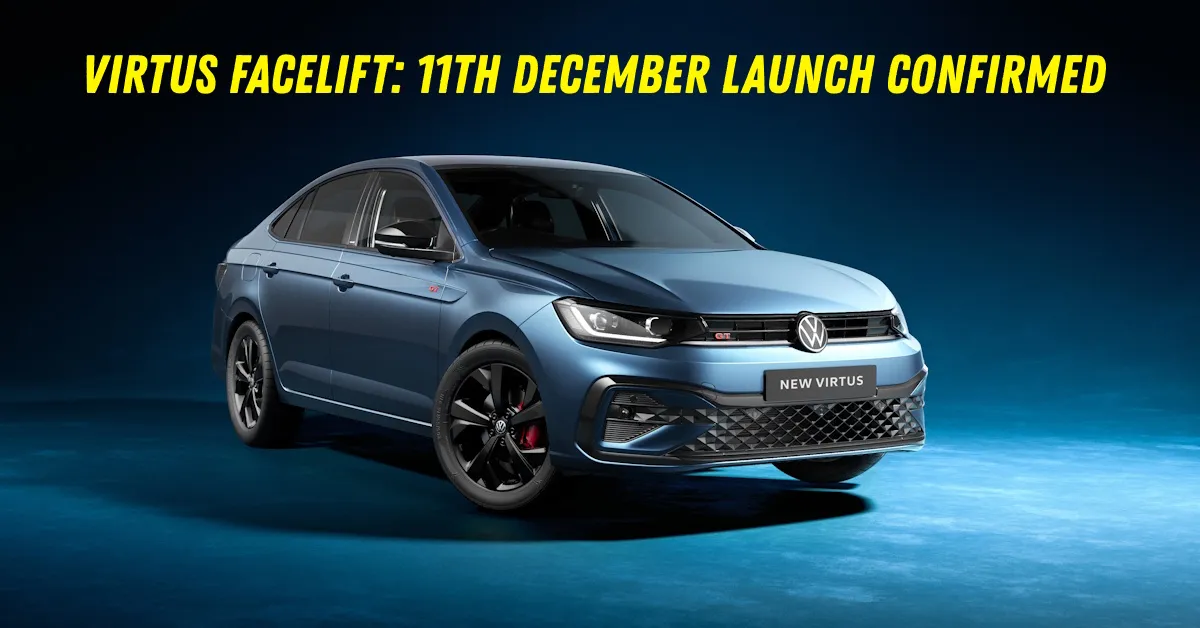
Volkswagen’s updated Virtus sedan will go on sale on December 11, 2026. The company has already released a teaser showing the facelift’s revised styling. This will be the Virtus’s first major update since it was introduced in June 2022. The Virtus is India’s best selling full size sedan.
The facelift won’t change the sedan’s basic dimensions or its two turbo-petrol engines. The more important changes will be a revised exterior, additional convenience features and a new eight-speed torque-converter automatic gearbox for the 1.0-litre engine. The higher-performance 1.5-litre TSI is expected to retain its seven-speed DSG automatic.
Volkswagen’s teaser shows a reworked front bumper, a revised grille and updated lighting details. The bumper has a wider lower intake and new inserts around the fog-lamp area. The GT model shown in promotional images features black alloy wheels, red badging and a dual-tone treatment with dark exterior accents.
The headlights retain the broad shape of the existing design, although the daytime running-light arrangement has been refreshed. At the rear, the Virtus gets darker taillight detailing, a revised bumper and a small lip spoiler on the boot. The basic sedan silhouette remains unchanged. This is a facelift, not a new-generation Virtus built on an entirely different platform.
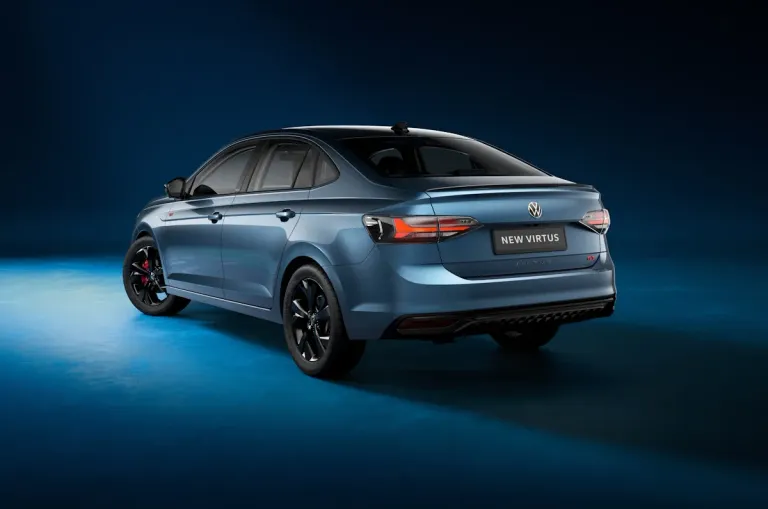
The photographed GT version also appears to have camera equipment associated with a 360-degree parking-view system. That would be a useful addition, especially for drivers negotiating crowded car parks. But Volkswagen has not yet published the complete variant-wise equipment list, so the feature should not be described as standard across the range.
The Virtus currently uses a 1.0-litre TSI engine producing approximately 115 PS and 178 Nm, offered with a six-speed manual or six-speed torque-converter automatic. The facelift will replace the existing six-speed automatic with an eight-speed unit, following a similar change on the updated Skoda Slavia.
More ratios can help the engine stay closer to an efficient operating speed while also reducing revs during relaxed highway driving. But an eight-speed gearbox is not automatically smoother or quicker simply because it has two additional ratios. Shift programming, gearing and how the transmission behaves in traffic will matter more in everyday driving.
The 1.5-litre TSI continues to appeal to driving enthusiasts. It produces 150 PS and 250 Nm and is expected to continue exclusively with the seven-speed dual-clutch automatic. Volkswagen discontinued the 1.5 TSI manual option in January 2026. Volkswagen has not announced a power increase or changes to the suspension.
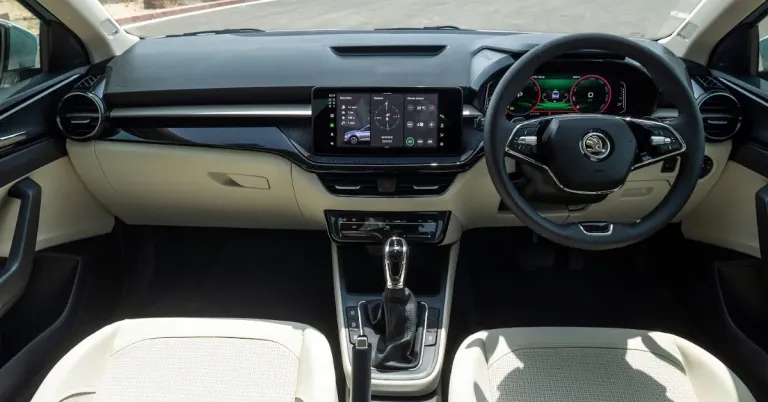
Slavia Facelift’s cabin used to illustrate
The existing Virtus already offers a touchscreen infotainment system, digital instrumentation on selected versions, ventilated front seats and a sunroof. The facelift will add a larger digital driver display, revised infotainment software and a a 360-degree camera. Some features introduced on other recent Volkswagen and Skoda models may also be adopted.
The outgoing Virtus is priced from approximately Rs 10.71 lakh to Rs 19.20 lakh, ex-showroom. The facelift may cost a little more, particularly on variants getting the new gearbox and extra features. However, Volkswagen has not announced a revised price list or delivery schedule.
The Virtus competes with the recently updated Skoda Slavia, Hyundai Verna and Honda City. Its driving dynamics and 1.5-litre turbo engine have traditionally been strong points. Sales of the Virtus stood at 1,172 units in September 2026, according to SIAM-based data, down from 1,301 in August. It remained the highest-selling midsize sedan in that month’s comparison, ahead of the Verna, Slavia and City.
The December update should help Volkswagen keep the Virtus competitive without changing the qualities enthusiasts already value. A refreshed cabin and better automatic gearbox could also attract family buyers who place greater importance on comfort and equipment.