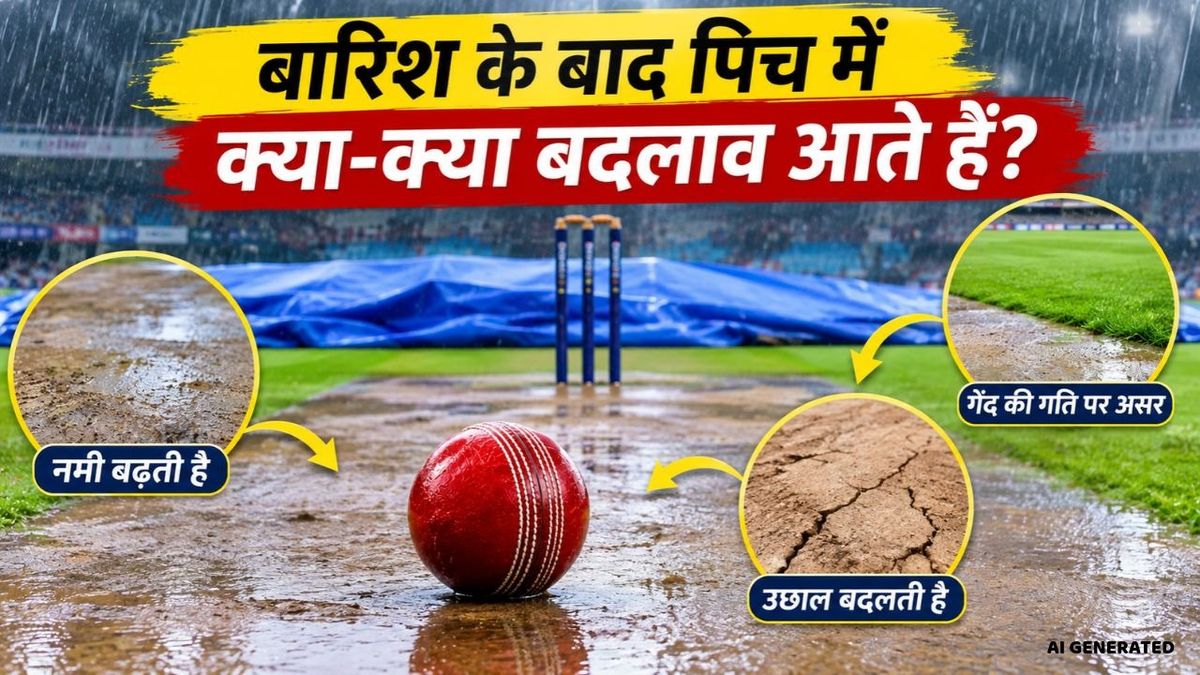
EXPLAINER: Many times when it rains during the match or before it rains, the fun of the match gets spoiled. In cricket, rain affects not only the time and overs of the match but also the nature of the pitch. Many times, when the match starts again after the rain stops, the bowlers suddenly start getting extra help and it becomes difficult for the batsmen to score runs. Actually, due to being covered with covers for a long time, moisture can remain in the pitch. Due to this, changes are seen in the bounce, speed and movement of the ball. But after the rain, which bowler gets the advantage and why does the challenge for the batsmen increase? Let us know.
What changes in the pitch after rain?
The condition of the cricket pitch can change to a great extent after rain. When it starts raining, the ground staff covers the pitch with covers, so that water does not reach its surface directly. However, despite installing covers, the moisture present under and around the pitch may affect its surface. Due to being covered with covers for a long time, the moisture already present in the upper surface of the pitch does not dry quickly. Apart from this, due to lack of sunlight and air, the pitch gets less chance to dry naturally.
In such a situation the surface of the pitch may remain slightly moist and soft. However, its effect is not the same on every pitch. The type of soil the pitch is made of, how much grass is present in it and how good its drainage system is, all these things depend on how it will behave after the rain.
Fast bowlers get help due to increase in moisture in the pitch
If moisture remains in the pitch after rain, fast bowlers can get advantage. Especially the conditions may be favorable for players bowling with the new ball. Seam movement can be seen after the ball hits a damp surface. Due to this, the ball can change its direction after hitting the pitch and it becomes difficult for the batsman to understand it.
Additionally, if there is little grass present on the pitch and the weather is cloudy, the fast bowlers may get additional help. In such circumstances the possibility of swinging the ball may also increase. This is the reason why in matches that resume after rain, captains often make their fast bowlers bowl more aggressively in the initial overs.
However, it is important to understand that the moisture of the pitch and the moisture present in the air are different things. Wind conditions and shine of the ball also affect the swing of the ball, while seam movement is related to the deviation that occurs after the ball hits the pitch.
There may also be a change in the bounce and speed of the ball
Due to moisture in the pitch after rain, the bounce and speed of the ball is also affected. If the upper surface of the pitch becomes soft, the ball can get a little more grip on it. In such a situation, the speed of the ball may slow down and the batsmen may have to take extra time to play their shots.
At the same time, in some circumstances the ball can also come faster after hitting the pitch. Especially if there is grass on the pitch and the surface is hard, fast bowlers can get extra bounce. Therefore, it is not right to say that the ball will be slow on every pitch after rain. The biggest challenge for batsmen is to understand the behavior of the pitch. In the first few balls, they have to guess how fast the ball will come and how much bounce it will have.
Do spin bowlers also get help?
It is often believed that only fast bowlers get the benefit after rain, but it is not so. Depending on the circumstances, spin bowlers can also take advantage of this. If the pitch surface becomes soft after the rain and the ball starts getting grip, then it can help the spin bowlers to get turn.
However, when there is too much moisture, it can be difficult for spin bowlers to get a good grip on the ball. Moreover, if the ball gets wet, it also becomes challenging to grip it properly. In such a situation, bowlers are not able to give enough spin to the ball with their fingers. Therefore, whether spin bowlers will get advantage after rain or not depends on the actual condition of the pitch and whether the ball is dry or wet.
Why does batting become difficult for batsmen?
After rain, moisture on the pitch and change in the behavior of the ball can increase the difficulty for the batsmen. When the ball sometimes takes extra bounce and sometimes slows down after hitting the pitch, it is not easy for the batsmen to create timing.
Additionally, if the ball is gaining seam movement, batsmen have to be careful in playing balls off the stump and beyond. In such a situation, the risk may increase in playing shots like drive and cut.
Wet outfield can also cause problems for the batsmen. The ball which reaches the boundary quickly under normal circumstances may become slow on a wet ground. Due to this, the batsmen have to work harder to hit fours and sixes.
Outfield and ball speed also have an impact
The outfield may also become wet after rain. Due to the presence of water on the grass, the speed of the ball reduces. Normally the ball which moves quickly towards the boundary after the batsman's shot, may slow down on a wet outfield.
Apart from this, it can also be challenging for fielding players to catch the ball and throw it quickly. There is a danger of slipping on wet grass. In such a situation, players have to take extra caution while fielding. In case of water accumulation in the field, it is not possible to restart the match. Umpires and ground staff have to ensure that the field is safe for the players.
Is it better to bat or bowl after rain?
Now the question arises whether when the match starts after the rain, the captain who wins the toss should bat or bowl first. It is decided by looking at the condition of the pitch, weather and remaining overs of the match. If the pitch is moist, cloudy and there is a possibility of help for the fast bowlers, then the captain may prefer to bowl first. This may give his team a chance to put pressure on the opposition batsmen in the initial overs.
On the other hand, if the pitch has dried out after being under covers for a long time and looks good for batting, then batting first can also be beneficial. In such a situation, it is very important for the captain to check the pitch properly.
Also read: IND VS NZ: It is raining heavily in Hamilton, where the third ODI will be played tomorrow, know how the weather will be during the third ODI?