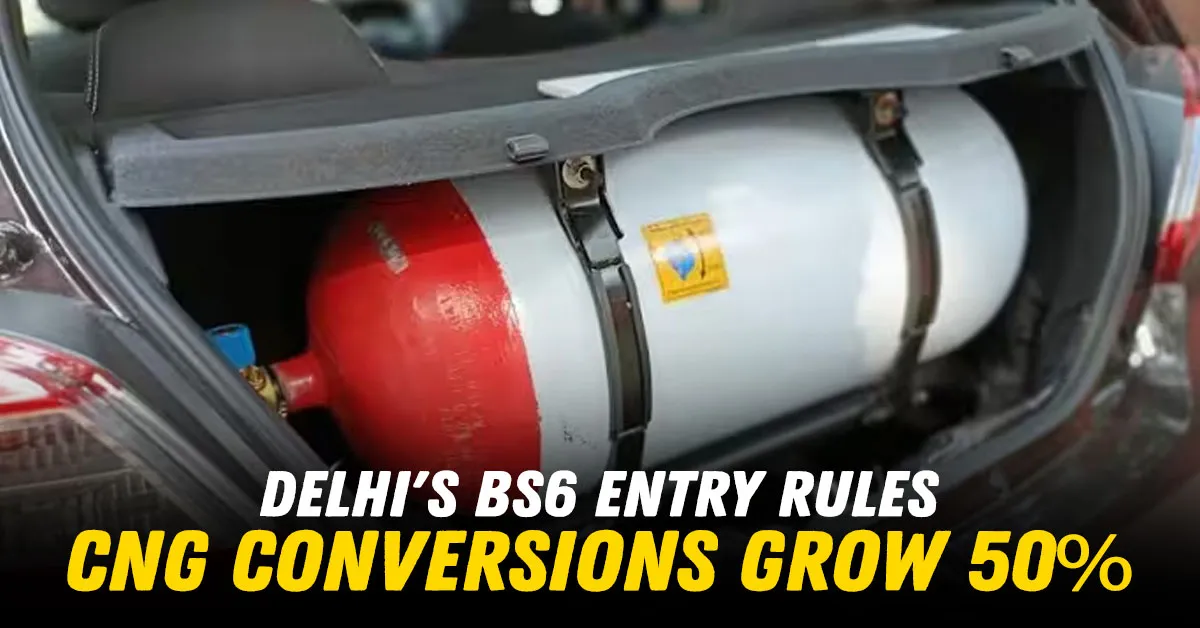
Delhi’s new restrictions on older out-of-state vehicles are pushing more car owners in Noida, Ghaziabad and Gurugram towards CNG conversions. Local installation businesses report increases of up to 50% in enquiries and fitments, with some owners choosing to modify an existing petrol car instead of spending several lakh rupees on a new BS6 vehicle.
The restrictions came into effect on November 1 and are scheduled to remain in force until January 31, 2027. Petrol and diesel vehicles registered outside Delhi that do not meet BS6 emission standards cannot enter under the winter pollution measure. Electric and CNG vehicles are exempt from this particular entry restriction, along with specified emergency vehicles. Other applicable vehicle rules still remain in force.
Shakti Singh, associated with a CNG installation business in Sector 122, Noida, told PTI that demand had increased by more than 50% in the preceding 15 days. A workshop in Ghaziabad said it was now converting four or five vehicles in two or three days, compared with the same number over an entire week earlier.
Yatin Bansal of Car Craft in Sector 83, Noida, reported an almost 50% increase in daily calls and enquiries. Another Ghaziabad installer said it was receiving nearly 20 calls a day. A Karnal workshop reported a smaller increase of 25–30%. These are accounts from individual businesses, not an official finding that total CNG conversions across the NCR have risen by exactly 50%.
The customers are mainly commuters who travel between NCR cities and Delhi for work, education or family needs. A restriction at the border can make an otherwise serviceable car much less useful. For a household with one vehicle, retrofitting an approved CNG kit may appear cheaper than buying a replacement.
Installers quoted by PTI say the cost of converting a BS4 vehicle generally ranges from Rs 35,000 to Rs 50,000. A BS6 conversion can cost approximately Rs 50,000 to Rs 70,000. The actual amount depends on the kit, engine, vehicle and workshop. These are market quotations, not government-fixed prices.
There can also be running-cost savings if the owner drives enough kilometres and CNG is cheaper per kilometre than petrol. But that calculation depends on local fuel prices and the car’s actual mileage on gas. A conversion may reduce available boot space, add cylinder weight and affect performance. Some engines are better suited to retrofitting than others.
A CNG conversion is not legally complete just because a workshop fits a cylinder. Automotive Research Association of India guidance requires an approved retrofit kit and compliance with applicable emission and safety rules. The work should be carried out by an authorised installer, with an installation certificate provided to the owner.
The vehicle’s registration certificate also has to be updated to record its changed fuel configuration. Under the applicable retrofit procedure, the owner must approach the registering authority for endorsement within the prescribed period. The insurance company should be informed as well. An unapproved installation or an RC that still shows only petrol may create problems during enforcement and after an accident.
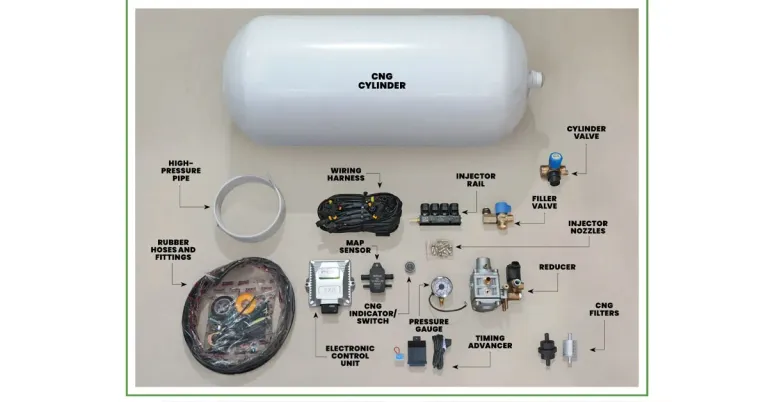
Image source
Owners should also check whether their particular vehicle can legally be converted and whether the Delhi entry exemption will apply after its papers have been updated. Retrofitting does not automatically erase any separate restrictions related to vehicle age, fitness, pollution certification or other rules. The current winter entry restriction is only one part of Delhi’s vehicle enforcement system.
A new BS6 petrol car may cost several lakh rupees more than a retrofit. That price difference explains the sudden interest in CNG, but buyers should calculate how long they intend to keep the older vehicle. Spending Rs 50,000 on a car close to the end of its useful or legally permitted life may not be sensible.
There are practical costs too. CNG queues can be long, highway stations are not always convenient and the kit needs periodic checks. A vehicle used only occasionally in Delhi may not recover the conversion cost through fuel savings. A daily commuter covering substantial distances could have a stronger case, provided the fitment and paperwork are fully compliant.