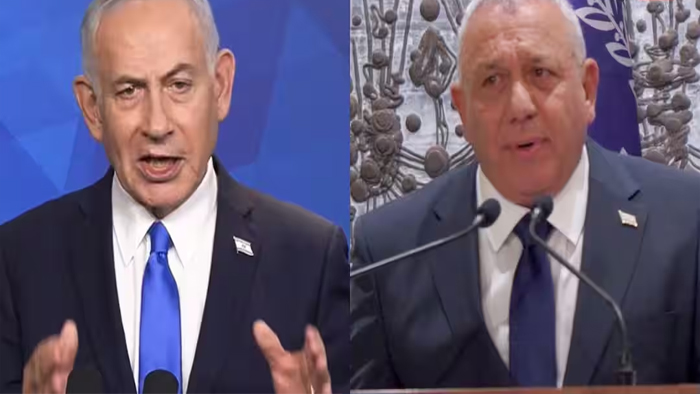
Desk: Amidst the ongoing political deadlock in Israel, former military chief and president of the Yashar Party, Gadi Eiseenkot, has taken a big step towards removing Benjamin Netanyahu from power and forming a new government. Just before the swearing-in of the 26th Knesset (Israeli Parliament), Eiseenkot has reached an agreement with four prominent opposition leaders Naftali Bennett, Yair Golan, Avigdor Liberman and Yair Lapid on the distribution of important posts in the parliament. Before taking oath as the new MP, Aizencott said that he is fully committed to forming a national emergency government as soon as possible in this situation.
Aizencott posted on social media platform Under this agreement, former minister Matan Kahana has been made the candidate for Parliament Speaker. Apart from this, it has been proposed to make former Defense Minister Avigdor Liberman the head of the Foreign Affairs and Defense Committee, Roy Folkman as the Chairman of the 'House Committee' and Liran Avisar Ben-Horin as the Chairman of the 'Finance Committee'.
The formation of these committees will be discussed this week and the final list will be presented to the Parliament for approval on Wednesday, while some special committees will be announced later. Opposition leader Yair Lapid also confirmed the meeting with Eisecoat and reiterated the need for coordination and forming an emergency government. President Isaac Herzog gave Gadi Eiseenkot the first chance to form a government on 8 November, as no group got a clear majority in the elections on 27 October.
According to Rashtrapati Bhavan, Aizencott's name was recommended by 67 MPs in the 120-seat parliament, including two Arab-led parties. Whereas 46 MPs supported Netanyahu and 7 MPs did not take anyone's name. According to Israeli law, Eisecott has 28 days to form a government, which the President can extend by another 14 days if he wishes. However, despite getting the mandate, it is not easy for Aizencott to become the Prime Minister.
To have a majority in the 120-member Parliament, the support of at least 61 MPs is required. Aizenkot's four-party alliance has 48 seats, with his own party 'Yashar' being the second largest party with 21 seats. On the other hand, Netanyahu's party 'Likud' is the single largest party with 27 seats and his religious-nationalist alliance has 53 seats.
In such a situation, to achieve the magic number, Aizencott will have to seek the support of parties outside his coalition, especially Arab-Israeli MPs, who have won a record number of seats due to anger against the Netanyahu government. Eisencott has made it clear that he is prepared to take unconventional and creative political steps to form this national emergency government.