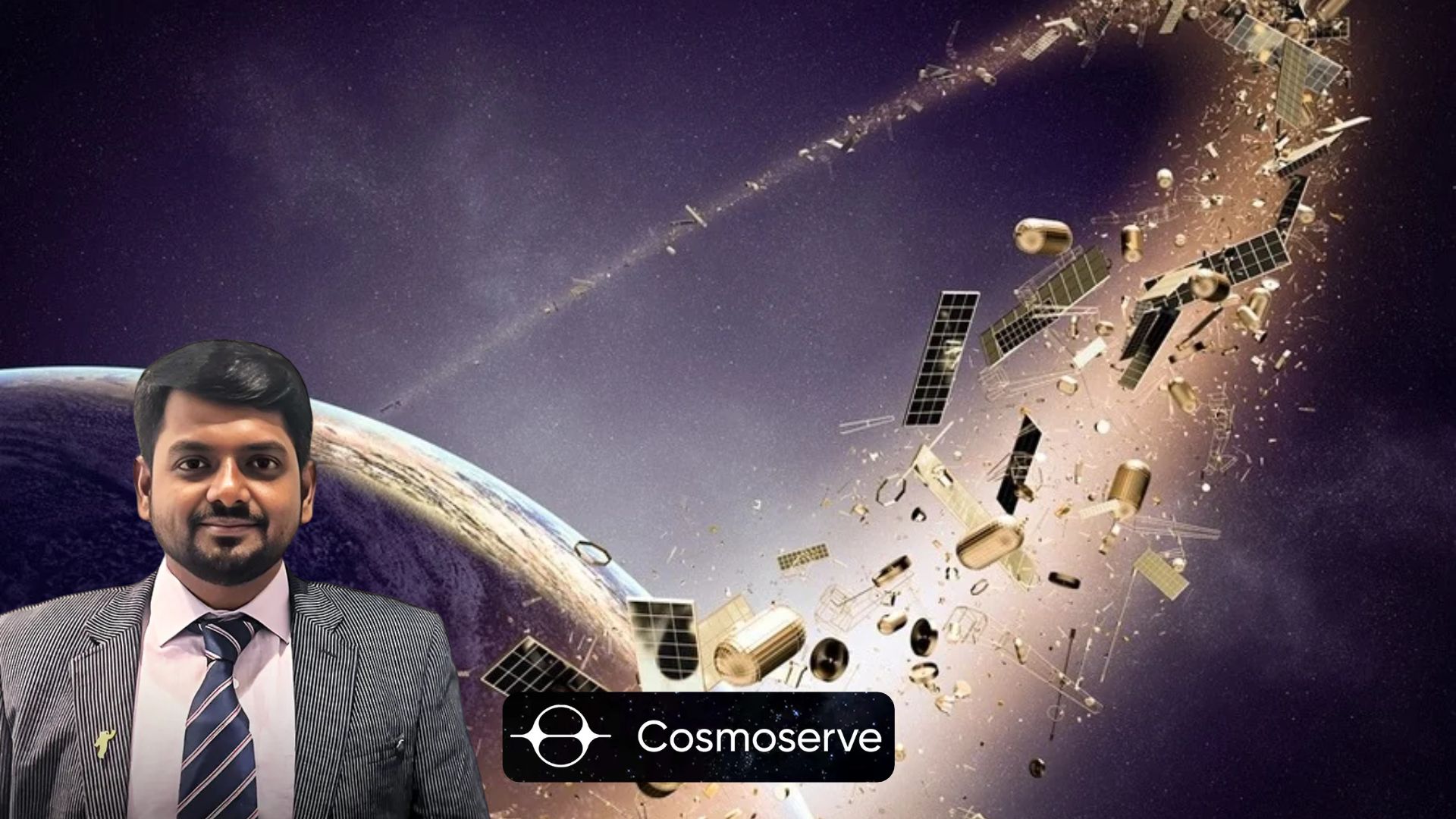
Chiranjeevi Phanindra grew up in a village with no exposure to advanced science. On summer nights, he slept outdoors, and noticed how the stars seemed to keep pace with him as he walked, a trick of distance rather than motion. His real fascination was with airplanes. Planes flew high over his village, and when he first visited a city at around 17 or 18, he saw aircraft descending low on final approach. He was so captivated that he spent afternoons standing near the airport perimeter, watching planes land. That curiosity led him to aerospace engineering, and eventually to a career centred on something few people never see: The debris orbiting above them.
Phanindra is now the founder and CEO of CosmoServe Space, a Hyderabad-based startup focused on removing dead satellites and debris from orbit. “If we do not clear dead satellites, the cascading effect of collisions could trigger the Kessler syndrome in five to six years, rendering Low Earth Orbit completely unusable,” he warns.
As humanity prepares to launch up to one million satellites over the next decade, orbital crowding threatens everyday services such as navigation, weather forecasting and disaster management. The Federal spoke to Phanindra about the urgent need for in-orbit debris removal, the technical hurdles of space robotics, India’s evolving commercial space ecosystem, and his favourite space films.
Edited excerpts:
How did you initially get into the space industry?
I was interested in aerospace engineering, which led me to IIT Kanpur for my Master’s. My thesis was on supersonic jets, whose aerothermal aspects have few practical applications beyond jet engines and rockets. That work brought me to the Vikram Sarabhai Space Centre (VSSC) in Thiruvananthapuram, where I worked on the aerothermal aspects of rockets, and that is how I entered the space industry.
When people hear about space missions, they typically think of exploratory missions and high-profile launches. CosmoServe Space is focused on cleaning space debris and in-orbit servicing, which might not seem as glamorous. How did you get interested in this specific aspect of space exploration?
ISRO’s core values shaped my vision. Dr Vikram Sarabhai once said we are second to none in applying space technology for humankind’s benefit, and we were never driven purely by exploration. ISRO’s focus was using space for the common person. To keep using space sustainably, we must clean up orbital space, and that realisation led me to focus on debris removal.
Watch: ISRO restores India’s navigation system NAVIC to minimum strength
Can you break down what space debris removal actually involves for a layperson and explain why it is so important for everyday life on Earth?
Anything travelling in low Earth orbit (LEO) moves at approximately 7.5 kilometres per second, or around 28,000 kilometres per hour. At that speed, even a tiny 1 or 2 millimetre aluminium ball carries kinetic energy comparable to a Formula 1 racing car hitting a stationary wall at top speed. Because kinetic energy scales with the square of velocity, speed matters far more than mass, which makes orbital impacts so catastrophic.
About 650 collisions or anomalous breakups have already generated massive debris fields. Around 50,000 objects are tracked in orbit, but only about 16,000 are operational satellites; the rest is junk. When junk strikes a working satellite, it creates thousands of fragments, each one a bullet, in a runaway cascade. If that happens, space becomes unusable. What is the point of building powerful rockets and exploring other planets if we cannot cross our own orbit because it is choked with junk?
Humanity also relies on space for GPS navigation, weather forecasting, disaster warnings and search-and-rescue. If those capabilities fail, everyday life on Earth will be severely disrupted unless we actively clean up space.
How close are we to Kessler syndrome, where space becomes too crowded to operate?
Kessler syndrome is a critical threshold where cascading collisions create self-sustaining debris fields that permanently block orbital corridors. Humanity has launched roughly 20,000 objects in seven decades, and commercial operators plan to launch over one million satellites in the next decade alone. If we do not manage orbital traffic and de-orbit defunct satellites, Kessler syndrome could become a reality within five to six years.
How did CosmoServe Space come into being, and when did you decide to leave ISRO to start your own company?
I began my career at the Vikram Sarabhai Space Centre in 2010. In 2019, ISRO set up the Human Spaceflight Centre to manage the Gaganyaan programme, and I was among its initial team of 20 specialists handpicked from across ISRO centres. I worked on debris mitigation, including shields to protect the crew module against micrometeoroid and orbital debris (MMOD) impacts, since bringing astronauts back safely is the mission’s primary objective.
That led to my role on the Inter-Agency Space Debris Coordination Committee (IADC), an international body of 13 space agencies. After four years there, I saw that orbital clutter was a massive global crisis and that existing solutions were severely limited. Having understood those technology gaps from the inside, I left ISRO to start CosmoServe Space.
We began operations in August 2025 and raised $3.17 million in seed funding by September. On July 18, 2026, less than a year after founding, we completed our first test flight in space. We recently raised another $6 million and opened our advanced testing facility, inaugurated by Union Minister Jitendra Singh and Telangana IT Minister D Sridhar Babu.
Also read: World Space Week 2026: How Rocket Revolution is reshaping exploration
Why did you choose Hyderabad as your headquarters over Thiruvananthapuram or Bengaluru?
Hyderabad offers two structural advantages. First, a large share of India’s rocket components are fabricated here, supported by defence laboratories like the Defence Research and Development Laboratory (DRDL) and DRDO. Second, it has specialised testing infrastructure, including thermal vacuum chambers, vibration testing and environmental test facilities. It is also highly cost-effective while hosting leading firms like Skyroot Aerospace, Dhruva Space and XDLINX Space Labs, and collaboration with ecosystem builders like T-Hub and T-Works made it the ideal base.
Is CosmoServe Space the only Indian company focused on space debris removal?
While other Indian startups explore refuelling or in-orbit servicing, CosmoServe is currently the only company explicitly focused on debris removal. The technologies are mutually beneficial: Hardware built for debris removal can be adapted for repair and refuelling, and vice versa. We prioritised debris removal because it is the most immediate, critical market demand, while keeping our technology stack flexible.
Your BASE One testing facility was recently highlighted as India’s first private facility—and the world’s sixth—capable of simulating space vision and microgravity. How do you simulate those orbital conditions on the ground?
Targets are identified using ground-station catalogue data for objects larger than 10 centimetres, but those coordinates can be off by up to a kilometre. A chaser can use catalogue data to get within a kilometre, but then it must rely on its own navigation sensors for the final approach and capture.
We chose vision-based optical cameras for close-range navigation. Onboard AI models, trained on synthetic images, calculate relative position and orientation down to centimetres. Space optics are challenging, though, given harsh lighting, extreme solar angles and shifting backgrounds between deep space and Earth. Our orbital rendezvous lab is a dark room with a high-intensity solar simulator and realistic Earth background projections that replicate orbital lighting.
To simulate microgravity, two six-degree-of-freedom (6-DOF) robotic arms manoeuvre the chaser and target, actively counterbalancing gravity on both. When they make contact, the interaction reflects pure contact dynamics. The chaser also moves along an 8-metre linear track, creating a 13-DOF microgravity and vision testing platform. The facility is fully operational and commissioned.
Also read: India’s ‘artificial Sun’: What new gyrotron milestone means and how it compares with China
Does your soft robotic capture system take design inspiration from nature?
We drew direct inspiration from the carnivorous Venus flytrap, whose lobes snap shut when an insect steps inside. Our soft robotic capture mechanism follows that same principle, which is why we call our capture arms “petals.”
How do you view the current Indian space startup landscape?
A few years ago, India had only a couple of space startups; today there are over 450 registered space-tech companies. Yet only a fraction grasp the operational rigour required. A functional lab prototype is relatively easy, but hardware bound for space needs meticulous quality protocols, standard operating procedures and rigorous reviews to prevent early flight failures. Downstream startups using satellite data on Earth don’t need that manufacturing rigour, but companies building launch vehicles, satellites or debris removal hardware must. That maturity is gradually taking root.
How does the business model for space cleanup work? Is there a “polluter pays” regulatory framework taking shape?
Yes, regulation is creating a commercial market based on the polluter-pays principle. The US Federal Communications Commission (FCC) now requires satellite operators to de-orbit dead satellites within five years of end-of-life, rather than leaving them in orbit indefinitely. The rule covers any satellite launched from, registered in or serving the US, roughly 80% of global commercial satellites. Like a broken-down vehicle towed at its owner’s expense, satellites now face mandatory cleanup costs. Similar policies are emerging, including the European Space Agency’s (ESA) Zero Debris Charter and India’s commitment to debris-free missions by 2030.
What were the biggest challenges in transitioning from an ISRO scientist to a space entrepreneur?
Technical knowledge is essential, but the steepest learning curve involves legal framework design, corporate finance, operational execution, and business strategy. Early-stage founders must handle executive roles across operations and finance long before hiring dedicated C-suite officers.
After 15 years in government research, I had to unlearn formal institutional habits and adapt to investor vocabulary. In government, “DD” stands for Demand Draft, whereas venture investors use “DD” for Due Diligence! Adapting to commercial terminology and investor expectations required significant unlearning, but overcoming those hurdles has been rewarding.
Finally, do you watch space movies? Are there any that resonated with you?
I only started watching space movies after joining ISRO, including Gravity and The Martian. Gravity is my favourite because it accurately depicts the threat of space debris and cascading collisions. I also appreciate The Martian after working at ISRO’s Human Spaceflight Centre, where designing a life-support environment, regulating oxygen, carbon dioxide, temperature and humidity, even for a seven-day mission on Earth, is extraordinarily complex. Seeing those survival challenges depicted realistically makes it stand out.