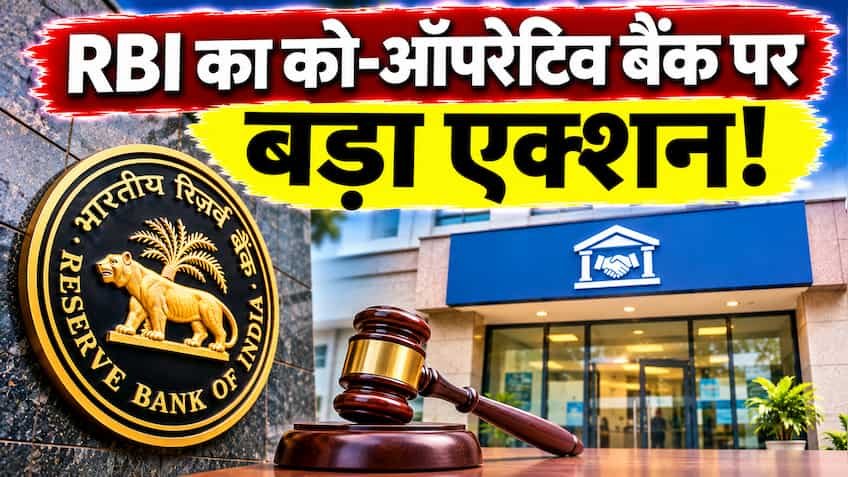
To keep the country’s banking system safe and protect the interests of depositors, the Reserve Bank of India (RBI) has once again adopted a strict stance. The Central Bank has issued an official order to extend the period of regulatory restrictions i.e. ‘Suspension/Directions’ applicable on a major Urban Co-operative Bank (UCB) facing poor financial condition and liquidity crisis for another 1 year. After this decision of RBI, thousands of account holders of the concerned bank will have to wait longer to withdraw their deposits and conduct normal banking transactions. The Central Bank has clarified that due to lack of expected improvement in the financial health of the bank, it has become mandatory to continue these restrictions in public interest.
The Reserve Bank of India imposes ‘All-Inclusive Directions’ (AID) on weak banks under Section 35A of the Banking Regulation Act, 1949. The main reasons for this issue are as follows:
-
Falling Capital Adequacy Ratio (CRAR): The bank’s capital base has fallen well below regulatory standards due to rising non-performing assets (NPAs) on its balance sheet and poor loan recovery.
-
Liquidity Crunch: The bank was found to lack the ability to provide immediate cash as per the demand of depositors, which put the bank at risk of bankruptcy.
-
Administrative and Management Flaws: The initial suspension was imposed after irregularities in loan distribution and weaknesses in the internal control system came to light during RBI inspection. Since the bank management could not come up with any concrete revival plan or raise new capital within the stipulated period, the central bank had to extend this ban for another 12 months.
The following conditions will remain applicable to the functioning of the Bank and transactions of account holders till the RBI instructions remain in force:
| banking activity | RBI rule/restriction status |
| giving a new loan or investing | The bank cannot give a new loan (loan/advance) to anyone nor renew the old loan without the prior written permission of RBI. |
| accepting new deposits | The bank cannot accept any new savings, current or FD deposits from customers. |
| ban on selling property | The Bank is not authorized to sell or transfer any of its immovable property or investments. |
| Withdrawal limit of account holders | Every depositor can withdraw only the maximum limit prescribed by RBI (e.g. ₹10,000 to ₹50,000) out of the total available balance in all his savings, current or other accounts. |
| special emergency discount | For essential expenses like treatment of serious illness, higher education or marriage, depositors can apply for additional withdrawal under special guidelines of RBI, subject to a maximum limit of ₹5 lakh. |
RBI has clearly said in its statement that Suspension or extension of guidelines does not mean cancellation of the license of the bank.. The Bank will continue to carry on limited banking business until its financial position improves or a final decision on merger/liquidation is taken.
Biggest relief for account holders: DICGC insurance cover of ₹5 lakh
Even if the license of this bank is canceled in future for any reason, common depositors need not panic:
-
100% protection up to ₹5 lakh: Wholly owned institution of Reserve Bank of India Deposit Insurance and Credit Guarantee Corporation (DICGC) Under this, each depositor’s deposits up to ₹5,00,000 (including principal and interest) are fully insured.
-
Payment Guarantee in 90 Days: As per the amended DICGC law, eligible account holders get their sum assured transferred directly to their alternate bank account within 90 days of the imposition of restrictions or cancellation of license.
-
Claim Process: Account holders have to submit the claim form at the concerned branch along with their KYC documents (Aadhaar, PAN) and any other active bank account details.
Banking experts believe that customers should be cautious while depositing money in cooperative banks. Avoid depositing more than ₹5 lakh in any one bank in a single name, so that in case of any unexpected regulatory action or crisis your entire deposit remains 100% protected within the insurance protection cover of DICGC. Also, customers of such banks can only visit the official website of RBI (rbi.org.in) Or one should rely only on the information issued from the bank branch and avoid any rumour.