GoKwik's Golden Handcuffs
GoKwik has added a contentious twist to its ESOP policy. Under the new rules, current and former employees could forfeit their unvested and vested-but-unexercised options if they join any of GoKwik’s nine rivals. Can the startup use ESOPs to restrict where its talent goes next?
A New Kind Of Restriction: GoKwik’s amended ESOP Plan 2021 names Razorpay, Shiprocket, CRED, Cashfree Payments, BiteSpeed, Snapmint, WebEngage, Shopflo and Pine Labs as restricted companies. Employees cannot join, advise and invest in them without risking the loss of outstanding options. Crucially, the restriction applies retroactively to previously issued grants and extends for two full years after an employee’s departure.
Employees In Limbo: For GoKwik employees with significant ESOP holdings, the new policy has created a difficult choice between career mobility and potential wealth loss. Many are weighing offers from larger or better-known companies against the risk of forfeiting ESOPS they have already earned the right to exercise.
The timing has added to concerns. GoKwik has seen several senior-level departures in the recent past, while the recent layoff, earlier this year, is further adding to the staff’s concerns.
A Legal Gray Area: Non-compete clauses are common in Indian employment agreements, but explicitly linking rivals to the forfeiture of vested options is unusual. Legal experts believe that GoKwik’s amendment could face legal scrutiny if it is used to penalise employees for joining a competitor.


The issue also raises governance concerns. By converting earned equity into an aggressive retention tactic, startups risk eroding the trust that underpins employee wealth creation. So, will GoKwik stand by its restrictive ESOP policy or roll back the controversial clause? Let’s find out…
From The Editor’s Desk
🎓 New CEO At Unacademy
- Barely two months after upGrad completed the acquisition of the edtech platform, Gaurav Munjal is now stepping down as the CEO of Unacademy. He will now transition to the role of executive chairman at the startup and will “help” with upGrad’s IPO.
- Meanwhile, Unacademy’s chief business officer Akhilendra Kumar will take over as the chief executive of the recently-acquired edtech platform.
- The transition marks the end of Munjal’s tenure as the top executive of the once-high flying edtech platform. Unacademy raised billions of dollars at the peak of the pandemic, but ran into monetisation issues and ballooning losses as soon as schools reopened.
📊 RentoMojo’s Mixed Q2
- The recently-listed furniture rental company saw its profits tank 62.6% YoY to ₹18.2 Cr in Q2 FY27. This decline was largely due to a deferred tax expense of ₹6.2 Cr in Q2 FY27 and a deferred tax credit of ₹32.8 Cr in the year-ago quarter.
- Meanwhile, operating revenue grew 52.8% YoY to ₹142.1 Cr in Q2 FY27, driven by growth in customer orders, live subscribers and rental inventory. Nevertheless, expenses continued to bite and rose 53.2% YoY to ₹119.8 Cr.
- On the operational front, Rentomojo expanded its network to 96 stores at the end of September 2026. The platform’s live subscriber base also grew 43% YoY to 3.2 Lakh, while users ordered 3.8 Lakh gross items during the quarter under review, up 45% YoY.
⚔️ Cult.fit’s Trademark Dispute
- The Madras HC has directed the IPO-bound gym chain to file its response on a petition, which seeks the cancellation of the CULT trademark held by one of Cult.fit’s subsidiaries. The matter has been scheduled for next hearing on December 2.
- The plea in the HC was filed by Deepak Poduval, who cofounded the CULT fitness business in 2015. He alleges that his signatures on a 2017 assignment deeds, which purportedly transferred the brand to Cult.fit, were forged.
- If the challenge succeeds, the case could affect Cult.fit’s right to use the trademark. Additionally, the gym chain could also face SEBI scrutiny for previously acknowledging that its DRHP did not correctly describe the ownership of the CULT trademarks.
⛔ Govt Bans Black Mass Exports
- The directorate general of foreign trade has issued directions to prohibit export of ‘black mass’, a mineral-rich product of recycled EV batteries. The order will be applicable immediately to all outbound shipments of the battery waste material.
- Obtained from shredding end-of-life lithium-ion batteries, black mass is rich in metals like lithium, cobalt and nickel. These minerals can be recovered from the black mass and reused in new batteries, which could save costs and reduce foreign dependence.
- While the restriction could retain critical raw materials within domestic borders, India still has limited capacity for black mass extraction and refining. As such, capabilities will have to be built up to capture the full economic value of black mass.
📱 Dull Diwali For Retailers
- Weak consumer demand and rising prices weighed heavily on the recently-concluded Diwali festive season. According to AIMRA, mobile phone retailers saw sales volumes decline by 18-20% over the four-day period between November 6 and November 9.
- However, overall sales value remained broadly in line with last year’s festive season on the back of higher average selling prices. Nevertheless, AIMRA noted that the contraction in volumes squeezed margins and store profitability across retail channels.
- The sub-₹20,000 segment was particularly impacted by a shortage of fresh, competitive 5G models from leading brands. On top of this, financing emerged as another constraint during the festive season as only 60-70% of the loan applications were approved.
Inc42 Markets
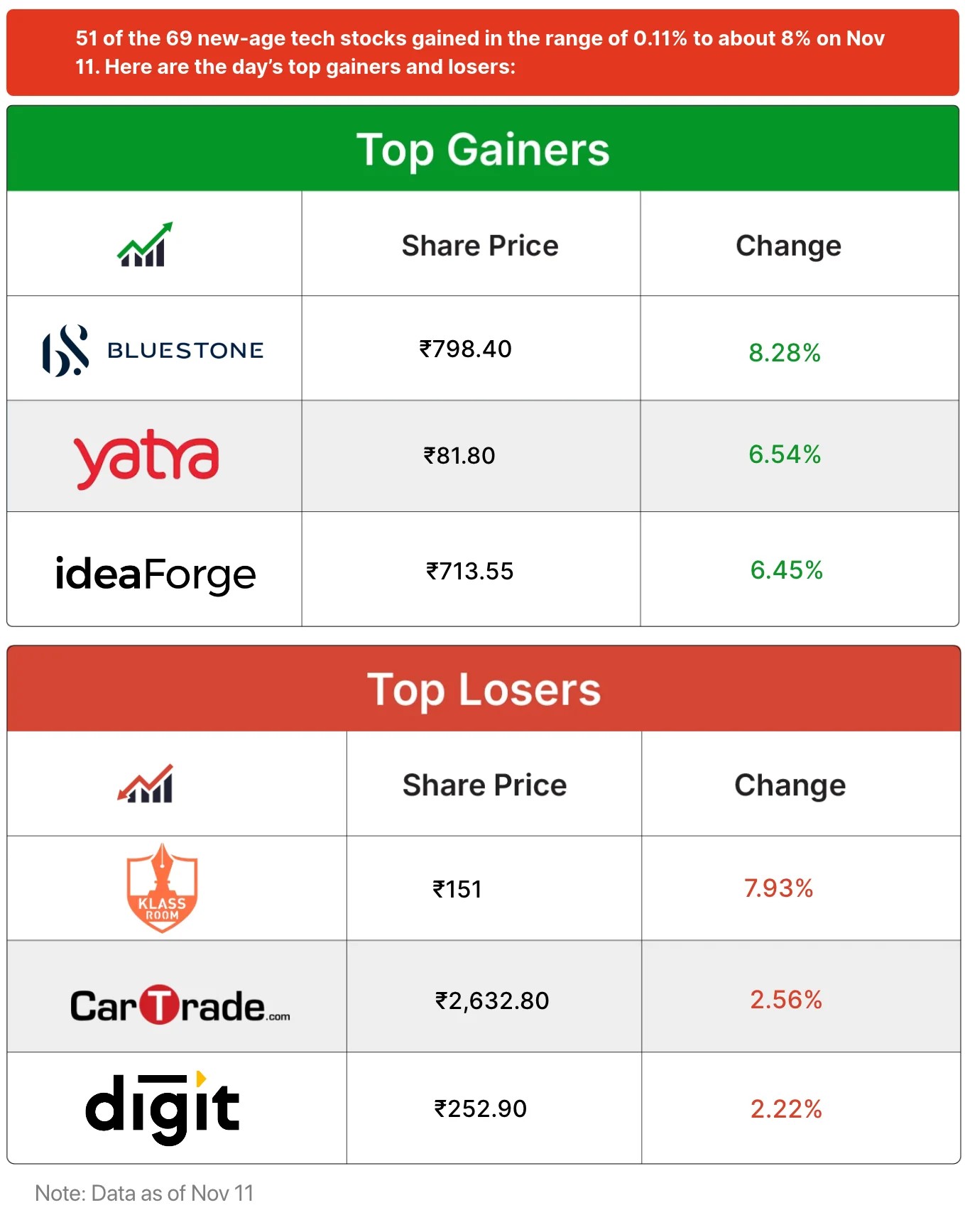
Inc42 Startup Spotlight
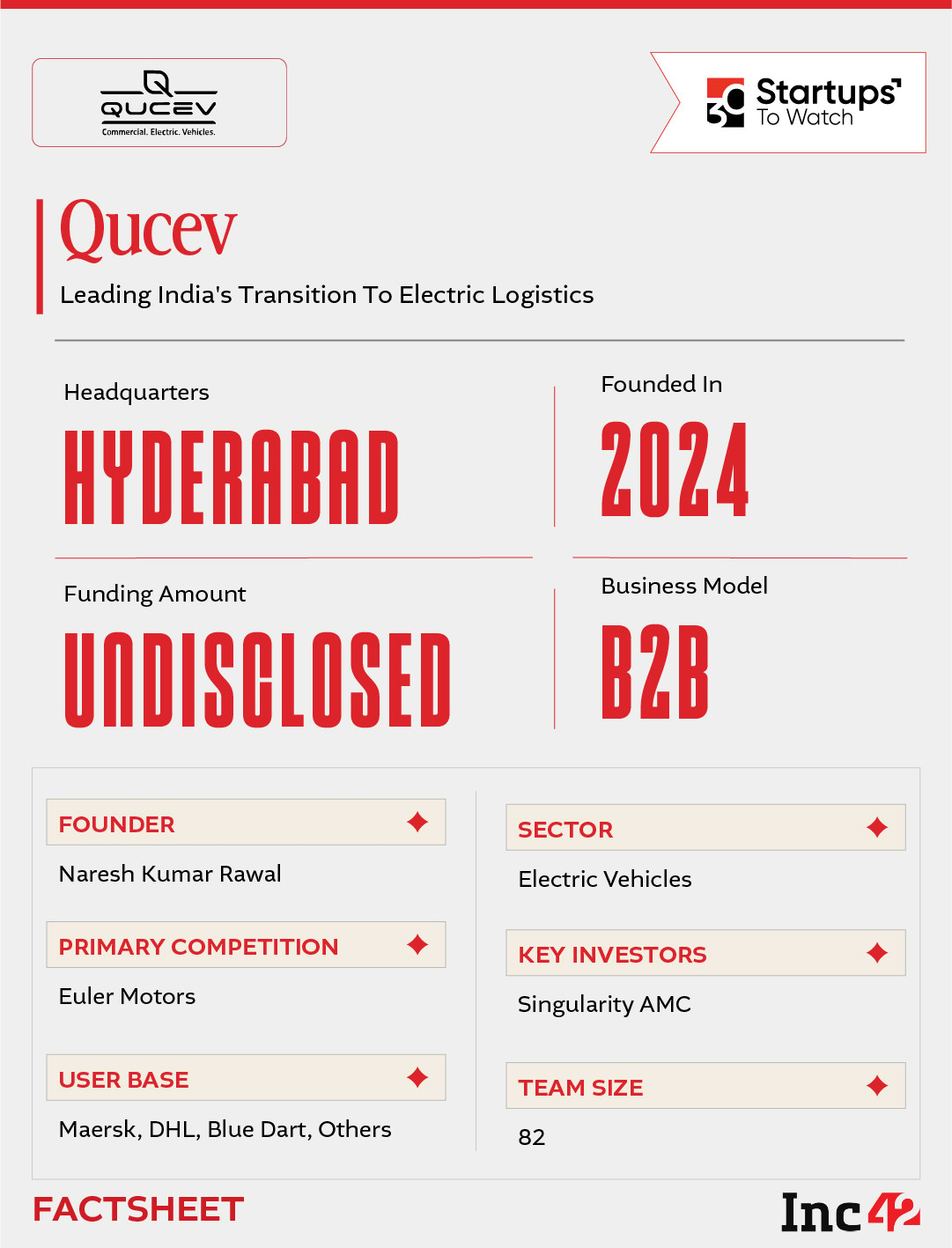
Can Qucev Break Diesel’s Grip On The Indian Freight?
India’s EV revolution is gathering pace, but heavy-duty trucks remain difficult to electrify because of heavy payloads, long duty cycles and patchy charging infrastructure. Qucev is trying to fix this gap with its indigenously designed and manufactured electric commercial vehicles.
Electrifying India’s Logistics: Founded in 2022, Qucev sells delivery and refrigerated vans, heavy-duty trucks, electric tractors, and electric concrete mixers. The startup caters to sectors including logistics, manufacturing, construction and cold-chain operations. Besides, it also offers charging support, financing partnerships, fleet tracking and after-sales services.
The High-Mileage Ride: The Hyderabad-based startup operates two manufacturing facilities and operates a service network that spans 17 cities. Qucev claims that its vehicles, which have clocked over 1.3 Mn kms so far, cater to more than 20 enterprise customers, including DHL, Blue Dart, Mondelez and Godrej.
The Road Ahead: Backed by Singularity AMC, the startup now plans to scale manufacturing and develop new products. But the road ahead may not be easy. Competing against rivals like Tata Motors and Euler Motors, its next challenge will be proving that its purpose-built electric trucks can deliver dependable economics at scale. So, can Qucev make heavy-duty electrification India’s next EV success story?
Infographic Of The Day
From seed paper to reusable boxes, Indian startups are finding new ways to make packaging less wasteful. Here is all about it…