By: Obnews Editorial Staff
International Trade Minister Maninder Sidhu’s latest visit to India has added momentum to Canada’s effort to deepen trade, investment and innovation ties. Ministerial discussions and participation in a major investment summit reinforced an economic relationship that both governments are seeking to expand through a comprehensive trade agreement.
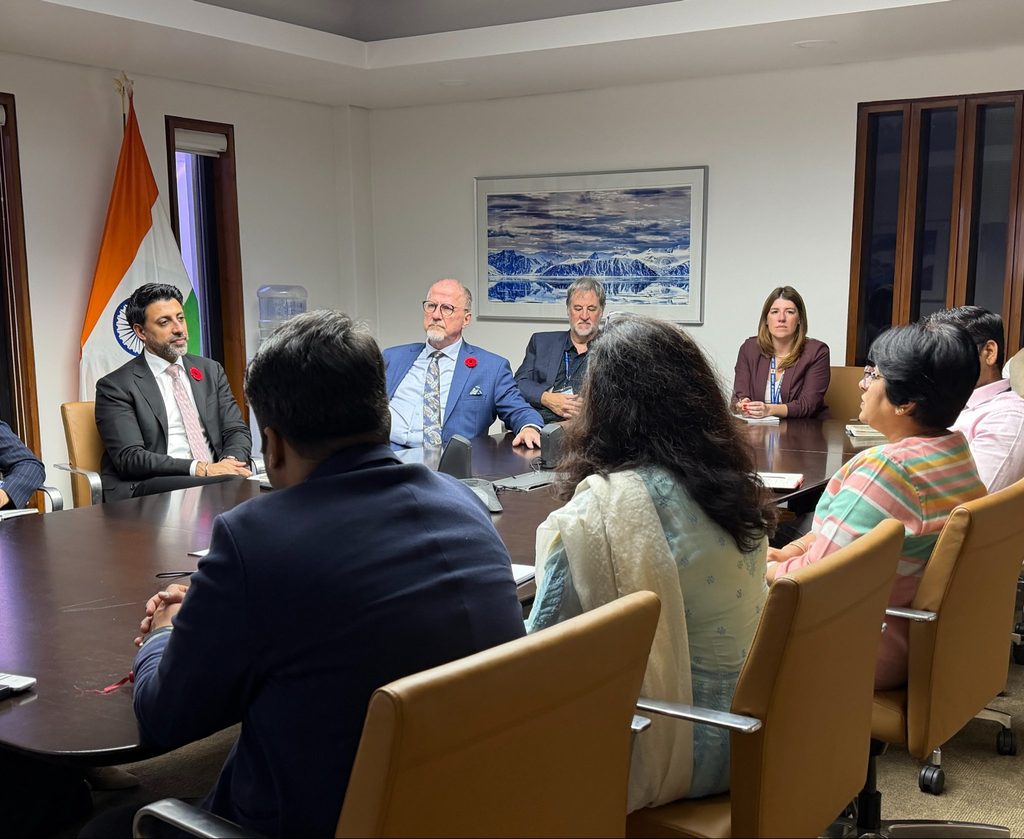
Sidhu met India’s Minister of Commerce and Industry, Piyush Goyal, in New Delhi on November 11, as negotiators began their sixth round of talks on the proposed Canada–India Comprehensive Economic Partnership Agreement, known as CEPA. The round runs until November 20, with both countries aiming to conclude negotiations before the end of 2026. The ministers have met more than a dozen times since May 2025, reflecting sustained attention to the economic relationship.


The discussions focused on carrying forward the results of the recent Team Canada Trade Mission and producing commercial opportunities in aerospace and space, clean technology and the energy transition, information and communications technology, life sciences and agri-food. These sectors connect Canadian expertise with areas of Indian demand, while giving businesses a broader range of potential customers, partners and investment opportunities.
Sidhu also participated in the 31st Confederation of Indian Industry Partnership Summit in Visakhapatnam, Andhra Pradesh, held on November 12 and 13. He was among the special guests at the November 12 ministerial plenary. The gathering brought policymakers, ministers and business leaders from nearly 60 countries together around trade, technology and investment, placing Canada’s engagement with India within a wider discussion about how countries can build dependable economic partnerships.
India used the summit to make its own case for international investment. Goyal highlighted opportunities in manufacturing, research, technology and infrastructure, and urged overseas businesses to consider India for new plants, research centres and design operations. For Canadian firms assessing the market, that pitch points to potential partnerships extending beyond the sale of finished products into engineering, joint development and participation in industrial supply chains.
The latest visit follows a substantial Canadian business delegation to India in October. Nearly 300 delegates travelled to Mumbai and Bengaluru during a mission that Ottawa described as the largest Canadian trade delegation to India in 30 years. Global Affairs Canada reported 34 commercial agreements, partnerships and investment outcomes with a combined estimated value close to C$300 million. Those announcements belong to the October mission and provide the commercial foundation for the latest ministerial follow-up.


The projects illustrate the range of that relationship. MDS Aero Support and Tata Projects are establishing a partnership involving aero-engine testing infrastructure in India, while eLeapPower and Napino are establishing a joint venture to manufacture integrated power electronics for the electric vehicle sector. The Port of Montreal and Adani Ports and SEZ also renewed a five-year memorandum of understanding covering logistics, supply-chain innovation and trade through the Mundra–Montreal shipping corridor.
Education and investment in Canada form another part of the picture. Humber Polytechnic and India’s ITM Group of Institutions signed a letter of intent to explore cooperation in mechatronics and advanced manufacturing education. Indian technology company Happiest Minds also formalized an investment in New Brunswick that the Canadian government said would create more than 50 IT services jobs. The announcements include commitments and plans at different stages, making implementation an important part of the next phase.
A comprehensive trade agreement could give these business connections a more predictable framework. Canada’s published negotiating objectives seek lower tariff and non-tariff barriers, clearer customs procedures, improved access for services and rules supporting digital trade and investment. For a Canadian exporter, the practical value would depend on the final provisions: whether they reduce costs, make requirements easier to understand and improve the ability to compete for business in India.
Ottawa’s objectives also identify protections it intends to maintain while pursuing greater market access. Canada says it will defend supply management in dairy, poultry and eggs, preserve governments’ ability to regulate in the public interest, and seek provisions covering labour rights and environmental protection. These are negotiating positions, rather than agreed treaty provisions, but they set out how Canada aims to balance commercial expansion with domestic priorities.
The broader ambition is to increase two-way trade with India to C$70 billion annually by 2030, alongside Canada’s goal of doubling exports to markets beyond the United States over the next decade. India therefore occupies an important place in Ottawa’s diversification strategy. The economic logic is to develop additional sources of demand and investment so Canadian businesses have more options for growth across international markets.
The renewed engagement builds on the meetings between Prime Minister Mark Carney and Prime Minister Narendra Modi in 2025 and Carney’s visit to India earlier in 2026. It also rests on longstanding personal connections: the 2021 census counted more than 1.8 million Canadians of Indian origin. For families and entrepreneurs with ties to both countries, a more stable commercial relationship could support business planning, research cooperation and partnerships that draw on experience in both markets.
The next milestone is the negotiating process itself. Canada’s official CEPA page continues to list the agreement as being under negotiation, and the year-end objective is a target rather than confirmation of a completed deal. Sidhu’s latest visit strengthens the momentum behind that effort. Its lasting significance will depend on whether continuing talks and existing business commitments produce durable market access, investment and employment opportunities for people in both countries