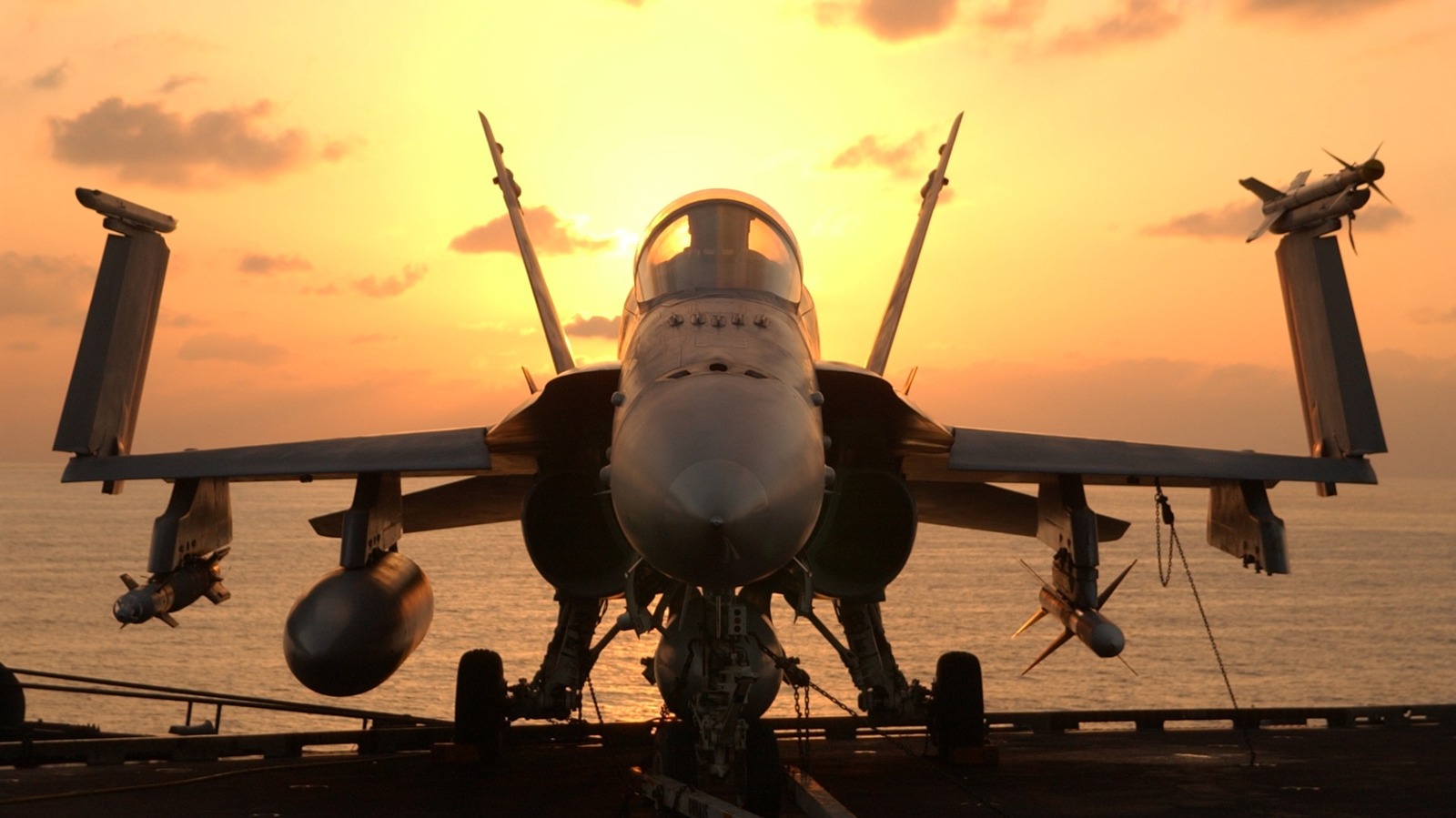
Aircraft carriers are at the core of United States Navy (USN) combat power, but despite their immense size, a carrier isn’t a combat vessel, at least not in the traditional sense. While they’re jam-packed with weapons like the Phalanx Close-In Weapon System (CIWS), an aircraft carrier’s weapons are generally used for defensive purposes. In a Carrier Strike Group, the flattop sits at the center of a large array of combat vessels capable of firing all manner of ship-to-air missiles, cruise missiles, anti-ship missiles, and more.
They’re not only there to protect the carrier, but also to function as combat ships. For the carrier itself, when it comes to projecting power, that’s where its air wing comes into play. A carrier air wing is the primary combat element of an aircraft carrier, and depending on what types of planes are onboard, the effective combat range of a modern carrier like the USS Gerald R. Ford (CVN-78) is measured in the hundreds of miles, if not more. Throughout the 20th and 21st centuries, the USN has employed some excellent fighter jets, and many of them have extensive ranges.
Because the air wing encompasses a carrier’s force projection against an enemy, the range of naval fighters is an important design factor. Moreover, the weapons they carry extend each individual naval fighter’s combat range even further, thanks to long-range air-to-air missiles (AAMs) like the AIM-174B Gunslinger, cruise missiles, and similar ordnance. These five naval fighters are all operational, and they have the longest ranges, arranged from shortest to longest.
Mikoyan MiG-29K
During the Cold War, the Soviet Union developed several aircraft designed to counter whatever the West was fielding at the time. When the U.S. began flying the F-15 Eagle and the F-16 Fighting Falcon, the Soviets developed the Mikoyan MiG-29. The twin-engine air superiority fighter was used by the Soviet Air Forces beginning in 1982. In the years since its introduction, several countries have flown and continue to operate the MiG-29. While the base version of the Soviet fighter wasn’t designed for carrier operations, the MiG-29K was, and it arrived in 2009 for the Indian Navy.
That makes sense, seeing as the Russian Federation lacks a functioning aircraft carrier and the nation often exports its arms to other countries. The MiG-29K and MiG-29KUB are one- and two-seat naval fighters designed primarily for air-defense missions, air superiority, and precision striking targets far from a carrier. It manages this via its twin Klimov RD-33MK turbofan engines, each of which produces 7% more thrust than the baseline RD-33 engines used in other MiG-29 variants.
That power helps project the MiG-29K to a maximum range of 932 miles with external drop tanks. With its weapons, it can reach even farther. The MiG-29K can carry a variety of weapons loadouts, including several air-to-air (AAM) and air-to-surface (ASM) missiles. The domestically produced Astra Mk. 1 AAM has a range of up to 217 miles, extending the MiG-29’s effective range to 1,149 miles. For ground targets, India has the Rampage long-range supersonic ASM, which has a maximum range of 190 miles.
Dassault Rafale M
The Dassault Rafale is a French multirole fighter that first flew in 1986. In the years since its introduction, several models have arisen, including the Dassault Rafale M, which is a carrier variant. Like other carrier versions of existing aircraft, the Rafale M features a reinforced airframe, a tailhook, and other tools needed to land and take off safely from a carrier. It’s also the only foreign-made fighter that’s authorized to land and take off from U.S. aircraft carriers, going back to the first such instance in 2007.
The innovative 4th-generation fighter jet Rafale is a powerful aircraft that extends a carrier’s range far from the shore. The twin-engine fighter is powered by two Safran M88 turbofan engines capable of providing a combined 33,000 pounds of thrust with afterburners engaged. It has a normal range of 1,150 miles, but the Rafale M carries a variety of munitions that extend its combat power much further, thanks to a series of AAMs and ASMs with proven track records.
The Rafale M features 13 hardpoints and is capable of carrying a total payload capacity of up to 20,900 lbs. For ASM operations, France’s Air-Sol Moyenne Portée Amélioré Rénové (ASMPA-R) boasts a maximum range of 373 miles. That extends the Rafale M’s range to 1,523 miles. For AAMs, France doesn’t use American missiles like the AIM-120 AMRAAM, and instead uses a variety, with the Meteor providing the greatest distance of 60+ miles, though its true, classified range is likely much greater.
Lockheed Martin F-35C Lightning II
The F-35 Lightning II is the U.S. military’s second 5th-generation fighter, and there are multiple variants. The USN operates the F-35C, which features foldable wingtips to reduce storage space, a reinforced structure and tailhook, and other elements that make it ideal for carrier-based operations. The USN began operating the F-35C at initial operational capability in February 2019, and it has been slowly replacing legacy aircraft. The F-35C is powered by a bespoke Pratt & Whitney F135-PW-100engine, and it is an incredibly powerful piece of machinery.
The F-35C is not a twin-engine aircraft like most naval fighters, but its single engine manages to produce 40,000 lbs. of thrust on its own. This enables speeds up to Mach 1.6 (1,200 mph), and the F-35C has a maximum range of 1,380 miles on internal fuel. The F-35C is designed to carry its weapons in an internal bay to maximize its stealth capabilities, though it can accommodate a variety of devices and ordnance on its external hardpoints.
This allows for an incredibly wide variety of bombs, AAMs, ASMs, fuel tanks, cruise missiles, and more, including the Meteor normally carried by the Dassault Rafale M. One impressive weapon that the F-35C can carry is the SCALP-Naval Storm Shadow, an air-launched cruise missile that has a range of up to 342 miles. That extends the F-35C’s lethality to a distance of 1,722 miles for targeting things on the ground. For air-to-air engagements, the F-35C can fire off the Malice, extending its lethality against airborne targets to 1,610 miles.
McDonnell Douglas F/A-18 A-D Hornet
The USN began flying the F/A-18 Hornet in 1985, and in the years since its introduction, there have been numerous variants. As of this writing, the F/A-18 Super Hornet makes up the backbone of USN aircraft carrier air wings, and the F/A-18 Block III Super Hornet is the USN’s next-level fighter. While the original F/A-18 Hornet was an excellent 4th-generation fighter, the F/A-18E/F Super Hornet is one of the world’s most capable 4.5th-generation fighters, as it’s been upgraded and modernized into a premier platform for USN force projection.
The F/A-18E/F uses two General Electric F414-GE-400 afterburning turbofan engines, which provide a combined 44,000 lbs. of thrust. This not only gives the aircraft a maximum speed of Mach 1.8+, but it also gives the F/A-18E/F excellent range. The USN’s premier fighter has a maximum range of 1,467 miles, but that’s just where things begin because the F/A-18E/F can carry a wide variety of ordnance, including long-range ASMs and AAMs.
For air-to-air engagements, the F/A-18E/F carries the AIM-424 Malice, which is a long-range AAM capable of reaching targets up to 288 miles away. This effectively extends the F/A-18E/F’s combat range against other aircraft to 1,540 miles. For targeting things on the ground, the F/A-18E/F can carry and launch the AGM-158C Long Range Anti-Ship Missile (LRASM), which has a range of 230 miles, giving USN aircraft carriers an effective combat radius in excess of 1,500 miles. That said, while the F/A-18E/F has the greatest range for the USN, it’s not close to the aircraft with the furthest range.
Shenyang J-15T
The People’s Republic of China began operating the Shenyang J-15 in 2013 as its highly capable twin-engine carrier-based multirole fighter. Since its introduction, China has fielded several updated variants, upgrading the 4th-generation fighter. The U.S. government sees the J-15 as an interim carrier multirole fighter that China will eventually replace with a 5th- or 6th-generation successor. Until that happens, China has been stocking its aircraft carriers with J-15s.
In November 2026, the carrier Fujian was seen sporting a large number of J-15s on its deck, indicating that the aircraft is fully operational. Based on the fighter’s design and believed capabilities, it appears to be a potential counter to the F/A-18E/F Super Hornet, and like that aircraft, it’s both fast and capable of reaching far beyond a carrier’s flight deck. The J-15B is the most up-to-date single-seat variant, and like its predecessor, it utilizes two Shenyang WS-10 afterburning turbofan engines.
It’s believed that each engine has a maximum thrust capability of 31,000 lbs., which, if true, is extensive at a combined 62,000 pounds of thrust. Regarding its range, the J-15 boasts the furthest maximum range of any operational naval fighter at 2,175 miles with external fuel tanks. Additionally, the J-15 can achieve speeds of up to Mach 2.4, so it’s fast and far-reaching. In terms of Chinese arms, the PL-15 AAM has a range of 186+ miles. For air-to-ground engagements, the J-15 can fire the YJ-15 anti-ship and land-attack cruise missile, boasting a maximum range of 621 miles. That gives the J-15 a maximum strike range of 2,796 miles.