|
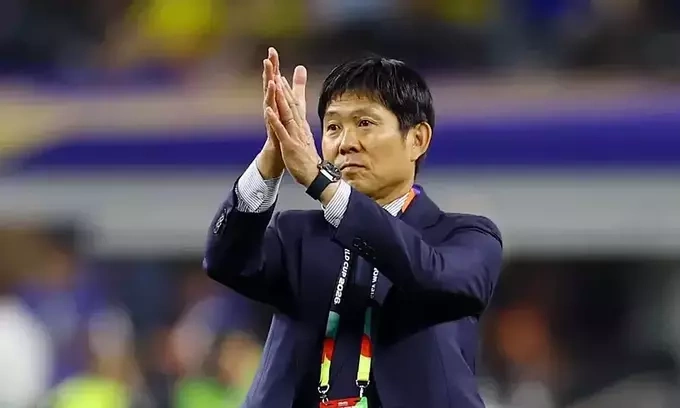
Coach Hajime Moriyasu applauds after Japan’s draw with Sweden in the final Group F match of the World Cup in Arlington, Texas, U.S., on June 25, 2026. Photo by Reuters |
In stoppage time during a friendly at the Singapore National Stadium on Sunday, Tatsuhiro Sakamoto chipped the goalkeeper to seal a thrilling 3-2 win for Japan against Brazil. Exactly a year after their first-ever victory over the five-time world champions, Moriyasu’s side repeated the feat with the same score.
This victory holds deep significance for Moriyasu, as it is one of his final matches with the national team. His eight-year tenure concludes following their match on Tuesday against Paraguay. He was initially set to lead the team at the 2027 Asian Cup, but the tournament was postponed for a year and this accelerated his departure.
The win against Brazil reflects Moriyasu’s remarkable journey. Once capable only of occasional upsets, the Blue Samurai have evolved into a formidable opponent for any big team.
According to Nikkan SportsMoriyasu’s Japan recorded eight wins, two draws and two losses in 12 encounters with former World Cup-winning nations. This tally includes two victories each over Germany, Brazil and Uruguay, and one each against Spain and England. Before Moriyasu, Japan have suffered seven consecutive defeats against the former world champions.
This giant-killing reputation was cemented at the 2022 World Cup in Qatar. Japan staged stunning 2-1 comeback victories against both Germany and Spain to survive a brutal group stage. They eventually fell to Croatia on penalties in the Round of 16 after drawing 1-1, narrowly missing their first-ever quarter-final appearance.
An even more solid proof of Japan’s improvement came nearly a year later, when they crushed Germany 4-1 at the opponent’s home ground in a friendly.
Moriyasu instilled great confidence in his squad. Ahead of their historic 3-2 comeback victory over Brazil in October 2025, he told his players they would challenge the South American giants as equals, according to AFP. That message is a part of his legacy, as he was teaching Japanese players to enter the match without viewing themselves as inferior to strong teams.
 |
|
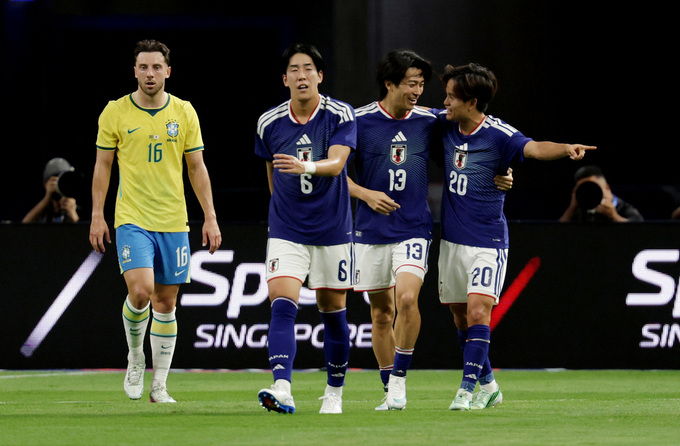
Keito Nakamura (number 13) and his teammates celebrate a goal when Japan beat Brazil 3-2 in a friendly match in Singapore on Nov. 14, 2026. Photo by Reuters |
World Cup ambitions
For the 58-year-old manager, beating big teams was never the ultimate destination. He has many times talked about winning the World Cup, an ambition echoed by captain Wataru Endo after the team qualified for the 2026 tournament early, Reuters reported.
Moriyasu wanted squad depth, emphasizing that even substitutes must possess the elite quality to decide matches, in order to seize World Cup glory. However, the 2026 World Cup revealed both the squad’s maturity and its limitations following the absence of a few key players. Arriving with title ambitions, Japan beat the group stage but suffered a heartbreaking 1-2 comeback defeat to Brazil in the Round of 16.
While the 3-2 friendly victory in Singapore four months later is a response to Brazil, it could not erase the sting of that World Cup exit. After the match, Moriyasu emphasized the continuation between starters and substitutes, claiming that Japan have improved each time they play Brazil, thanks to combining personal responsibility and teamwork.
Legacy of a domestic coach
Moriyasu’s journey holds a special meaning for Japanese football because he’s a former player, a product of the country’s youth system. Prior to his appointment, Japan had placed faith in foreign coaches like Philippe Troussier, Zico, Alberto Zaccheroni, and Javier Aguirre. Their best results were also reaching the Round of 16 at the World Cup.
But what Moriyasu did proved that a Japanese coach could maintain long-term stability across two World Cup cycles. Under his leadership, Japan climbed from outside the top 50 to 17th in the FIFA rankings by July 2026.
 |
|
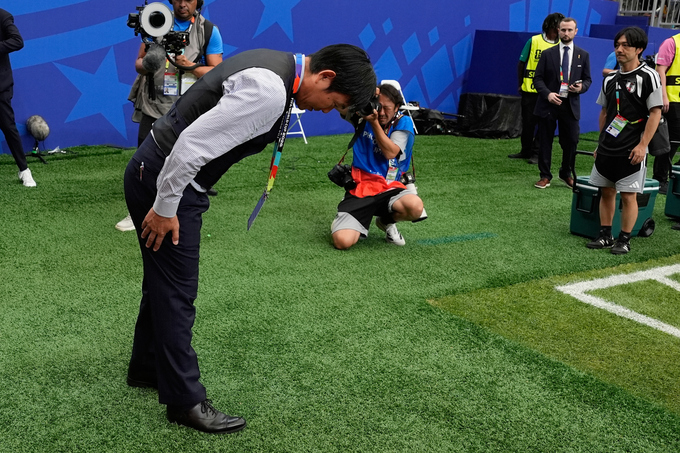
Coach Hajime Moriyasu bows his head in apology after Japan’s 1-2 defeat to Brazil in the Round of 16 of the World Cup in Houston, June 29, 2026. Photo by AP |
In Asia, Japan continued to assert dominance, delivering commanding 2026 World Cup qualifying wins over China (7-0) and Bahrain (5-0). They also captured the East Asian Championship in 2022 and 2025. However, continental heartbreak remained, with a 2019 Asian Cup final loss to Qatar and a 2023 quarter-final exit against Iran.
These unfulfilled dreams now present a challenge for his successor, Go Oiwa. What Moriyasu leaves behind is a solid foundation: Japan can now look at the world’s strongest teams with greater confidence, which was shaped by victories and defeats.
Winning the World Cup is still a distant dream for the Blue Samurai. However, after eight years in charge, Moriyasu has given Japan a genuine reason to believe that lifting the trophy is no longer an impossible goal.