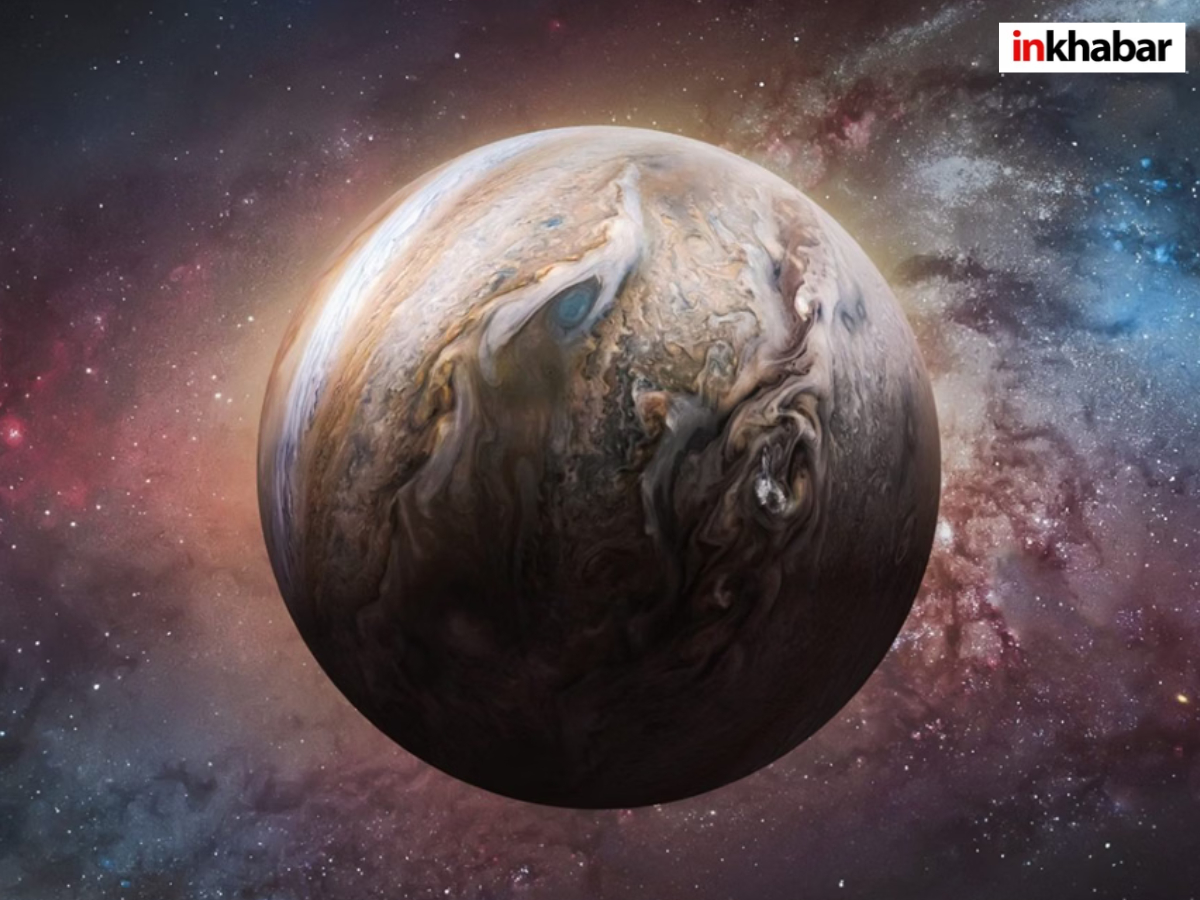
Mystery Planet: Information has been received about a mysterious planet which can redefine our solar system. Scientists say that beyond Neptune there may be a hidden planet larger than Earth. This mysterious world may have been hidden beyond Neptune for billions of years, while humans have been using ever more advanced technology to explore the universe.
Its gravitational force may be the cause of the strangely inclined and elongated orbits of those distant icy bodies, which have long puzzled scientists. Dr. Patrick Sophia Likavka of Kindai University in Japan said that imagine that after mapping our solar system for decades, it was discovered that another planet was hidden from us for so long.
Could the hypothetical planet 'Planet X2' be hidden beyond Neptune?
If this planet exists, it could change the way we understand the history of our solar system and also explain why the orbits of its most distant objects are so unusual. An artistic visualization of the hypothetical planet 'Planet X2', which may lie beyond Neptune. If this planet exists, it could change the way we understand the history of our solar system. This possible planet named 'Planet
There is a huge region beyond Neptune, which is filled with frozen remains left when the solar system was formed. These are called 'trans-Neptunian objects'. Most of these objects orbit the Sun on largely predictable paths within the Kuiper Belt. Over the past two decades, astronomers have discovered several distant objects with unusually long and inclined orbits that cannot be easily explained.
The planet may be unknown
The most mysterious of these is 'Sedna' – an icy body, whose long journey takes it far beyond the limits of the known planets. Some scientists believe that behind these strange activities there could be an unknown planet, which is exerting its gravitational influence from deep space. To test this idea, researchers ran computer simulations taking into account the entire 4.5 billion year history of the solar system.
Planets of the Solar System: Basic Information
Mercury
Distance from Sun: 58 million km
Orbital period: 87 days
Surface Area: 74.8 million km²
Radius: 2,440km
Mass: 3.285 × 10^23 kg (0.055 M⊕)
Day duration: 176 days
moon: nobody
Venus
Distance from Sun: 108.2 million km
Rotation period: 225 days
Day duration: 116 days and 18 hours
moon: nobody
Surface Area: 460.2 million km²
Radius: 6,051km
Mass: 4.867 × 10^24 kg (0.815 M⊕)
Earth
Distance from Sun: 148.13 million km
Rotation period: 365 days
Surface Area: 510 million km²
Radius: 6,371km
Mass: 5.972 × 10^24 kg (1 M⊕)
Day duration: 24 hour
moon: The Moon
Mars
Distance from Sun: 228 million km
Rotation period: 687 days
Surface Area: 55.91 million mi²
Radius: 2,106 miles
Mass: 6.39 × 10^23 kg (90.107 M⊕)
Day duration: 24 hours, 39 minutes and 35 seconds
moon: phobos, deimos
Jupiter
Distance from Sun: 782.34 million km
Rotation period: 12 years
Surface Area: 61.42 billion km²
Radius: 69,911 km km
Mass: 1.89813×10^27 kg (317.9 M⊕)
Day duration: 9 hours and 56 minutes
moon: 95 officially recognized moon
saturn
Distance from Sun: 1.434 billion km
Rotation period: 29 years
Surface Area: 42.7 billion km²
Radius: 58,232 km
Mass: 5.683 × 10^26 kg (95.16 M⊕)
Day duration: 10 hours and 42 minutes
moon:82 officially recognized; Also numerous small moons (moonlets)
Arun (Uranus)
Distance from Sun: 2.913 billion km
Rotation period: 84 years
Surface Area: 8.1 billion km²
Radius: 25,362 km
Mass: 8.681 × 10^25 kg (14.54 M⊕)
Day duration: 17 hours and 14 minutes
moon: 28 known moons
Varun (Neptune)
Distance from Sun: 4.4702 billion km
Rotation period: 164.8 years
Surface Area: 7.6 billion km²
Radius: 25,362 km
Mass: 1.024 × 10^26 kg (17.15 M⊕)
Day duration: 16 hours and 6 minutes
moon: 28 known moons
Through these models, it was examined how a hidden planet with different masses and orbits could affect distant icy bodies over time. Their simulations revealed a planet that has not yet been discovered. This could explain many of the strange orbital patterns currently being observed by astronomers. Simulations suggest that a hypothetical distant planet, named 'Planet X2', could help explain the unusual, long and inclined orbits of icy objects beyond Neptune. These orbits are shown by red and magenta colored paths.
The mass of 'Planet X2' could be up to twice that of Earth
The team's findings suggest that the mass of 'Planet Even when closest to the Sun, this planet will be at least 200 times further away from the Sun than Earth, which makes it extremely difficult to see.
Gravitational force can bend orbits
Researchers found that its gravitational force can slowly pull distant objects away from Neptune's influence and greatly tilt their orbits. These findings offer an alternative to the 'Planet Nine' theory. According to the 'Planet Nine' theory, a very large and massive planet may be hidden in the outer part of the solar system. Although the new model does not perfectly match every known observation, scientists say it successfully explains many unusual features observed in distant icy objects.
The post Mystery Planet: What is that mysterious planet? Beyond Neptune, a hidden world may be bigger than Earth, scientists' claim is surprising appeared first on Tezzbuzz.