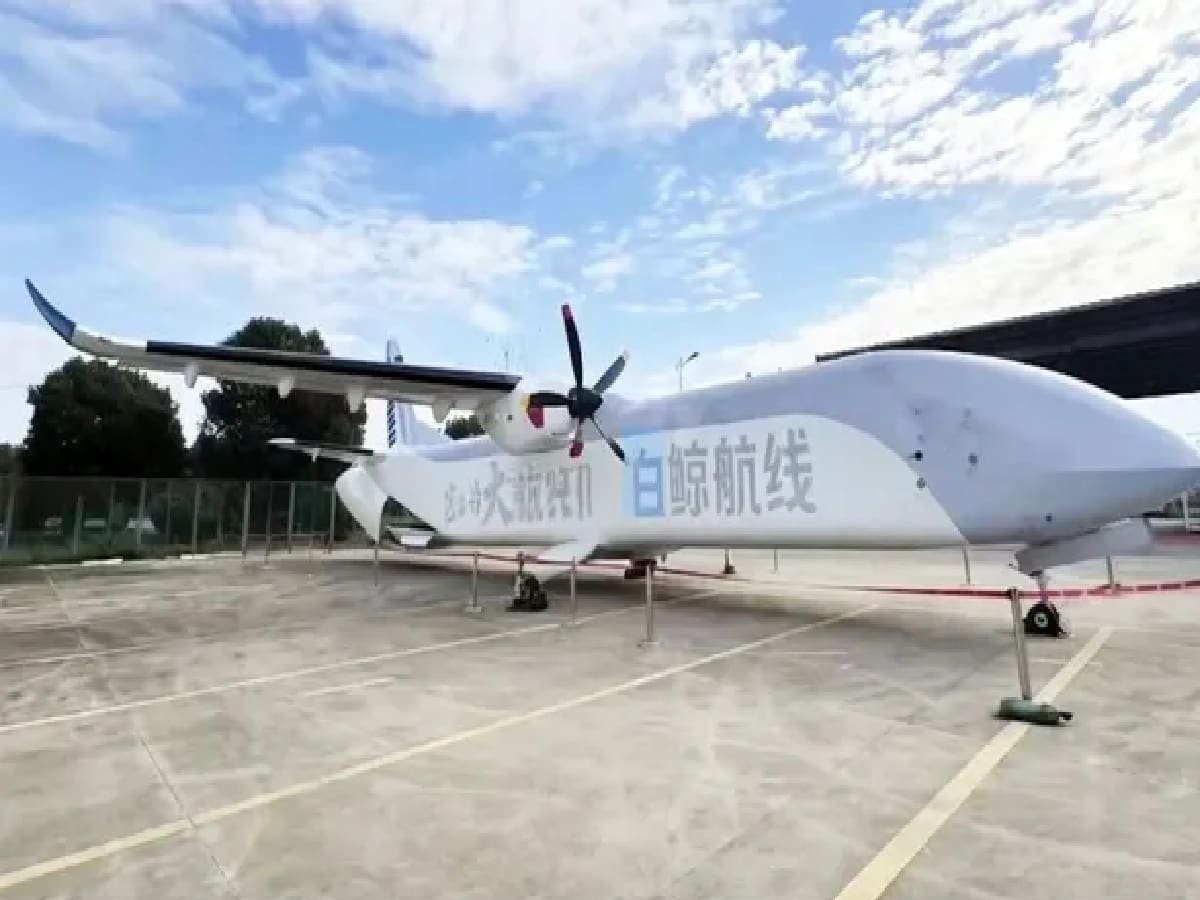
At present, a very important, technical and topic of discussion among defense analysts and readers across Uttar Pradesh and the country, from Beijing and Zhuhai to Lucknow and Kanpur, is coming to light related to modern military strategies, expansion of unmanned aircraft and supply chains of the battlefield. China has unveiled the W8000 drone with 8-tonne cargo capacity, which is being seen as a game-changer in the way military supplies and logistics are delivered in modern warfare. Today, unmanned aircraft are not limited to just reconnaissance missions, surveillance, target identification or attacks, but armies are moving towards incorporating them in logistics and supply; China's heavy cargo drone initiative is a continuation of this shift as many countries look to integrate unmanned aircraft into their military supply systems. According to the report of defense affairs magazine 'The War Zone', the 'W8000' drone developed by Chinese aviation company 'Air White Whale' was presented in Zhuhai, which has been selected for the 'China International Aviation and Aerospace Exhibition' starting from December 7. The twin-turboprop aircraft is designed to carry up to 8 metric tons of cargo and has a rear loading ramp to allow easy loading of large equipment and palletized cargo, although it is still in the development phase and the proposed payload capacity is yet to be demonstrated in flight. Let us know in detail why China is developing large cargo drones, what is America's preparation in this race and why cargo drones are considered important in modern warfare. Why is China developing large cargo drones? Focus on South China Sea and remote areas China's development of heavy-lift cargo drones is aimed at the challenge of delivering supplies to troops deployed in remote and disputed areas and maintaining military operations. These unmanned aircraft can provide the People's Liberation Army (PLA) with an additional means of delivering ammunition, medical supplies, food, spare parts and equipment to military bases, which can prove especially useful for remote areas and island outposts located in the South China Sea. The importance of these aircraft increases in the event of a conflict when there is a possibility of attack on military bases, ports and common supply routes. These pilotless cargo aircraft can be helpful in continuing supply missions without putting pilots at risk by flying over disputed areas. China is not alone in this race: America's SkyCourier UX and the challenge of 'competitive logistics' China is not alone in this race for unmanned aircraft in military logistics, but America (US) is also developing autonomous cargo aircraft. US military planners are considering using them to deliver supplies to remote islands and troops stationed at forward bases in the Indo-Pacific region, as traditional transport aircraft, ships and logistics infrastructure are vulnerable to attack in times of conflict and are essential to keeping supply lines running. In this direction, American aviation company 'Textron Aviation' and autonomous technology expert 'Merlin' are jointly developing 'Cessna SkyCourier UX', which is an unpiloted version of the twin-engined 'SkyCourier' and is designed to carry about 6,000 pounds of cargo. The importance of cargo drones in modern warfare is also being highlighted because military operations depend on timely delivery of ammunition, food, fuel, medical supplies and equipment, and these supply lines can become targets in a conflict. Cargo drones offer the option of maintaining logistics without endangering pilots and can deliver supplies to restricted or risky areas in conjunction with manned aircraft and ships; The US Army has identified this situation as 'contested logistics', and US Air Force Lt. Gen. Kenyon K. Bell, Deputy Chief of Staff (Logistics, Engineering and Force Protection), has said that the era of uncontested logistics is over.