Recently. the Karnataka state government carried out inspections at multiple petrol pumps in the state and found that the ethanol level in the fuel dispensed was higher (as high as 30 percent) than the permissible 20 % limit. While the central government and oil companies denied these claims, the state government has continued its investigations. When the government’s legal metrology department inspected the Indian Oil Corporation’s ethanol blending terminals at Devanagonthi, Mysuru, they found evidence of excess ethanol being dispensed.
Minister Rizwan Arshad took to X to announce that the Karnataka State’s Legal Metrology Department has begun inspecting Oil Marketing Company (OMC) terminals, where the blending is carried out. On 25th November, officials from the Karnataka government’s legal metrology team inspected the IOCL terminal at Devanagonthi. During inspection, the team inspected the mass flow meters installed at the terminal using a verified master proving measure.
During inspection, the team found the following discrepancies. The mass flow meter on Bay 9 of the terminal dispensing ethanol was found delivering an excess of 14 litres for every 3,000 litres that was measured. This is nearly half a percent excess ethanol.
The mass flow meter fitted on Bay 9, dispensing motor gasoline or petrol, as we call it, was dispensing 4 to 6 litres short for every 3,000 litres. This is about 0.02 percent. Another mass flow meter on Bay 4 was found delivering an excess of 3 litres for every 3,000 litres of ethanol measured. This is about 0.01 percent.
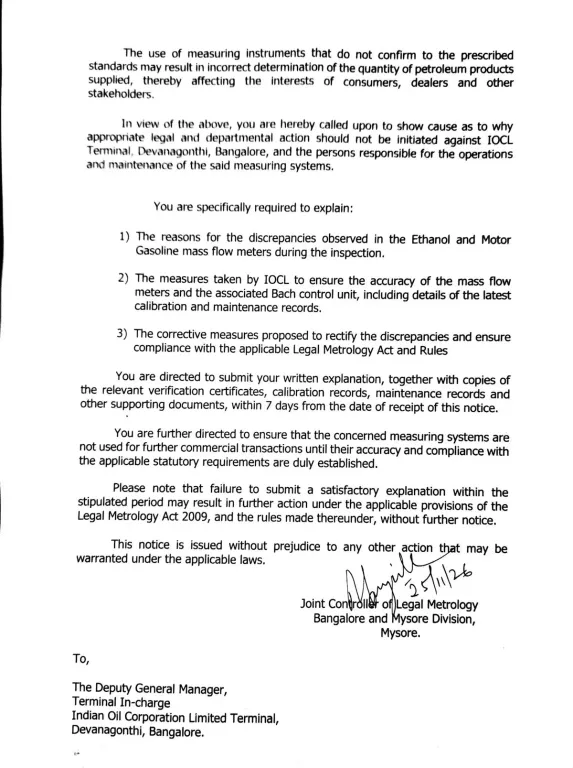
Minister Rizwan Arshad has shared the findings from the inspection on his social media profile, and he has also mentioned that, under the Legal Metrology Act, 2009, the Karnataka government has officially sent a show-cause notice to IOCL.
The notice mentions that the use of measuring instruments that do not conform to the prescribed standards may result in incorrect determination of the quantity of petroleum products supplied, thereby affecting the interests of consumers, dealers and other stakeholders.
The notice asked the IOCL terminal to show cause as to why the government should not take appropriate legal and departmental action against the IOCL terminal, Devanagonthi, Bangalore, and the persons responsible for the operations and maintenance of the said measuring systems.
The IOCL terminal is required to explain the reasons for the discrepancies observed in the ethanol and petrol mass flow meters during the inspection. The government has also asked IOCL to share the measures taken by them to ensure the accuracy of the mass flow meters and the associated batch control units, including the calibration and maintenance records.
The government also asked for the corrective measures that IOCL proposes to take to rectify the discrepancies and ensure compliance. The explanation has to be submitted within 7 days of receiving the notice.
The notice is mainly for the faulty meters that IOCL has at the blending facility. If the meters dispensing ethanol and petrol are not calibrated correctly, the chances of the ethanol blending going wrong are pretty high.
The recent investigation found that, for every 3,000 litres of ethanol, the plant was dispensing 14 litres extra, which is 0.5 percent extra. The terminal was also dispensing 6 litres less petrol for blending (0.2 percent). Taken together, both errors add up to about 0,7 %.
As per the BIS, the permissible range for ethanol content should be strictly maintained between 19% and 21% by volume. In other words, the E20 petrol you fill can have 19 % (on the lower side) to 21 % (on the higher side) ethanol, and it’s legal.
The minister’s post clearly mentions that both petrol and ethanol dispensed at the terminal are beyond the permissible limits, and that is the reason why they have issued a show-cause notice.
It is not just Karnataka that has started inspections at petrol pumps. After the Karnataka government released the E30 petrol reports online, the Kerala government also decided to start inspecting petrol pumps across the state and collect samples. They have collected the samples, and the minister had said that they were sent to laboratories for testing. The results are expected to come back in the next 10 days.