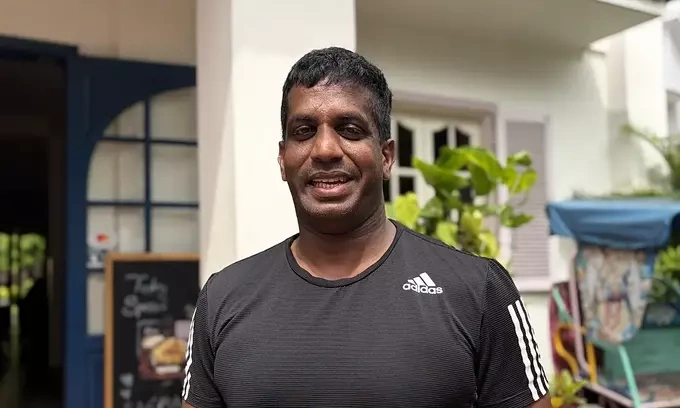
At 1:30 p.m. on a late November afternoon, a taxi stops outside the Thien Phuoc Shelter for Disabled Children in Thoi An Ward, Ho Chi Minh City.
Deepu opens the trunk and carries an insulated box containing 80 hamburgers into the lobby. Hearing the sound of the car, the children playing in the yard rush out to surround him.
After helping the caretakers hand out the food to the kids, he walks into the special care room. In the corner of the room is a little boy lying on a thin mattress, his frail arms trembling as he sees Deepu approach.
The Indian then sits on the floor, slips his arms beneath the boy’s back and neck, and cradles him in his lap.
In the last five years, he has spent at least two hours every single week visiting this shelter.
|
Robin Deepu at the Thien Phuoc Shelter for Disabled Children in Thoi An Ward, HCMC, in September 2026. Photo courtesy of Deepu |
He was born in the state of Kerala in southern India. In 2007, after graduating with a degree in physics, he traveled to HCMC to visit his uncle, who was working at a local hotel.
Impressed by the city’s safety and the friendliness of the Vietnamese people, he decided to return in 2010 and open a restaurant.
In the beginning, he lived in a rental room on Co Giang Street in Cau Ong Lanh Ward.
Seeing a young foreigner living all alone, his landlady and her husband, both in their 70s, treated him like their own grandson. They would make him a glass of Vietnamese iced coffee every morning, and occasionally invite him downstairs for dinner.
While preparing to open his restaurant, Deepu brought hundreds of millions of dong (VND100 million = US$3,868) in cash from his savings back home to rent a place and buy equipment.
Since he did not have a bank account yet, he left the money with his landlady for safekeeping. She agreed immediately, locking the cash in a private cabinet and handing some whenever he needed to pay for expenses.
Once his first restaurant was up and running, one of his Vietnamese employees suffered a severe stroke and had to be admitted at Cho Ray Hospital.
After he made it through the critical stage, he was too weak to work in the kitchen, and so Deepu told him to rest at home but kept paying his entire salary. But the young man would take the bus to the restaurant every morning to wipe tables and arrange utensils. “It is thanks to that kindness and loyalty that I was able to build my career,” Deepu says.
Over a decade, he opened four restaurants in HCMC and Hoi An. In 2021, all four restaurants had to close due the Covid-19 outbreak. During lockdown, a longtime employee passed away due to the disease, and the shock changed Deepu’s perspective on life. “So many Vietnamese people helped me when I started out with nothing, and I needed to personally do something to repay that kindness,” he says.
At the height of the pandemic, he cooked hundreds of meals every day to send to field hospitals and quarantine centers.
When the quarantine ended and his business stabilized, instead of donating money to charity organizations, he started driving personally to shelters to visit disadvantaged people in person.
He makes monthly trips to Cu Chi Commune to visit orphans and others, or stopping by Chuc Tu Shelter in Binh Thanh Ward to donate milk, but the place he has grown most attached to is the Thien Phuoc Shelter for Disabled Children.
 |
|
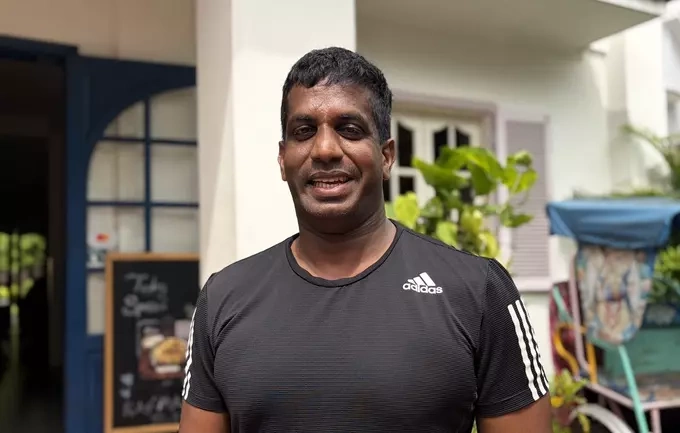
Robin Deepu at his restaurant in An Khanh Ward, HCMC. Photo by Read/Ngoc Ngan |
Through his visits, he realized that while living and educational facilities at the shelter were adequate, the children had few visitors from the outside to talk and play with.
During his first few weeks visiting the common room at Thien Phuoc, many of the children hid in the corners when they saw a stranger with an appearance drastically different from theirs.
He understood this and kept his distance. But for week after week, he would sit quietly in a corner and turn on a few toys that made gentle sounds. By the third week, a few kids walked over to touch his shirt.
Then, the following month, as soon as they spotted him coming through the gate, the children would run out to greet him and neatly line up to receive their snacks.
His frequent interactions meant he knew each child’s habits and health condition. One of them is Binh Minh, a 10-year-old boy abandoned by his parents as an infant. He has severe motor disabilities, is bedridden, cannot speak, and frequently suffers from phlegm buildup in his throat.
Lying in one position for too long often causes his body to tense up, making him cry constantly.
Every time Deepu visits, he lifts Minh onto his shoulder, elevates his head, and gently pats his back to help him breathe easier. Within a few minutes, as the boy’s muscles relax, he stops crying, and falls asleep.
Deepu’s most cherished memory in the past five years is watching Phuoc, 8, learn to walk. When they first met, Phuoc was malnourished, and his leg muscles were so weak he could only crawl on the floor.
During physical therapy sessions, Deepu would sit across from him, holding both of his hands for support. After nearly a year, the little boy was able to pull himself up against the wall and walk steadily on his own. “Little by little, I’ve come to see these kids as my own family,” he says.
Dinh Thi Nhu, the shelter’s deputy director, says approaching and caring for children with autism and severe disabilities requires immense patience. “Robin’s consistent presence gives the children someone to talk to and helps relieve their emotional stress. Because he sits for hours playing with and holding them, the kids who once barely spoke to anyone have become noticeably more outgoing,” she says.
In September, noticing that many of the children responded well to sounds, he bought them plastic horns and small drums so that they could practice tapping out rhythms.
Once a month, he rents a bus and teams up with the caretakers to take about 30 children who are healthy enough on field trips to the Saigon Zoo or a water park. “Seeing the children grow up and wait for me every week brings me joy,” Deepu says.