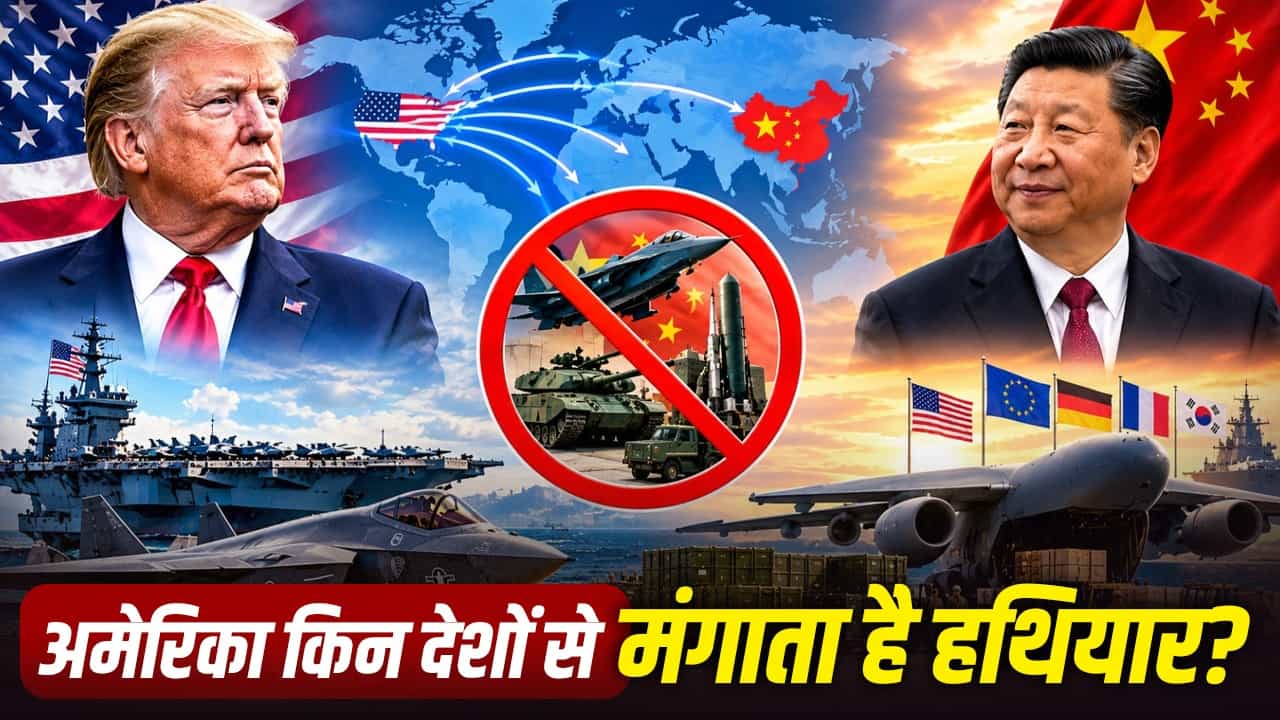
Whenever there is a meeting of the top leadership of Washington and Beijing on the stage of global politics, the eyes of the world are focused on the stance of the superpowers. Trade tariffs, technological dominance, the Taiwan crisis and global supply chains have always been at the center of talks between Donald Trump and Chinese President Xi Jinping. Despite being America's largest trading partner in smartphones, electronics, clothing, toys and industrial components, there is one area where the Pentagon's doors are completely sealed to Beijing—the arms trade. Washington and Beijing: Billions of dollars in trade, but zero deals in defense If you look at the statistics, bilateral trade between the United States and China is worth hundreds of billions of dollars every year. From American supermarkets to Silicon Valley, there is an abundance of Chinese products. On the contrary, when it comes to strategic security and military hardware, America does not buy even a single bullet or drone from China for its army. This is no coincidence but a deliberate decision related to tough foreign policy, strategic distrust and national security that has been going on for many decades. The Tiananmen Square massacre of 1989 and the permanent US arms embargo The foundation for a complete US embargo on the import and export of Chinese arms was laid after the Tiananmen Square incident of June 1989. The then US President George H.W. The Bush administration imposed tough defense sanctions on China in protest against Beijing's gross human rights abuses. Under this law, America imposed a complete ban on the sale of any type of defense material, sensitive military equipment and dual-use technologies to China. Also, the import of any military equipment from China for the US defense forces was declared completely illegal. This ban is still in full force today. Backdoor Espionage and the Deadly Risks of Modern Cyber Warfare Twenty-first century warfare has become a game not just of cannon and gunpowder, but of software, microchips, AI algorithms and satellite connectivity. Pentagon strategists clearly fear that if any defense equipment or military chips are purchased from China, they may contain 'hardware trojans' or secret backdoor programs. In the event of war, Beijing could cripple US missile defenses, radar networks or the avionics of fighter jets with just one cyber command. This is why the US Congress has thrown out Chinese telecom and tech companies from the US defense supply chain under the National Defense Authorization Act (NDAA). The Bitter Reality of Reverse Engineering and Intellectual Property Theft The backbone of the US defense industry is its unmatched technology and innovation. Many of China's People's Liberation Army (PLA) modern fighter aircraft, such as the J-20 stealth fighter and J-31, bear striking resemblance to the designs of the American F-22 and F-35. The US has long alleged that China has stolen patent technologies through industrial espionage and cyber hacking. In such an environment, if America gets involved in any defense trade or joint construction with China, then there is a 100 percent risk of its remaining cutting-edge military technologies being leaked. Geopolitical conflict in the Indo-Pacific region and the question of Taiwan: China is not only America's trade rival but also its biggest strategic and military competitor as mentioned in the US National Defense Strategy. China's construction of artificial military outposts in the South China Sea, border dispute with India in eastern Ladakh, and Beijing's threats to forcibly occupy Taiwan directly challenge US interests. America sells advanced weapons worth billions of dollars to Taiwan so that it can stop Chinese attack. Purchasing arms from an opponent who could enter into direct conflict at any time would amount to strategic suicide. NATO interoperability and self-reliance of the US military-industrial complex The US defense system operates fully in accordance with the standards of the North Atlantic Treaty Organization (NATO). Western weapons' programming, communication frequencies and combat systems are simply not compatible with Chinese standards. The second important thing is that America itself is the world's largest arms exporter. Giant American companies like Lockheed Martin, Boeing, Northrop Grumman, Raytheon and General Dynamics make the world's deadliest weapons. The Pentagon gives priority to its domestic companies and NATO allies under the 'Buy American' policy, so that its military self-reliance remains unbroken. High-level diplomatic talks between Donald Trump and Xi Jinping may bring immediate relief on tariffs, currency swaps or agricultural trade, but military relations between the two countries may never normalize. Arms trading rests on the supreme foundation of trust, and as long as Beijing and Washington are locked in a battle for global dominance, 'Made in China' will have no place in the Pentagon's arsenal.