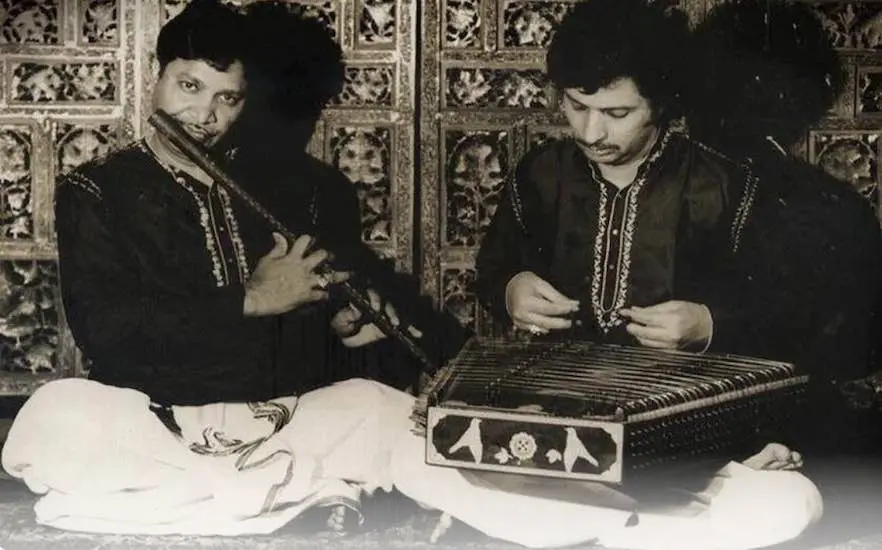
There are partnerships in Indian music that seem inevitable in retrospect. Pt Shivkumar Sharma and Pt Hariprasad Chaurasia, however, did not begin as the iconic film-composing duo the country would eventually cherish as Shiv-Hari. Their musical bond developed gradually through Bombay’s studio circuit, classical concerts, and, crucially, the encouragement of legendary composer Sachin Dev Burman.
One of the earliest and most revealing chapters of that story is hidden in a song from S D Burman’s 1971 film Tere Mere Sapne: “Jeevan Ki Bagiya Mehkegi”. Remembered for its extraordinary simplicity, the song features vocals by Lata Mangeshkar and Kishore Kumar, lyrics by Neeraj, and music by Burman. It is built around a delicate dialogue between Sharma’s santoor and Chaurasia’s flute. Directed by Vijay Anand and produced by Dev Anand, who also starred in it alongside Mumtaz, the track remains a classic. Contemporary and retrospective accounts both identify Sharma and Chaurasia as the two principal instrumentalists behind the recording.
A Friendship Before “Shiv-Hari”
The relationship between the two virtuosos predated this recording by more than a decade. In a 2022 reflection published by India Today, Chaurasia recalled first meeting Sharma in 1958 at Delhi’s Talkatora Stadium during an inter-collegiate event. They formed a deep friendship a few months later after reconnecting in Bombay. Chaurasia noted that Sharma’s background in both santoor and tabla gave him an exceptionally nuanced understanding of melody and rhythm.
Both artists subsequently became pivotal session musicians in Bombay’s film industry, working under several prominent composers before their partnership took formal shape. Chaurasia later recalled that he and Sharma collaborated with music directors such as C Ramchandra, Shankar-Jaikishan, and Kalyanji-Anandji.
Their first major recorded collaboration was not a Hindi film score at all. In 1967, Sharma, Chaurasia, and guitarist Brij Bhushan Kabra recorded Call of the Valley. The album became a landmark in Indian classical and semi-classical music, eventually becoming HMV’s bestselling classical record in India. The unusual combination of santoor, flute, and guitar forged the distinctive musical chemistry that would later define Shiv-Hari. Yet, it was an earlier studio encounter in film music that truly foreshadowed what was to come.
The S D Burman Connection
S D Burman had already worked with both musicians individually. Chaurasia had transitioned into Bombay cinema following his tenure at All India Radio, while Sharma had already established himself as a sought-after instrumentalist. Manohari Singh, a key arranger and musician in the Burman circle, recalled that S. D. Burman gave him his early break in cinema.
By the time ‘Tere Mere Sapne’ was being recorded, Burman’s studio arrangements drew heavily from a shared pool of musicians who also worked with his son, R D Burman. Basu Chakraborty and Manohari Singh were central to that ecosystem.
The iconic recording of “Jeevan Ki Bagiya Mehkegi” came about due to a twist of timing. A detailed account of the session reveals that the regular arrangement team was away in the then Madras with R D Burman, whose recording schedule for ‘Lakhon Mein Ek’ had been extended. Among them was Manohari Singh. Unwilling to delay his own schedule, S D Burman turned to two musicians he trusted completely: Shivkumar Sharma and Hariprasad Chaurasia.
This marked a pivotal moment. The song was never meant to be a grand orchestral showcase stripped down by necessity; Burman intentionally chose to proceed with a minimalistic ensemble.
“You Decide and Play”
What followed was extraordinary. Burman instructed the two musicians that their instruments would fill the space where a heavy orchestra would typically feature. He chose not to use an arranger, entrusting Sharma and Chaurasia to shape the arrangement through their live performance, backed only by a tabla player to provide the rhythmic foundation.
That spontaneous trust is evident in the final track. “Jeevan Ki Bagiya Mehkegi” does not feel like an orchestral piece lacking instruments; it feels deliberately intimate. The flute and santoor weave seamlessly around the vocals, answering and accentuating them rather than competing. The tabla offers a subtle, restrained pulse, eliminating the need for the conventional wall of violins, guitars, and heavy percussion standard for the era.
Lyricist Neeraj’s accounts confirm this artistic direction. He recalled that Burman asked him to write a song capturing the quiet joy of an expectant mother. To match this mood, Burman encouraged Sharma and Chaurasia to improvise freely over a gentle tabla beat. What resulted was not a compromised compromise, but a deliberate masterclass in simplicity.
Neeraj’s lyrics radiate domestic warmth and anticipation. As the expected child becomes the anchor of an imagined future, Burman’s arrangement reflects that emotional innocence. The santoor adds a shimmering, crystalline texture, while Chaurasia’s flute breathes movement and lyricism into the composition. Rather than merely accompanying Lata and Kishore, their instruments craft the atmospheric canvas that allows the lyrics to shine, a rare instance where studio constraints yielded pure artistic magic.
From Session Musicians to Shiv-Hari
It would be premature, however, to mark “Jeevan Ki Bagiya Mehkegi” as the official birth of Shiv-Hari as a composer duo; that milestone arrived a decade later.
The pair continued to perform together in concerts and record classical works, with ‘Call of the Valley’ standing as their defining early milestone. Their transition into mainstream film composition occurred when director Yash Chopra invited them to score ‘Silsila ‘(1981). Sharma later admitted that taking the assignment felt like a huge risk, as classical maestros entering commercial cinema was virtually unheard of at the time. The risk, however, yielded incredible rewards.
As Shiv-Hari, they went on to score eight feature films: Silsila (1981), Faasle (1985), Vijay (1988), Chandni (1989), Lamhe (1991), Parampara (1993), Sahibaan (1993), and Darr (1993). Seven of these were directed by Yash Chopra.
Their music became synonymous with melodious elegance during an era dominated by heavy orchestration. Classics like “Dekha Ek Khwab”, “Neela Aasman So Gaya”, “Rang Barse”, the soundtrack of ‘Chandni’, and the haunting score of ‘Darr’ demonstrated how naturally their classical roots could adapt to commercial storytelling, even within the framework of a psychological thriller.
Despite their cinematic success, neither musician allowed film work to eclipse their classical heritage. Chaurasia later noted that film scoring was a practical endeavour that always ran parallel to their classical commitments, while Sharma emphasised that they accepted film offers only when their concert schedules permitted.
A Partnership Beyond Cinema
Long after their film-composing years concluded, Shiv-Hari continued to captivate audiences worldwide through classical duets and jugalbandis. Their enduring bond and musical camaraderie spanned decades, continuing until Pt. Shivkumar Sharma passed away in Mumbai on May 10, 2022, at the age of 84.
On “Jeevan Ki Bagiya Mehkegi”, they didn’t need the formal title of Shiv-Hari. All it took was a santoor, a flute, a tabla, two iconic voices, and S D Burman’s unwavering trust in their artistry. When Yash Chopra formally paired their names on ‘Silsila’ years later, cinema simply gave a title to a friendship that had been making music all along.
Ultimately, the legacy of Shiv-Hari traces back to something far intimate than the grand film scores that made them household names. It reaches back to years of camaraderie, session work in Bombay recording studios, a stroke of studio serendipity, and two maestros who shared an instinctual musical trust.