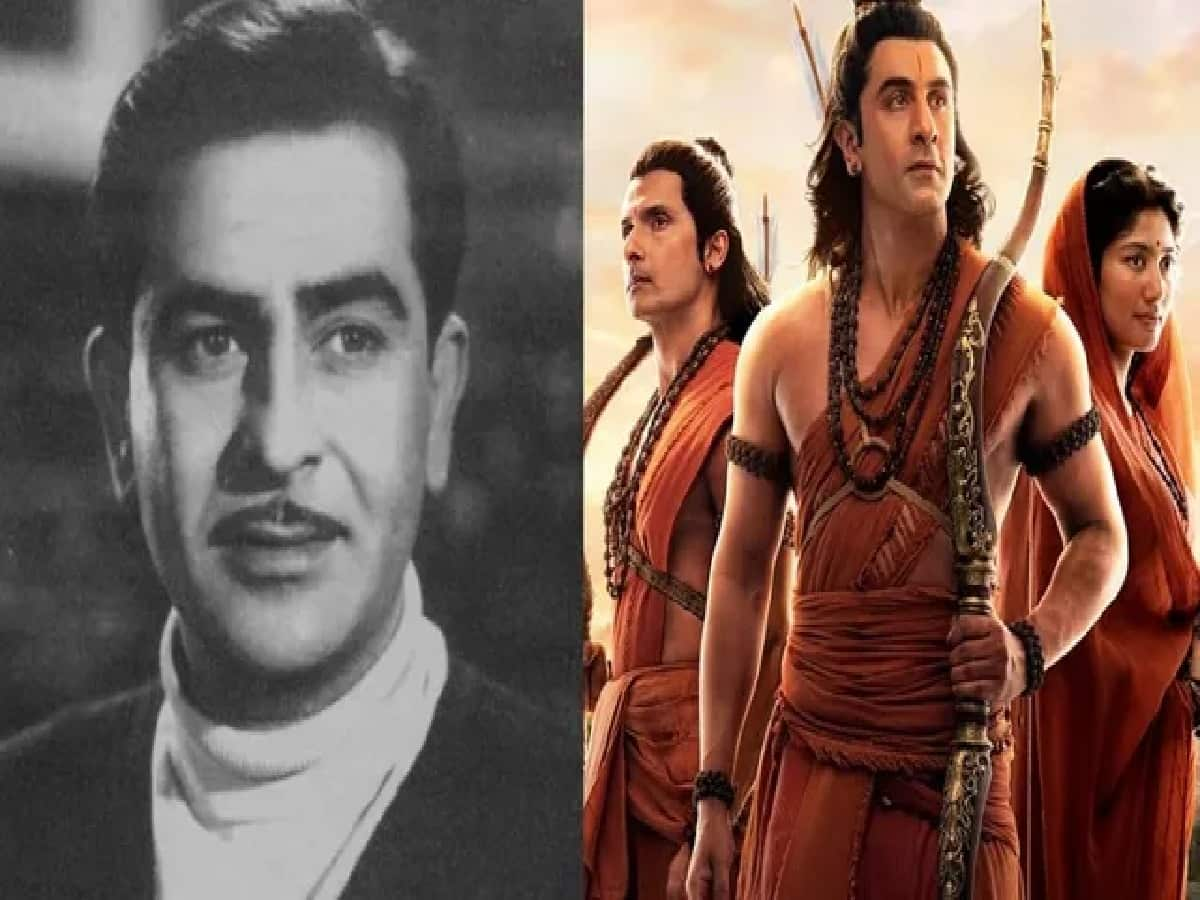
Whenever we look back at the pages of the golden history of Indian culture, eternal faith, folk life and the world of entertainment i.e. Hindi cinema, it becomes clear that no matter how modern or western the canvas of our films has become, the story of Maryada Purushottam Prabhu Shri Ram has always been embedded in their soul and essence. On the occasion of the holy and bright festival of Diwali, when the impact of Ram Katha and its cultural depth is discussed across the country, it becomes interesting to think why our films ultimately end with the victory of truth, justice and family values. A historic and priceless lesson given by veteran Hindi cinema actor and filmmaker Raj Kapoor to veteran screenwriter Sachin Bhowmik is even today the biggest proof that the foundation of Indian cinema is actually based on the ideals of Ramkatha. Let us know in detail how those teachings of Raj Kapoor and the threads of Ramkatha are woven in everything from 'Sholay' to modern family films.
That historical lesson of Raj Kapoor: “The story of Hindi films is only one…”
When a list of the most successful, excellent and popular screenwriters in the history of Hindi cinema is made, Sachin Bhowmik's name is taken with utmost respect in it. Sachin Bhowmik was the same visionary writer who, in his long and illustrious career, wrote many blockbusters and classic films like 'Anuradha', 'Aai Milan Ki Bela', 'Jaanwar', 'Aaya Sawan Jhoom Ke', 'Golmaal', 'Karz' and 'Saudagar'. His pen-power can be gauged from the fact that he has the highest number of superhit films in his name in Hindi cinema.
In his initial phase, when Sachin Bhowmik reached Mumbai with his dream from Kolkata and R. Of. When he met the great filmmaker Raj Kapoor in the studio, he expressed his desire that he wanted to write a great story for a legend like Raj Kapoor. Raj Kapoor listened to him with great patience and intimacy. When the conversation ended, Raj Kapoor smilingly told Sachin Bhowmik a profound statement which became a part of cinematic history. Raj Kapoor said that you write stories for Hindi films, it is very good, keep writing, but always keep in mind that in Hindi cinema there is basically only one story –“Ram was there, Sita was there and Ravana came.”
This small statement of Raj Kapoor had a very deep meaning. Sachin Bhowmik himself had admitted in an interview that he had kept that lesson of Raj Kapoor in his heart, mind and subconscious mind forever. After this, whenever he composed a story, the structure of Ramkatha was definitely active in some corner of his subconscious.
How are the dignity and culture of Ramkatha visible in the characters of Hindi films?
When any writer writes a story, the traditions of Tulsidas' Ramcharitmanas and folk tales that have been going on for centuries are working in his subconscious mind. The great poet Tulsidas established the character of Maryada Purushottam Prabhu Shri Ram at the highest peak of sacrifice, love, devotion and ideals. All the characters of Shri Ramcharitmanas – be it Lakshman, Sita, Bharat or Mata Kaushalya – all of them are seen tied in an unbreakable and sacred thread of dignity.
You will clearly see this dignity and discipline in the conduct of the hero or heroine of every more or less successful Hindi film. No matter how rebellious the main hero of the film may be against the system, no matter how much anger he has against the injustice of the society, and no matter how angry a young man he is who takes the law into his own hands, ultimately his rebellion remains within the bounds of social welfare and a certain decorum. The end of the story always moves towards a happy ending, which symbolizes that despite all the struggles and obstacles, goodness ultimately wins.
The villain's concerns and family values
The character of Ravana, the biggest antagonist and villain of Ramkatha, also had some such contradictions and characteristics which can be easily seen in the villains of today's films. Ravana took great care of the comforts, safety and order of his entire Lanka and all the citizens living there. Similarly, when a don or the main villain is shown in Hindi films, he also takes full care of the safety and maintenance of his gang members, their families and children.
Apart from this, if you look at the relationship equations of Hindi films, you will find deep traces of Ramkatha. Even if the hero or heroine in a film goes astray, gets entangled in modern complexities like extra-marital affairs, by the time the story reaches the climax, they begin to repent deeply for their actions. The lost husband eventually returns to his wife and family. No matter how much the son may rebel against the harsh discipline of his father, but in times of crisis or at the end, he bows down at his father's feet and this union of father and son establishes the same eternal dignity of the Indian family, which Ramayana teaches us.
How Ram context is reflected in films like 'Kabhi Khushi Kabhie Gham' (K3G) and 'Sholay'
Karan Johar's blockbuster film adorned with modern setting, grand sets and stars. 'Happiness some time, sorrow another time' If you analyze the story deeply, you will clearly see the shadow of the 14 years of exile of Prince Shri Ram of Ayodhya in it. In the epic, to protect the honor and dignity of the words of King Dashrath, Lord Shri Ram voluntarily goes on 14 years of exile on the orders of his father, due to which the entire city of Ayodhya and his mother Kaushalya are immersed in deep mourning.
Adapting the same plot into modern context, in the film, when father Yashvardhan Raichand gets angry with his elder son Rahul or talks about family decorum, then on a gesture of his father, Rahul takes the difficult decision of leaving his family, his ancestral property and the country and going abroad with his wife. Behind him, his mother Nandini continues to suffer and the family falls apart. Even though Karan Johar chose the characters and environment which were completely modern and urban, the basic ideological theme was completely inspired by the spirit of Ramkatha.
Similarly, the biggest cult film in the history of Indian cinema 'cinder' The basic spirit of the script has also been borrowed from a very famous incident of Ramkatha. Maharishi Vishwamitra, troubled by the terrible terror and atrocities of the demons, goes to King Dasharatha and takes Shri Ram and Lakshman with him from Ayodhya to protect the ashram. If you look at the story of 'Sholay', the role of Maharishi Vishwamitra is played by a retired police officer (Jailor Saheb), who brings with him two brave warriors – Jai and Veeru – to free Ramgarh from the terror of the demon in the form of dreaded dacoit Gabbar Singh.
In conclusion, it can be said that Ramkatha is not just a part of a religious text, but it has become such an integral and vibrant part of the social life of our Indian society, our values and our collective consciousness that whenever a storyteller picks up his pen, even if unknowingly, his fingers start putting the same eternal and human values of Ramkatha on paper.