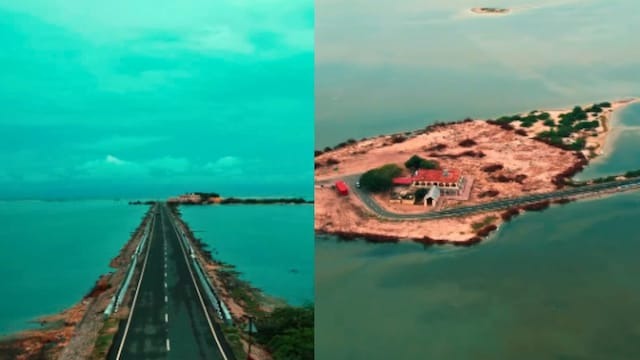
At the southern end of India, such a unique confluence of the beauty of nature and its destructive form is seen that it gives goosebumps to the viewer. Dhanushkodi, situated at the end of Pamban Island in Tamil Nadu, has today become such a mysterious and deserted place, which the world knows as 'Ghost Town'. As much as the history of this place standing amidst the huge waves of the sea is exciting and linked to mythological beliefs, its dark past is equally painful when the entire city was submerged in water in a single night. The ruins standing amidst the blue waters of the ocean and white sand all around testify to the fact that human life once existed here. Today, even though no one lives here permanently, every year lakhs of tourists come here to see this mysterious and exciting sight. In this detailed report, we will tell you how a cheerful city turned into ruins and what are the unheard stories related to this place. That fateful night of 1964: When the entire city was destroyed in a single cyclone. Before December 1964, Dhanushkodi was a very busy and major center of trade and travel between India and Sri Lanka. There used to be a railway station, custom office, hospital, church and market here, which was called Mini Lanka or a small city. But that dark night of 22-23 December 1964 became a fate for this area. A terrible cyclone (Rameswaram Cyclone) that arose in the Bay of Bengal created such a havoc of destruction that it is difficult to even imagine. Winds blowing at a speed of about 250 to 280 kilometers per hour and sea waves about 25 feet high (Storm Surge) engulfed the entire city in a moment. That night, an entire passenger train (Boat Mail) coming from Pamban to Dhanushkodi got hit by the strong waves of the sea and got submerged in water, in which hundreds of passengers died tragically. After this natural disaster, the Madras government declared this place completely unsafe to live in and it remained a deserted ghost town forever. The ruins are still standing amidst the waves of the sea, have a deep connection with the Puranas. Today, when tourists move ahead from the Pamban beach of Dhanushkodi, they see British era buildings, remains of churches and broken pillars of the railway station at various places. These ruins, bearing the brunt of the salty sea water and strong winds, still tell the story of that era. The biggest specialty of this place is that its religious and mythological importance is also linked to the Ramayana period. It is believed that Lord Rama started the construction of 'Ram Setu' from here to attack Lanka with the help of his devotees. The place was named 'Dhanushkodi' because it is believed that Lord Rama had marked this place with the koti (end) of his bow. Here the Bay of Bengal and the Indian Ocean meet, which is called 'Arichal Munai', and from here the distance to Sri Lanka remains only a few kilometers. Dhanushkodi has become a big center of adventure and mystery for tourists amidst desolation. Dhanushkodi, which remained deserted and away from the eyes of the world for years, has now become one of the most popular offbeat tourist destinations of India. Since the government and administration have constructed a paved road from Pamban to here, it has become very easy for tourists to travel. Reaching here passing through the bottomless sea on both sides and the narrow road in between is no less than an exciting journey. As the evening approaches, a strange silence prevails in this area, which creates a different thrill among the tourists. This lively document of nature's devastation and human struggle makes the viewers think deeply about how helpless human power is in front of nature. If you also want to closely experience the history, mystery and immense beauty of the sea, then this trip to Dhanushkodi during Rameshwaram trip will prove to be one of the most memorable experiences of your life.