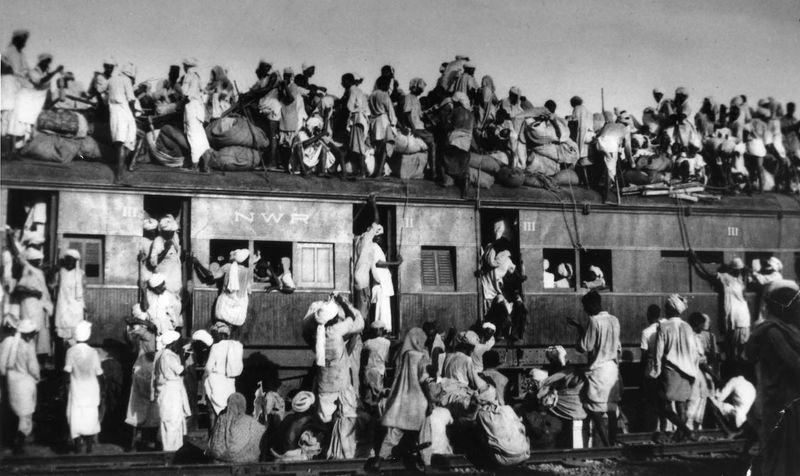
The Partition of India in 1947 is remembered as the moment when British rule ended and two independent dominions, India and Pakistan, were born. But, that is only one side of the story. For millions of Indians, it was the beginning of an unimaginable nightmare for them and generations to come. Families were uprooted from homes where their ancestors had lived for generations. Trains carrying refugees became symbols of death. Villages were burnt, women were abducted and subjected to horrific violence, children were separated from their parents, and property accumulated over generations was abandoned overnight. Millions leading comfortable lives were reduced to refugees. More than 14-15 million people were displaced from their homes to cross the newly created international borders, making Partition one of the largest forced migrations with millions of people killed making it one of the darkest chapters of the human history.
The question that continues to trouble mine as well as next generations is not merely : Why was India partitioned? Equally uncomfortable question is : Could the massacres and displacements be avoided, or at least minimised? Could the movement of millions be organised and protected when the signs of communal hatred were already visible? And, did the British, Nehru and Jinnah possess sufficient foresight to understand and anticipate what was about to happen?
The warning signs of communal hatred and violence had appeared well before 1947. The Mappila rebellion in Malabar in 1921-22, involved serious communal violence. The situation had turned increasingly dangerous during the 1940s with the demand for Pakistan gaining momentum among sections of Muslim political leadership, while the Congress continuing to advocate an independent India. The British were more inclined in favour of Muslim league with congress reduced to a lesser priority as it had lost favour with them during the second world war time. Then came 1946, providing perhaps the clearest warning of what could happen when political disagreement turned into communal confrontation. On 16 August 1946, in Calcutta, the Muslim League called for “Direct Action Day” to press it’s demand for Pakistan. Calcutta witnessed horrific communal violence. Thousands were killed and injured, and retaliatory violence spread to other areas. The violence in Noakhali in eastern Bengal in October 1946 provided another grim warning. Hindu communities were attacked and displaced, and fear became so intense that Mahatma Gandhi had to personally travel through the affected areas in an effort to restore communal confidence. Violence in one region generated fear and retaliation elsewhere. A rumour about an attack on one community could trigger attacks against another community hundreds of kilometres away. Every abandoned village became demonstrated the vulnerability of minorities living in areas where they feared becoming physically insecure. Political leaders had seen mobs taking control of streets and neighbours turning against neighbours. They had also seen that once communal violence began, containing it became extraordinarily difficult. They had realised that mass mobilisation along communal lines could rapidly overwhelm civil administration.
By 1947, Punjab in particular was a power keg. It was a deeply interconnected social and economic region where Hindus, Muslims and Sikhs had lived together for generations. Lands, markets, canals, businesses, religious sites and family relationships crossed what would eventually become an international boundary. Dividing Punjab was therefore not like drawing a line across an empty map. It meant dividing living communities.
The Mountbatten Timetable: In February 1947, Lord Louis Mountbatten arrived as Viceroy with the task of overseeing Britain’s withdrawal from India. Initially, Britain had announced that power would be transferred by June 1948. Mountbatten accelerated the timetable dramatically and on 3 June 1947, announced that power would be transferred to India and Pakistan governments on 15 August 1947, almost a year earlier than the previously announced deadline. British and Indian officials were consequently left with only about nine weeks to work out the division of British ruled India. Nine weeks for an area containing hundreds of millions of people; for provinces as complicated as Punjab and Bengal; and for a division involving land, irrigation systems, railways, armies, police, government offices, currency, assets, records and, above all, millions of human beings. Why? There appears to have been no satisfactory humanitarian explanation for such extraordinary haste.
The Radcliffe Line: Mr Cyril Radcliffe was brought from Britain to chair the boundary commissions. He had never previously worked in India and was expected to draw boundaries separating India and Pakistan through Punjab and Bengal within an extraordinarily short period. He, while sitting inside a building along with his team drew the borders between two, to be born dominions without realising or even looking at ground realities. India became independent on 15 August and Pakistan on 14 August. The Radcliffe Boundary Award was announced only on 17 August. This meant that 14-15 million people did not know, at the moment of independence, on which side of the new international border their homes would ultimately fall. What a shame on part of the people at the helm of affairs!
Another unanswered question: Why did Partition unfold with such extraordinary haste and inadequate preparation when the warning signs of communal catastrophe were already clearly visible? Could independence have been postponed for a few months to allow adequate preparation? If reasonable wisdom prevailed among the decision makers ie Nehru, Jinnah and Mountbatten, they should have anticipated that large numbers of people might choose or be forced to migrate.Hence, there should have been created protected migration corridors, military escorts for refugee trains and convoys, pre positioned food and medical supplies, refugee camps, special arrangements for women, children and the elderly, protection for minority populations awaiting evacuation, joint India Pakistan security mechanisms, protection of railway lines and stations, registration systems for displaced families, mechanisms for recovering abducted women and children, and agreements concerning abandoned homes, land and property. Such arrangements would not have eliminated hatred or violence altogether but could have saved lives.
Who Was Responsible?
* British had ruled India for nearly two centuries and possessed enormous administrative machinery, intelligence networks, police forces, military formations, railways, district administrations and detailed knowledge of the country’s geography and population. Senior British officials were had discussed the possibility of serious trouble and precautions, including a joint India Pakistan force. The danger, therefore, was not invisible. Yet, the transfer proceeded at breathtaking speed.
* Mountbatten was central to the problem. Why was he so much in hurry? Why did he compress the timetable from one year to just nine weeks ? Did he have sufficient knowledge or wisdom to hold the chair of Viceroy? Why did the British appoint him as Viceroy instead of a wise administrator?
* Jawaharlal Nehru was destined to become India’s first Prime Minister. He had enormous political stature but stature carries responsibility. He had witnessed the increasingly poisonous atmosphere of 1946-47 and knew the enormous uncertainty that Partition would create. The question is : Why did not he insist on additional time and stronger safeguards before accepting the final timetable? Political independence was undoubtedly an overwhelming national objective, but it could not be separated from it’s humanitarian consequences. If millions of people were likely to become refugees, their protection should have been treated as an integral part of the independence process.
* Muhammad Ali Jinnah, the future Governor General of the newly coming up Pakistan had to understand that Pakistan would inherit millions of non muslims within it’s boundaries, while millions of Muslims would remain in India. He with experience of communal violence did not learn that partition was not going to be a peaceful cartographic exercise. His wisdom was equally questionable.
* Question History Must Continue to Ask: Partition was not simply the drawing of a line on a map. It was the division of homes, families, communities, economies and human lives. Could the immense human suffering accompanying Partition have been substantially reduced if political leaders had placed humanitarian preparation before the political deadline? And the most important lesson is simple : Political freedom may have a date, but protecting human lives cannot be treated as a deadline. And, those who claim to have brought independence to India must also own the responsibility of Partition, the resulting miseries and deaths of millions.