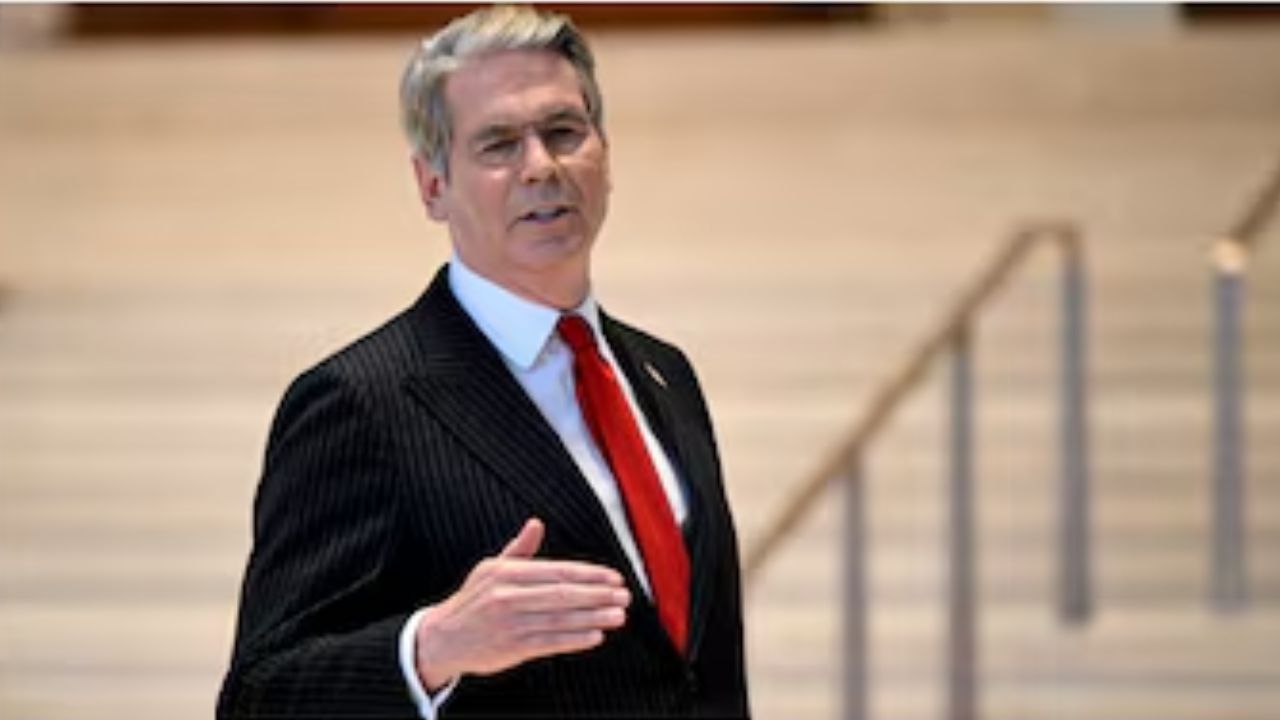
Washington: US Treasury Secretary Scott Bessant has said Iran could be forced into submission within two to four months as the Trump administration steps up an economic blockade targeting Tehran's oil exports, financial networks and international trade.
Speaking to Fox and Friends Weekend on Sunday, Bessant said Washington had moved from its earlier maximum pressure campaign to what he called an absolute isolation strategy, combining military action, maritime interdictions and financial restrictions.
US tightens economic pressure on Tehran
“For a year we had a maximum pressure campaign. Now we have an absolute isolation campaign,” he said.
Bessent claimed Iran had been shut out of international oil markets and was struggling financially. “Iran now has, no oil on the water. They have negative cash flow,” he said.
Also Read: Saudi Airport Crisis Widens As Dammam Airport Targeted; Houthis Warn 'Worse Is Yet To Come'
He said Washington was also targeting Iranian cryptocurrency holdings, shipping operations and access to international banking networks. According to Bessent, Iran had lost control of the Strait of Hormuz, although Iranian forces continued attempting to disrupt commercial shipping through drone attacks.
He claimed oil and petroleum products were still passing through the strategic waterway despite the attacks.
Nuclear Program At Center Of US Demands
Bessent said Iran would need to abandon its nuclear ambitions and end support for militant proxies to regain access to the international system.
“They have to give up their nuclear ambitions,” he said.
He claimed US military operations had severely weakened Iran's naval and air capabilities, as well as its missile and drone production infrastructure. The economic blockade, he argued, was adding to the pressure by restricting Tehran's access to dollars and destabilizing its finances.
Also Read: India Condemns Strait Of Hormuz Attacks After Two Ships Carrying Indian Seafarers Hit
Bessent said Iran's currency had depreciated sharply, falling from around 600,000 to the dollar 18 months ago to 2.8 million at one point. He also claimed Iranian authorities had restricted the publication of exchange rates as the crisis deepened.
'Iron Wall' Blockade Could Last Months
Bessent described the campaign as a sequence of six weeks of military operations, followed by a maritime blockade and broader economic isolation. He said US President Donald Trump referred to the blockade as the Iron Wall.
According to Bessent, the restrictions had disrupted fuel imports, forcing people in Iran to wait in petrol queues for three to four hours.
Asked whether Washington ultimately sought a negotiated settlement or regime change, Bessent acknowledged that the outcome remained uncertain.
“I don’t know how this ends. You never know how this ends,” he said.
Also Read: Russian Strike Reportedly Hits Kharkiv Power Plant Despite Trump's 'Energy Ceasefire' Announcement
He outlined three possible scenarios: a popular uprising, divisions within Iran's Islamic Revolutionary Guard Corps, or a negotiated agreement in which Tehran abandons its nuclear program.
Bessent predicted that the blockade would continue for several months, arguing that mounting economic difficulties could eventually push Iran's leadership to reconsider its position. He also said Trump did not expect further military engagement until at least after the US midterm elections.