
How village life, ‘the core of his films’, helps Adoor Gopalakrishnan resonate with his audience

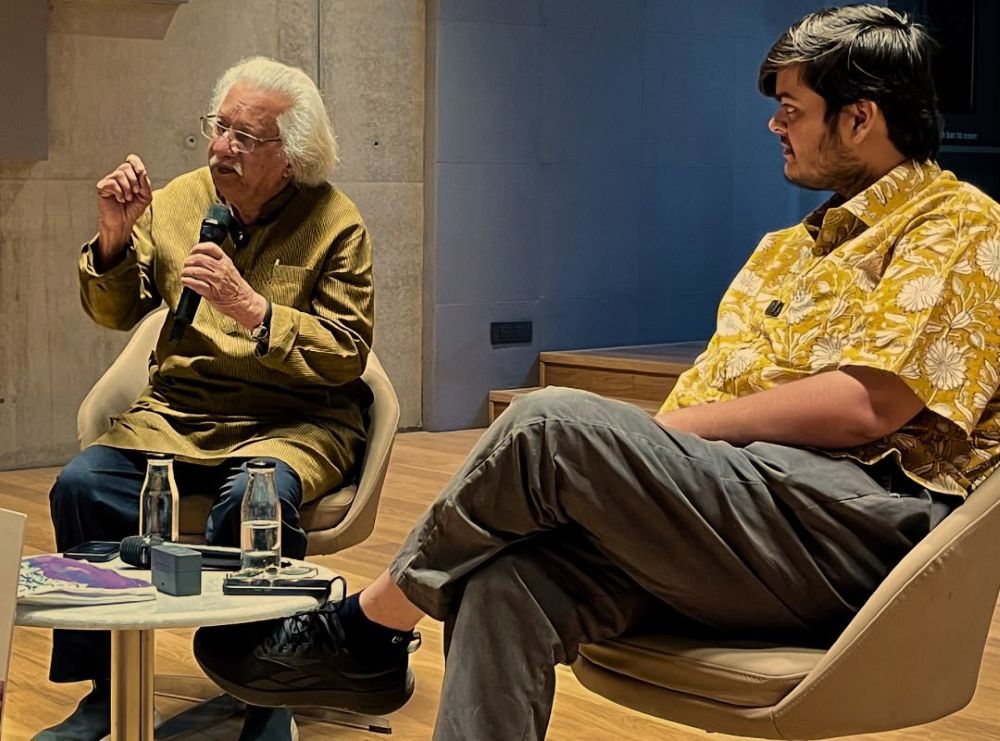
The audience was a motley crew of sorts. From theatre veteran MK Raina to art doyenne Jatin Das, alongside former bureaucrats, aspiring filmmakers, visual artists, and students with Bambi eyes — these were the sixty-strong who had gathered to chat with Adoor Gopalakrishnan, a stalwart of Indian and Malayalam cinema. The event, organised as part of the Karwaan Baithak series, saw Gopalakrishnan speaking on ‘Cinema as a Way of Looking’, a conversation meant to encompass films, art, and all that defines us.
On Sunday, June 21, for almost an hour, the basement auditorium of Arthshila, the multi-arts centre in Okhla, New Delhi, time-travelled to France between 1650 and 1789, the era when the iconic French Salons (social and intellectual gatherings) were de rigeur. Back then, public intellectuals, artists, and civil society routinely met in the informal intimacy and warmth of someone’s home. And ideas became the food for thought, shared maybe over wine!
While the stark, grey interiors of the basement couldn’t compete with velvet pouffes and French flair, the air crackled with the very same anticipation that must have filled the room when Voltaire ranted against religious intolerance in the 1700s. The students at the Baithak sat wide-eyed, delighted to be within touching distance of a filmmaker they had perhaps only ever encountered in textbooks. The millennials found comfort in a rare, grounding familiarity, while Gopalakrishnan’s contemporaries were rewarded by the warmth of catching up with a peer.
Training a school of thought
The conversation soon steered to Gopalakrishnan’s time at the Film and Television Institute of India (FTII), Pune, a stint that rewrote the famed director’s fate and in turn gave India films like Swayamvaram(1972), Kodiyettam (1977) and Naalu Pennungal (2007), among others. He rubbed shoulders with the ilk of Mani Kaul and Kumar Sahani, and also had the privilege of being taught by auteur Ritwik Ghatak. What was it like to be taught by the Great Ghatak? “People who were close to him (Ghatak), Mani Kaul and Kumar Shahani, would say he was a great teacher. But I was simply too shy to go up, introduce myself, and talk to him like that. Whenever I had free time, I would just head to the library and read. I was a very shy person, and even today, I think I still am,” admitted Gopalakrishnan.
The auditorum in Delhi became the famed French Salons of the 1700s, as Gopalakrishnan engaged with the gathering. Photo: By special arrangement
The FTII, however, left an indelible mark on the young student. “Theatre had always been my area of interest. I wanted to specialise and study more, but for NSD (National School of Drama) one needed Hindi. My Hindi, even now, is semi-functional at best. So, I slowly walked into cinema.”
He added: “Even after going to FTII, I was reading books only on theatre; that was my socialisation. Eventually, I was drawn into the new visual language that I was learning. As there was no chance of my becoming a theatre director. I owe everything to my studies at FTII,” added the 17-time National Film Awards winner.
The next stop on the Gopalakrishnan thought train was his relationship with the National capital, where his visits have become increasingly few and far between. The filmmaker attributed his absence to the censure faced by the Public Service Broadcasting Trust (PSBT), where he has served as chairperson since 2000. The PSBT established in partnership with Prasar Bharati, works to empower independent filmmakers.
“For nearly twenty-five years, filmmakers never had to pander to any politics. Once a project or theme was found to be interesting, we gave them our trust and out of the hundreds of young people who made those films, not a single one has let us down. That is a great record,” said Gopalakrishnan, with distinct pride in his voice.
Also read: AMMA crisis: How Malayalam cinema’s biggest association keeps falling apart
“But the government began insisting on rigid panels and making films on mandated subjects. We didn’t believe in that. Now, that entire system is being broken,” he added.
The seasoned director added that many films of the Indian New Wave, directed by the ilk of Mani Kaul and Kumar Shahani, were made possible only through state funding, with agencies like the Film Finance Corporation (FFC), whereas others like Shyam Benegal had to crowdfund his film Manthan (1976).
Paving the way
Gopalakrishnan, too, had to use the state apparatus to make his debut film Swayamvaram, a landmark film, earning him a National Award.
“We had to borrow from the FFC,” reminisced the filmmaker. “They charged us 80 per cent interest. Within one month of the film’s release, we paid back the money. They were so pleased, as we were probably the only ones who made the money back, so they reduced the interest to 60,” he recalled.
“Now they (the government) have brought everything under the NFDC (National Film Development Corporation of India), which doesn’t share the same culture,’” Gopalakrishnan observed. “All these independent institutions are going to be turned over. It is so obscene and insensitive on the part of the government. This public infrastructure belonged to the people, but these avenues are now being closed.”
Over many decades, Gopalakrishnan’s oeuvre has thrived irrespective of which party was in power. Even now, under less-than-favourable conditions, the filmmaker is gearing up for his next release, Padayaatra, joining forces with acting powerhouse Mammootty after more than three decades.
Also read: How Vijay made Tamil cinema’s oldest political tradition his own, one lyric at a time
One wonders how his art manages to still resonate so deeply. Especially in a world oversaturated by screens and overstimulated by content, how do his films, which essentially belong to a softer, slower pocket of time, still remain relevant?
“Because my films were all about villages,” he replied quietly, reflecting on his chosen locale to set his stories. “When I talk about my village, it is speaking about all the villages in this country. When you talk about basic human experiences, they are shared by everybody. An authentic village anywhere in India, or even in any other country, holds the same truths. It is a shared human reality,” concluded Gopalakrishnan.

Comments are closed.