

129
Kolkata:
For a leader who rebuilt herself from the ruins of electoral defeat not once but several times—who broke away from the Congress, founded a party from scratch and eventually brought an end to the Left Front’s 34-year rule in West Bengal in 2011—the week gone by may well represent the point of no return.
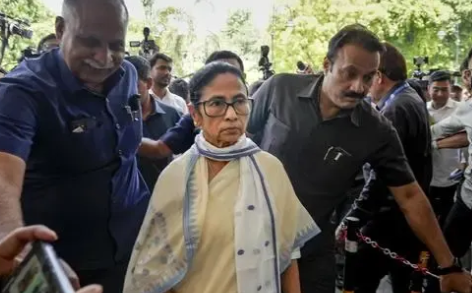
Mamata Banerjee, founder and supreme leader of the Trinamool Congress (TMC), returned from New Delhi earlier this week having achieved little politically, even as her party fractured simultaneously in Parliament and the West Bengal Assembly, civic bodies slipped from its control and investigators searched the party office located within her Kalighat residence. The scale of the crisis is unprecedented in the party’s history.
Banerjee travelled to New Delhi on June 8 to attend the INDIA bloc meeting at the Constitution Club of India, accompanied by her nephew and party general secretary Abhishek Banerjee. Political observers expected her to use the occasion to consolidate alliances and project confidence following the TMC’s defeat in the May 2026 Assembly elections. Instead, the developments that unfolded only deepened the perception of a party in turmoil.
While Banerjee was participating in the Opposition meeting, Lok Sabha Chief Whip Kakoli Ghosh Dastidar—a long-time loyalist who has now emerged as one of the principal rebels—was meeting Union Minister Bhupender Yadav at his residence. She was joined by several TMC MPs, including Prasun Banerjee, Sharmila Sarkar, Arup Chakraborty, Satabdi Roy, June Malia and Partha Bhowmick. West Bengal Chief Minister Suvendu Adhikari was also present, fuelling speculation that the rebel faction was preparing to align with the NDA.
“Nearly 20 TMC MPs, including me, have decided to write to Lok Sabha Speaker Om Birla and formally extend support to the NDA,” Ghosh Dastidar announced publicly, even as Mamata Banerjee remained engaged in the INDIA bloc meeting a few kilometres away.
The rupture within the parliamentary party has become severe. Rajya Sabha MPs Sukhendu Sekhar Roy, Sushmita Dev and Prakash Chik Baraik resigned from the Upper House. The TMC’s Lok Sabha unit now stands divided into two rival camps—one loyal to Mamata and Abhishek Banerjee and the other rallying behind Ghosh Dastidar, who insists she continues to remain the party’s Chief Whip despite being formally removed and replaced by Kalyan Banerjee.
For a party that once used its parliamentary strength as leverage in national politics, the developments represent a dramatic reversal.
The crisis intensified further when Kalyan Banerjee, one of Mamata Banerjee’s most vocal defenders, publicly issued a stark ultimatum.
“I am with Mamata Banerjee, but she must decide whether to keep Abhishek Banerjee or me,” he said. “If she believes the party cannot move forward without Abhishek, then I will not remain.”
His remarks came after he claimed that he had been sidelined in a legal matter involving Abhishek Banerjee despite having spent considerable time preparing arguments.
“Let Didi decide what she wants to do. If she decides to go with Abhishek, I will decide my own future,” he said.
The significance of the statement was unmistakable. A senior leader who had defended the party leadership throughout the crisis had now publicly questioned Abhishek Banerjee’s growing influence, reflecting the depth of internal dissatisfaction.
The situation in the West Bengal Assembly appears even more challenging.
The BJP won 208 seats in the 294-member Assembly in the 2026 elections, reducing the TMC tally to 80 from its previous strength of 215. Mamata Banerjee herself lost the Bhabanipur seat to Suvendu Adhikari, marking the second time the former TMC leader had defeated her personally after Nandigram in 2021.
Since the election, a majority of TMC legislators have reportedly revolted.
Expelled leaders Ritabrata Banerjee and Sandipan Saha have emerged as rallying figures for the dissident camp. The rebel MLAs approached Assembly Speaker Rathindra Bose claiming they represented the real TMC legislative party, and the Speaker subsequently recognised their faction.
With the rebel camp comfortably crossing the two-thirds threshold required under the anti-defection law, Mamata Banerjee’s loyalists have been reduced to a small group with limited legislative influence.
Much of the resentment within the party has centred on Abhishek Banerjee, whom Mamata Banerjee had projected as her political successor since 2021. Critics allege that his style of functioning created a parallel power structure and alienated senior leaders.
Leaders such as Manoj Tiwary, Arunava Sen, Papiya Ghosh and Kakoli Ghosh Dastidar have openly criticised what they describe as the growing dominance of the “Bhaipo” (nephew) and his close circle.
Meanwhile, Abhishek Banerjee faces mounting legal challenges. The West Bengal CID registered an FIR against him and recently summoned him again in connection with an alleged signature forgery case linked to a disputed TMC legislative party resolution. Investigators reportedly searched both his office and the party’s central office located within Mamata Banerjee’s Kalighat residence.
Separate FIRs have also reportedly been filed against both Mamata Banerjee and Abhishek Banerjee over alleged hate speeches made during the Assembly election campaign.
Across the state, the BJP government has moved swiftly against the TMC’s grassroots network. Several leaders, councillors and former legislators have been arrested in cases ranging from corruption to post-poll violence and extortion.
The Kolkata Municipal Corporation, one of the TMC’s strongest political bastions for over a decade, has also seen major changes following the resignation of Mayor Firhad Hakim and the arrest of multiple councillors. Similar developments have occurred in Bidhannagar Municipal Corporation.
Mamata Banerjee has survived major political crises before. She overcame the political wilderness of the 1990s, built a party from scratch and repeatedly staged comebacks. Her supporters insist she should not be written off.
However, the present crisis appears fundamentally different.
Today, she holds no elected office, commands no government, faces rebellion within both Parliament and the Assembly, and watches her party organisation weaken rapidly. Her chosen successor is under investigation, while civic institutions that once formed the backbone of TMC’s power are slipping away.
“She has survived everything,” a senior TMC leader told Read. “But this time she has lost her party, lost her MLAs, lost her parliamentary group and lost her grassroots structure. The question now is: what exactly is she still the leader of?”
For the first time in nearly four decades of public life, that question does not appear to have an easy answer.

Comments are closed.