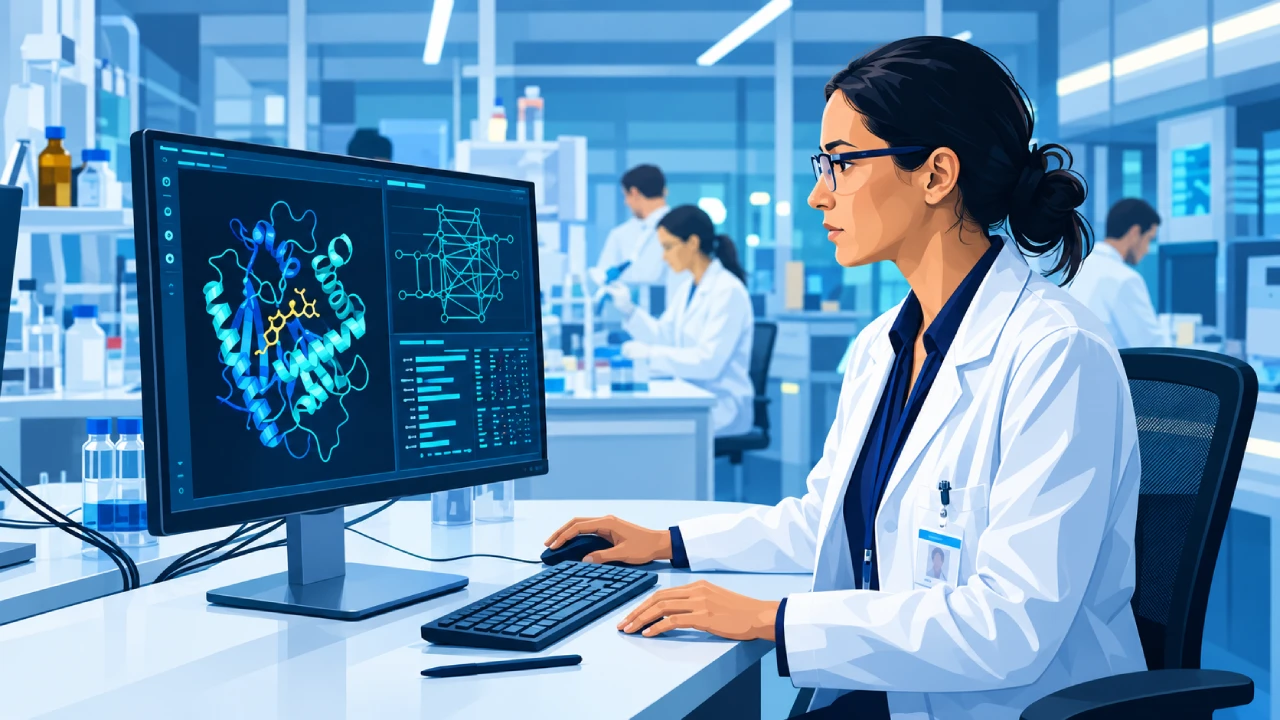
Drug discovery has traditionally been one of the most complex, time-consuming, and expensive processes in modern science. The process of developing a new drug requires more than ten years and costs over one billion dollars, with no assurance that the development will succeed. Researchers must identify potential compounds, test their safety and effectiveness, and conduct multiple phases of clinical trials before a drug can be approved for use. Artificial intelligence has become a valuable tool that can change the way people work.
AI technology uses its capability to handle large biological and chemical data sets to find patterns that enable it to make more precise predictions than conventional methods. The pharmaceutical industry and research institutions use AI technology to develop new solutions by its capability to find potential drug candidates and improve their clinical trial processes. The biotechnology industry now experiences major changes that create new approaches for conducting research and development through data analysis.
The Traditional Drug Discovery Process
The conventional drug discovery process involves multiple stages that cover several steps. The process begins with target identification and moves through to compound screening followed by preclinical testing and clinical trials until it reaches regulatory approval. The stage of drug development needs both extended time and various resources. The testing process results in many drug candidates failing, which creates expensive research expenses while producing few successful results.
The Limitations of Traditional Methods
Traditional approaches depend entirely on trial and error methods. Researchers test thousands of compounds to find one that shows potential.
The process requires:
The present system requires solutions that operate with enhanced performance and advanced capabilities because of its existing limitations.
How AI Is Transforming Drug Discovery
Data-Driven Analysis
AI systems can analyze large datasets that include:
- Genetic information
- Protein structures
- Chemical compounds
- Clinical trial data
The AI system uses data patterns to determine which compounds have the highest chance of succeeding.
Prediction of Molecular Interactions
One thing planned in drug discovery is to explore how molecules can interact with biological targets. AI models can simulate these interactions and predict:
- Binding affinity
- Drug effectiveness
- Potential side effects
The system directs researchers towards their most valuable candidates.
Accelerating Drug Development
Faster Identification of Drug Candidates
AI technology enables researchers to complete their work on drug identification within a shorter time frame. AI system tests show better results because it needs less time to identify effective drug candidates than researchers must spend testing many compounds.
Optimizing Clinical Trials
AI technology helps clinical trials become more effective through its capacity to:
- Identify suitable patient groups
- Predict trial outcomes
- Monitor patient responses
The system decreases expenses while improving success rates.
AI in Biotechnology Innovation
Personalized Medicine
AI technology enables researchers to create personalized treatment solutions that depend on a patient’s genetic information.
The approach enables doctors to create treatment plans that consider individual patient needs. The two treatments should be administered to their designated patients. The medical solution will become more effective through this approach. Through this, the remedial approach will achieve enhanced results. Fewer adverse effects occur through the remedial standpoint. Personalized medicine represents a major transformation that changes healthcare delivery.
Genomics and Protein Research
AI uses machine learning to analyze genetic information and forecast protein molecule arrangements. Drug development requires protein structure knowledge because protein structures form the foundation of drug creation.
The recent advancements in AI-based protein prediction systems have created new opportunities for research in biotechnology. The organization has established a research center to develop specialized AI applications for the pharmaceutical industry. The pharmaceutical industry has adopted AI technology to support its drug development research activities.
The pharmaceutical industry utilizes AI technology for three main purposes which are used to develop new drugs, modifying existing treatments, and enhancing production methods. Technology companies are partnering with biotech firms to develop AI-driven solutions. The two organizations work together to create innovative solutions that result in faster development of new medical treatments.
The pharmaceutical industry benefits from AI technology because it helps researchers discover new drugs, develop existing treatments, and enhance production techniques. The pharmaceutical industry incurs lower development expenses because AI technology decreases the number of research failures that need to be worked on. The use of artificial intelligence technology to discover drugs will shorten the time required to introduce new medical solutions to the public.
AI technology helps researchers find the most effective research candidates, which results in higher chances of research success. The study identifies two main areas that need to be addressed: data quality issues that affect research outcomes and data access limitations that restrict access to data. AI systems require access to accurate data because they depend on high-quality data for their operations.
AI systems become less effective when they receive incomplete or biased data, which results in wrong forecast outcomes. The regulatory authorities need to develop new procedures that will work with artificial intelligence technologies that are now used in drug development. The organization must maintain its focus on two essential elements, which are product safety and product effectiveness. The use of artificial intelligence technology in healthcare creates ethical dilemmas that involve three main areas: data protection, data usage rights, and treatment accessibility.
The Future of AI in Biotech
AI and human expertise are combined through their integration into their respective areas of work. Researchers will combine their efforts with AI systems to discover new drugs in future drug development projects. AI can perform data analysis tasks, whereas humans are responsible for making important decisions through their critical thinking abilities.
New Frontiers in Medicine
Healthcare delivery will undergo a fundamental change through AI because it enables the following benefits.
- AI enables researchers to develop new drugs through faster drug discovery processes.
- AI enables researchers to develop more effective treatments through advanced drug discovery processes.
- AI enables researchers to develop advanced methods for preventing diseases.
The global healthcare systems will experience transformation through these medical advancements.
Conclusion
AI systems revolutionize drug discovery and biotechnology research through their ability to enhance research efficiency while using data-driven research methods. Researchers use AI to create new drugs and enhance current therapies by analyzing intricate biological data, which they use to forecast treatment results.
(Source)