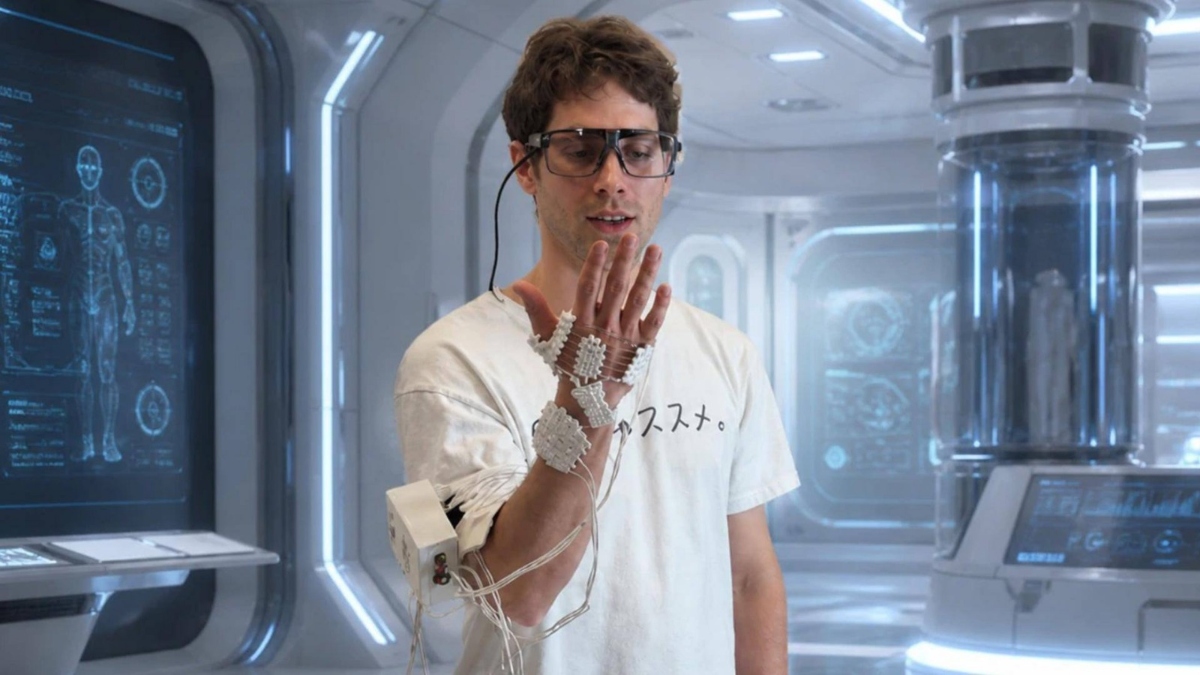
Technology Desk: The use of Artificial Intelligence i.e. AI is no longer limited to just answering questions, making pictures or making office work easier. Experiments are also being carried out rapidly in the direction of connecting AI with the human body. One such experiment was seen in the 48-hour hackathon of America's Massachusetts Institute of Technology i.e. MIT. Here a team of researchers has prepared a wearable device named Human Operator.
This device tries to convert AI instructions into physical movements of the human hand. For this, the device stimulates some muscles of the hand through electrical pulses, due to which movement can be created in the fingers and wrist.
Got first place in hackathon
The Human Operator project won first place in the Learn Track category of MIT's Hackathon. It has been created by the team of Peter He, Ashley Neal, Waldemar Dannery, Daniel Kaiser, Yutong Wu and Sean Lewis.
The aim of this project is not to make any general consumer gadget. The developers have presented it as an initial experiment to understand the possibilities of direct interface between AI and the human body.
How does Human Operator work?
Many different technologies are combined together in Human Operator. It includes head-mounted camera, voice commands, AI model, Arduino based control system and EMS i.e. Electrical Muscle Stimulation hardware.
If we understand its process in simple language, first the user gives instructions by speaking. The camera observes the surrounding situation and the AI tries to understand both types of information. After this the system decides what kind of physical movement to do.
Then the instructions received from AI reach the electronic control system. This system activates the EMS device, which delivers electrical pulses to the relevant muscles. These pulses cause contraction of muscles and cause movement in the hand or fingers.
What is the role of camera and AI?
The camera installed in the Human Operator captures the environment present in front of the user. Along with this, voice input is also taken. The AI model processes this information.
The project uses vision-language AI models connected to Anthropic's Claude API. Its job is to prepare further instructions by understanding the user's voice and visual information received from the camera.
That means the system not only listens to what the user is saying, but also tries to understand the surrounding environment.
Movement occurs in hands due to electrical pulses.
After receiving instructions from the AI, signals are sent to the Arduino control relay system. The system then activates the TENS-EMS device.
In EMS i.e. Electrical Muscle Stimulation technology, muscles are stimulated through electrical signals. In Human Operator, this same technology has been used to create movement in the muscles of the hand.
This does not mean that AI is directly controlling the mind. Here the AI first generates instructions and then the electronic system tries to stimulate the muscles according to those instructions.
The source code of the project was also made public
Regarding Human Operator, the developers have made public its source code, manufacturing information and hardware related details. With this, other researchers and developers can understand this system and do further experiments.
The advantage of such open research projects is that experts from different fields can further develop such technology by combining AI, robotics, bioelectronics and assistive technology.
Not a commercial product yet
According to the developers, Human Operator has not been designed to be sold in the market. This is currently a research project, whose focus is on Embodied AI, i.e. AI systems that can connect to any physical action in the real world instead of providing information in the digital world.
Common AI chatbots respond via text, and some AI systems generate images, videos, or other digital content. Projects like Human Operator represent a different kind of experiment towards connecting AI with a person's activity in the physical world.
Security is the most important issue
Safety is extremely important in technology that stimulates human muscles through electrical pulses. If the intensity or timing of the electrical signal is not correct, problems such as unwanted muscle activity or discomfort may occur.
In such a system, it will be necessary to make settings according to the user's body. Apart from this, a system like Emergency Stop is also important to shut down the system immediately in case of emergency.
Sensors like EMG i.e. Electromyography can also be useful in more advanced systems of the future. Such sensors can provide the system with information about the user's actual muscle activity by measuring the electrical activity of the muscles. This may increase the possibilities for improving control and security.
Can be used in medical field
One potential use of such technology could be in medical rehabilitation. For example, further research on such technology could be done to create assistive systems for people who have difficulty with hand or finger movements.
Research can also be done on combining AI and electrical muscle stimulation in assistive devices made for disabled people. However, just one hackathon prototype will not be enough for medical use. This will require extensive testing, safety testing, medical trials and related regulatory approvals.
New link between AI and human body
Experiments like Human Operator are trying to take the role of AI to a new level. In this, AI connects to any physical action in the real world with the help of camera, voice and electronic hardware, instead of merely generating digital information.
At present this technology is at the initial experimental stage and cannot be considered a ready product for everyday use. But projects like this do open up a new area for future research between AI, wearable technology, and human-machine interfaces.
Follow the LALLURAM.COM MP channel on WhatsApp