Vivek Shukla,
Former Principal Information Officer,
UAE Embassy
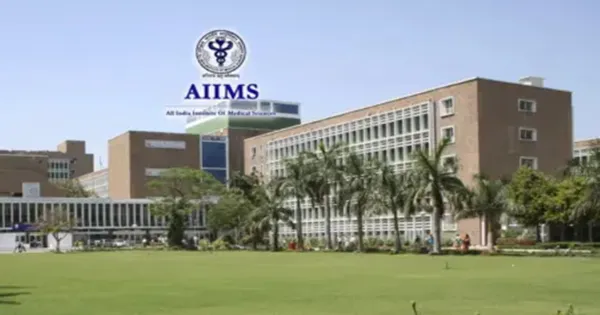
The noise of the capital's Prithviraj Road, about six-seven kilometers away from the All India Institute of Medical Sciences i.e. AIIMS, suddenly disappears when you enter the York Cemetery. A small grave is visible just outside the gate. Looking at its condition, it seems that no flowers have been offered on it for years; Princess Amrit Kaur is sleeping there. She was a close associate of Mahatma Gandhi, the first Health Minister of independent India and the founder of AIIMS.
Amrit Kaur belonged to the Kapurthala royal family. She studied at Oxford and after independence became the Health Minister in the Nehru cabinet. Initially there was a proposal to open AIIMS in Kolkata, but West Bengal Chief Minister Dr. BC Roy did not like it. The result was Kolkata's loss and Delhi's gain. Its foundation stone was laid in 1952. On 18 February 1956, Amrit Kaur introduced the bill in the Lok Sabha. On June 2, 1956, the AIIMS Act was passed and the institute got the autonomous status of national importance. She herself was the first chairperson of AIIMS and continued to strengthen the governance system till her death (1964).
Even today, after seven decades, AIIMS remains a place of hope and trust for patients. Hundreds of sick people and their relatives come here every day from every corner of India. There is confidence in the mind that we will return home after getting healthy. Doctors, nurses and other staff devote their lives in the treatment of every patient. Socialist system is implemented in AIIMS. The beggar and the big government official stand in the same queue. Doctors do not differentiate based on someone's status or money. Patients from Bihar, Eastern Uttar Pradesh and Jharkhand show special confidence.
If AIIMS was the result of the thinking of Princess Amrit Kaur, then its first director Dr. Bibi Dixit made it an excellent hospital and medical college. He was a great doctor, experienced teacher and efficient administrator. Dixit, former principal of BJ Medical College, Pune, made appointments based on merit and promoted research. He laid down the condition that there should be no political interference. Many excellent professors came during his time. If patients have confidence in AIIMS, then the credit for it goes to all the doctors and other staff here. You go to Rajendra Prasad Eye Care Center of AIIMS. The statue of the first President of India, Dr. Rajendra Prasad, is kept here.
Here, Surendra Jha, who came from Madhubani for complex retina related surgery, was saying that experienced retina doctors are not available in Bihar, hence one has to come here only. Actually this is also an amazing place. All the doctors here are an example of service. He has performed hundreds of surgeries and published dozens of research papers in the field of ophthalmology. On any day he had OPD, he used to see about thirty-forty patients.
After seeing the patients, he used to tell them right there how their treatment would proceed. These doctors used to operate on many patients on the days when operations were conducted in AIIMS. The ophthalmologists here have played an important role in the development of new technologies and treatment methods for the treatment of retinal diseases. These include laser therapy, intravitreal injections, and improvements in surgical procedures. His expertise is broad, including cataracts, glaucoma, retinal diseases and other complex eye diseases.
Dr. Vinay Aggarwal, former president of the Indian Medical Association, says that the spirit of service is deeply embedded in the nature of AIIMS. Here every year, brilliant students from across the country take admission in MBBS, MS and MD and later become the best doctors of the country and the world. Famous names include Dr. Deepak Chopra, Professor of Chicago University. Vinay Kumar, Gangaram's liver transplant surgeon Dr. Arvinder Singh Soin, former director Dr. Randeep Guleria, Dr. P. Venugopal, who connects broken hearts, ENT specialist Dr. Prateek Sharma, urologist Dr. Rajeev Sood. Eye specialists Dr. Jeevan Singh Titiyal, Dr. Pradeep Venkatesh and Dr. Tarun Dada are counted among the skilled doctors of the world.
Dr. Rajendra Prasad Center for Ophthalmic Sciences was established on 10 March 1967. The mantra of this center named after the first President of India is – 'Tamso Ma Jyotirgamaya'. The first director Dr. LP Aggarwal had returned from Boston. Every day twenty-twenty-five small and big bhandaras are organized around AIIMS. Things like bread-pakoda, tea, samosa, curry-rice, chole-rice are distributed free of cost.