Kerala BJP President Rajeev Chandrasekhar has defended India’s security clearance process for satellite communication services in a post addressed to billionaire Elon Musk, saying national security must take precedence as the country prepares to adopt new technologies.
“A country has to plan for itself and its interests before every new choice. That’s what India is doing. Patience is unavoidable and in this case is a necessity,” Chandrasekhar said in his post on X.
Responding to Musk, Chandrasekhar said all three satellite communication service providers were broadly at the same stage of obtaining security clearance. He added that safety and trust had to be verified before spectrum could be allocated.
“As someone who knows a little bit about telecom, as someone who played a decent-ish role in building India’s wireless sector as an entrepreneur and then as a policymaker, let me share my thoughts,” Chandrasekhar wrote.
Chandrasekhar flagged the security implications of satellite Internet services, particularly in a country that has faced terrorism and insurgency supported by hostile actors in its neighbourhood.
“From 26/11 terror attacks to recent ones in Pahalgam, satcom has been preferred communication for terrorists,” he said, adding that satellite-based voice-over-Internet services and encryption presented additional security challenges.
He said these challenges were not insurmountable but required new capabilities and capacity to ensure safety and trust.
While defending India’s security requirements, Chandrasekhar acknowledged the technological potential of Musk’s Starlink service.
“I have used Starlink and I think it’s awesome technology and represents a new era in mobility innovation. No doubt,” he said.
Clarifying that he was no longer in government and did not speak on its behalf, Chandrasekhar said India had to safeguard its own interests while assessing new technologies.
Elon Musk’s oligarch remark sparks debate
Chandrasekhar’s remarks come amid a debate over security clearances and the rollout of satellite-based Internet services in India.
Musk’s Starlink is seeking to launch its satellite Internet services in the country, with a focus on expanding connectivity in rural and underserved areas. The company has received a licence to operate in India, alongside Reliance Jio and Airtel-backed Eutelsat OneWeb, but is awaiting final security and spectrum-related clearances before beginning commercial operations.
Musk had claimed that unnamed “oligarchs” were attempting to block Starlink’s entry into India to protect existing monopolies.
The Indian government rejected the allegation, saying satellite spectrum would be allocated through a fair and transparent regulatory process.
The Ministry of Communications said the suggestion that India’s regulatory framework or its application was unfair or discriminatory was “baseless and misconceived”.
The ministry also pointed out that licences had been granted to three satellite broadband providers: Starlink, Reliance Jio and Airtel-backed OneWeb.
Starlink has been preparing India-specific infrastructure and security systems as part of its plans to begin operations. The company has said its satellite network could help bridge connectivity gaps in areas where conventional broadband infrastructure remains limited.
Jio makes progress on satellite Internet plans
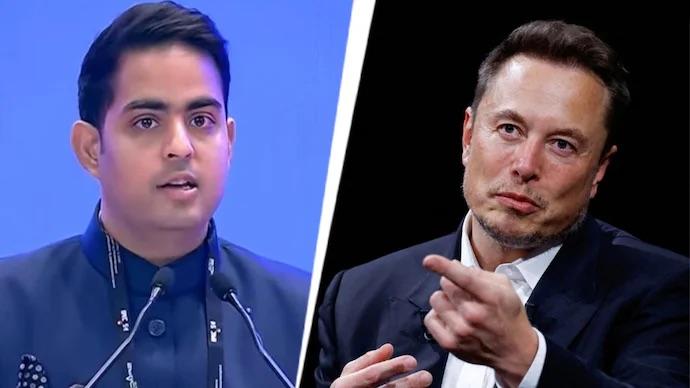
Meanwhile, Reliance Jio Infocomm Chairman Akash Ambani said the company was making progress on its satellite communication plans but declined to provide a specific timeline for launching its first fleet of low Earth orbit (LEO) satellites.
Speaking exclusively to India Today on the sidelines of the India Mobile Congress, Ambani was asked about Musk’s recent comments and the government’s response.
“No comments. We want to be heads down and deliver value to our Indian consumers,” Ambani said.

He added that satellite technology would play an important role in expanding broadband connectivity, particularly for homes that remain outside the reach of conventional networks.
“Satellite is one of the technologies that’s one of the biggest use cases is home broadband,” Ambani said, adding that Jio was already focused on ensuring Indian households had access to broadband services.
According to Ambani, satellite connectivity would help extend the reach of broadband services rapidly. He said Jio was making “good progress” in developing an end-to-end indigenous technology stack for its satellite service.
Jio aims to match global satellite technology standards
Ambani also said Jio wanted its satellite technology to be at par with or ahead of global standards, similar to its approach with other technologies it had introduced.
However, he stopped short of announcing a launch date for the company’s satellite service.
“I don’t want to give an exact answer of when we will launch,” he said, reiterating Jio’s broader goal of ensuring that every Indian home has access to a broadband connection.
As Starlink, Jio and OneWeb prepare for the Indian satellite broadband market, security clearances, spectrum allocation and regulatory compliance remain key steps before commercial services can begin.