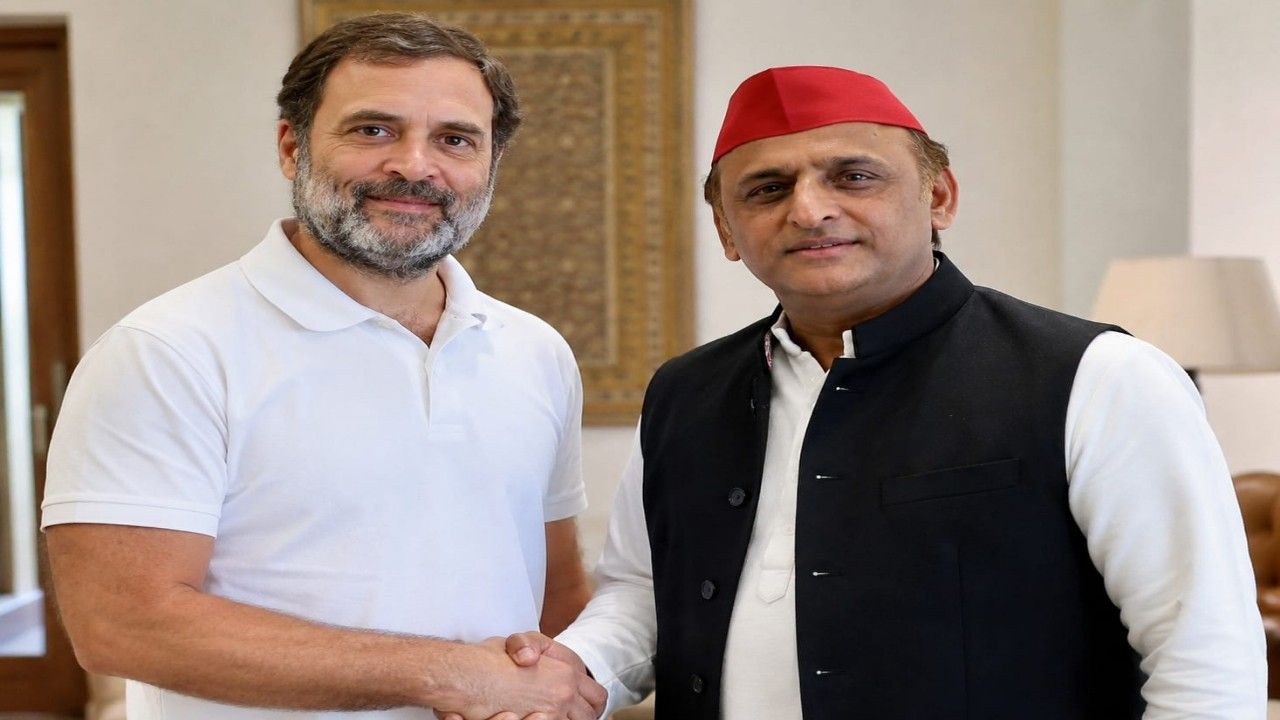
The 2027 Uttar Pradesh Assembly elections are still some time away, but a meeting in Delhi has suddenly raised the political temperature in the state. The closed-door meeting between Samajwadi Party National President Akhilesh Yadav and Leader of the Opposition in the Lok Sabha, Rahul Gandhi, is being considered the most important election meeting of the opposition. Political circles are abuzz with speculation that this meeting was not merely a formality, but involved serious deliberations on a wide range of issues, from seat-sharing to electoral strategy, caste equations, and a roadmap to oust the Bharatiya Janata Party (BJP). However, neither party has officially disclosed any details about what was decided in the meeting.
In the 2024 Lok Sabha elections, the Samajwadi Party and Congress alliance posed a significant challenge to the BJP in Uttar Pradesh. The Samajwadi Party returned as the state’s largest opposition force by winning 37 seats, while the Congress consolidated its position after years by winning six seats. The alliance won a total of 43 seats, completely changing the political landscape of Uttar Pradesh. Efforts are now underway to implement this model in the Assembly elections.
Where is the seat-sharing issue stuck?
According to political sources, Congress wants a larger role in the assembly elections. The party is expressing a desire to contest around 80 to 100 seats. Meanwhile, the Samajwadi Party, based on its strong organization and support base, was initially reluctant to give Congress more than 50 to 60 seats. Now, there is talk that the two parties may move forward on an agreed formula between 60 and 70 seats. However, this number has not been officially confirmed and negotiations are believed to be ongoing.
What will be the biggest challenge facing the BJP?
If the SP and Congress resolve the seat dispute in time and contest the elections unitedly, the BJP could face a tougher contest on many seats. The opposition’s strategy may focus on preventing vote splitting against the BJP. However, the BJP is also working on a strategy to strike a balance between backward classes, non-Yadav OBCs, non-Jatav Dalits, women, beneficiary groups, and its allies. Therefore, the electoral picture will be determined not only by alliances, but also by candidates, local issues, and the campaign.
The Samajwadi Party will strive to maintain its traditional Yadav-Muslim base. The Congress will try to strengthen its influence among Scheduled Castes, upper castes, urban voters, and youth. If the two parties form an effective alliance, they will attempt to bring together several social groups. On the other hand, the BJP will work on a strategy to maintain its influence among non-Yadav OBCs, non-Jatav Dalits, and beneficiary groups.
What will be the joint election plan?
According to sources, the meeting discussed not only seat allocations but also issues such as joint election campaigns, joint rallies, the role of star campaigners, candidate selection, booth management, and creating a common narrative against the BJP. Both parties may also outline several joint programs before the assembly elections.
What signals did the Delhi meeting provide? Political analysts believe that this meeting in Delhi provides important indications towards strengthening opposition unity. However, the final picture will only become clear after the seat-sharing agreement and formal announcements by both parties. For now, it is certain that this meeting in Delhi has created a new stir in Uttar Pradesh politics ahead of the 2027 election campaign. Now, all eyes are on when and with what formula the SP and Congress officially announce their alliance.