
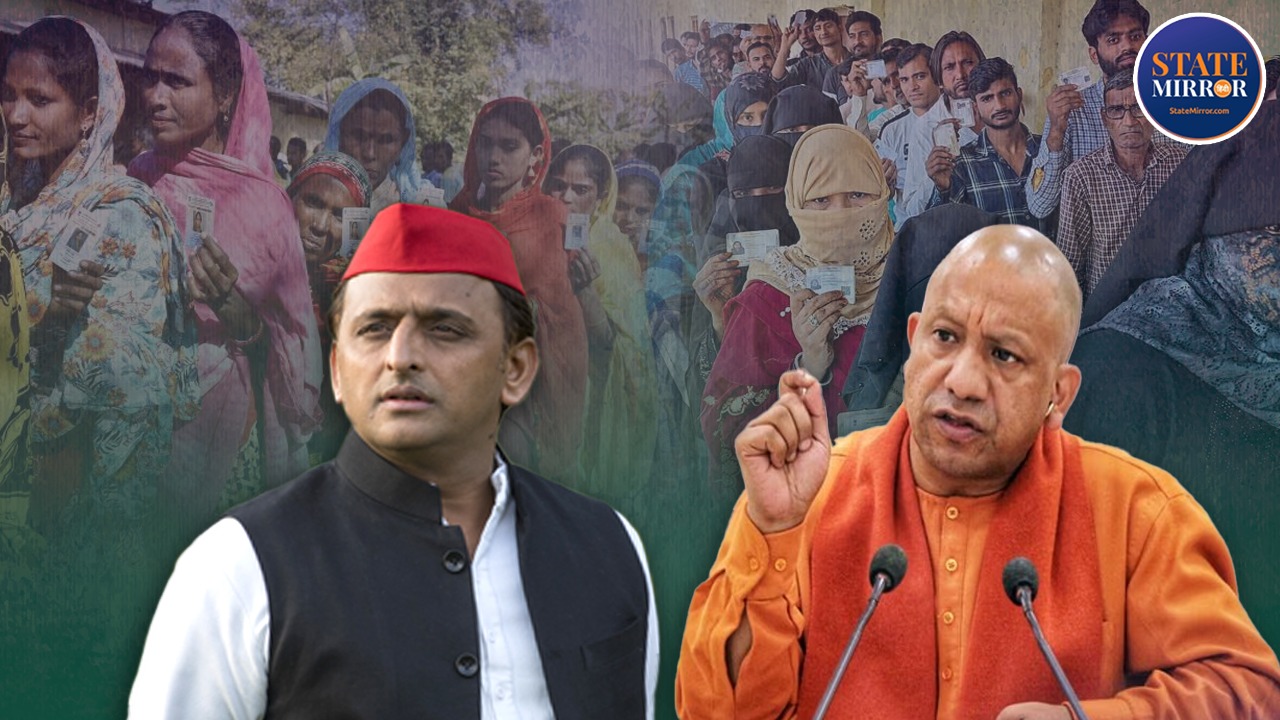

Preparations for the 2027 assembly elections have already started in the politics of Uttar Pradesh. On one side is the PDA (Backward, Dalit, Minority) formula of Samajwadi Party chief Akhilesh Yadav, while on the other side CM Yogi Adityanath Under the leadership of (Yogi Adityanath), BJP seems to be working on new social equations. The big question is whether BJP has found an effective counter to PDA or is this just an initial experiment of the election strategy? This is being discussed in the politics of UP because Yogi has clearly indicated through his recent speeches that as long as Hindus are united, there is no need to worry.
What exactly is PDA?
SP chief and former CM of the state Akhilesh Yadav made PDA the center of his political campaign in the 2024 Lok Sabha elections. Its basic idea was to bring the large population of backward classes (OBC), Dalit and Muslim communities of Uttar Pradesh on a common political platform.
The OBC population in UP is considered to be more than 40 percent, Dalits are about 21 percent and Muslims are about 19 percent. If a large section of these sections vote unitedly, it could pose a challenge to any party. PDA was considered an important reason behind the success of Samajwadi Party in the 2024 elections.
What is BJP’s challenge?
BJP has been maintaining a strong hold on non-Yadav OBC and non-Jatav Dalit votes for a long time. But the 2024 elections indicate that new political uneasiness has arisen among social groups in many areas. The biggest challenge before BJP was that it cannot contest elections only on the issues of Hindutva and development. It will have to pay as much attention to social representation and caste balance as the opposition is paying.
What is Yogi’s new social formula?
If we look at the strategy of BJP and Yogi Adityanath, its center appears to be “extremely backward + non-Jatav Dalit + upper caste + beneficiary class”. This strategy of his is indicative of the politics of United Hindu. This is because his statements have many meanings.
1. Special focus on extremely backward people
BJP is continuously giving political representation to castes like Nishad, Maurya, Kushwaha, Shakya, Bind, Rajbhar, Prajapati, Kashyap. These communities have been complaining that Yadavs have dominated OBC politics. BJP is trying to strengthen this sentiment that PDA should not actually mean “Yadav dominance”.
2. Non-Jatav Dalit Strategy
Jatav community has a strong presence in Bahujan politics, but BJP has been trying to woo communities like Pasi, Valmiki, Dhobi, Kori, Khatik for a long time. BJP argues that these communities have directly benefited from the schemes, housing, ration, toilets and other beneficiary schemes. Therefore, their voting behavior may be influenced not only by caste but also by beneficiary politics.
3. Politics of beneficiary class
BJP is looking at crores of people who are benefiting from the schemes of Yogi government and central government as a separate socio-political class. The beneficiaries of Ayushman Bharat Yojana, free ration, housing, Ujjwala, Kisan Samman Nidhi and health schemes include people of all castes and religions. BJP believes that this class can weaken the traditional caste polarization.
4. Effort for Hindu unity
The most enduring element of BJP’s politics has been the issue of Hindu identity. From the Ram Mandir movement to religious places and cultural nationalism, the party has been continuously trying to convey the message that a broad Hindu identity exists above caste divisions. This is why BJP seems to be developing a mixed model of “social justice + Hindu unity” as compared to PDA.
5. Can it become a PDA hack?
This question is not so easy. If Samajwadi Party is successful in maintaining a broad alliance of OBC, Dalit and Muslim votes, then PDA can remain a big challenge for BJP. But if the OBC vote gets divided and the non-Yadav backward communities remain with the BJP, the strength of the PDA may be limited.
The history of UP politics shows that mere numbers are not enough, unity of social groups is equally important. For example, OBC is not a single caste but a group of dozens of dominant castes. Similarly, the Dalit community is also not completely uniform politically.
6. How important will the religion equation be?
A large part of Muslim votes have been going with anti-BJP parties in the last elections. Therefore, the BJP’s strategy appears to be more focused on maintaining broad integration within the Hindu vote than on winning Muslim votes.
At the same time, the opposition is trying to include backward and Dalit classes along with Muslim votes on the issue of social justice. Therefore, the 2027 elections will not just be Hindutva versus PDA, but will also be a battle of “social representation versus social rebalancing”.
At present, it is too early to say that Yogi Adityanath has got a complete cut of Akhilesh Yadav’s PDA. But it is clear that BJP has taken the challenge of PDA seriously and is preparing to answer it not only ideologically but through social engineering.
The 2027 elections will depend on whether Akhilesh Yadav is able to turn the backward-Dalit-minority alliance into a permanent political force, or whether Yogi Adityanath creates a new social equation by including the extremely backward, non-Jatav Dalits, upper castes and the beneficiary class. The next political battle in Uttar Pradesh is actually going to be between these two social models.
7. New battle in caste mathematics – PDA’s challenge, BJP’s answer
According to political analysts, OBC population in Uttar Pradesh is considered to be around 40-45%, Dalit 21%, Muslim 19-20% and upper caste 18-20%. Akhilesh Yadav’s PDA formula claims to have a social alliance of about 80% of the population by including backward, Dalit and minority communities. The challenge, however, is that the OBC and Dalit votes are not completely united; There are different political tendencies within Yadavs, non-Yadavs, Jatavs and even non-Jatavs.
On the other hand, Yogi Adityanath’s social formula centers on non-Yadav OBCs (about 25-30%), non-Jatav Dalits (10-12%), upper castes (18-20%) and beneficiary classes. BJP’s effort is to link Hindu unity with caste identity and beneficiaries of welfare schemes. Therefore, the fight of 2027 will not be just about numbers, but about the real political unity of these social groups.

Comments are closed.