
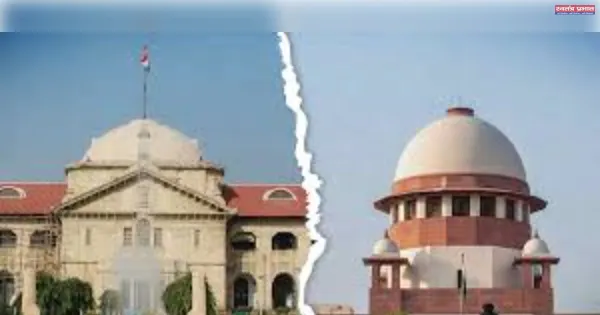

Bureau Prayagraj. The Supreme Court today questioned the Allahabad High Court as to why it granted bail to a man who was prima facie accused of dowry death. The court canceled the bail of the accused husband and directed him to surrender within a week. The court also ordered that the trial be completed within a year.
The bench of Justices JB Pardiwala and Vijay Bishnoi was hearing a special leave petition filed by the father of the deceased, challenging the bail granted to the husband by the Allahabad High Court.
Initially, the court saw the postmortem report, which stated that the deceased had injury marks around the neck. When the Court asked the Uttar Pradesh government’s counsel about this, they replied that they would file a counter-affidavit.
Justice Pardiwala said: “On such charges and in a case of death within seven years of marriage, why should you be granted bail? Lawyer sir, talk to the point, do not make weak arguments, otherwise we will cancel your bail right here and now. You are accused of dowry death, and your wife was found dead under suspicious circumstances in your own house. There were external injury marks on her body. What explanation do you give about your wife’s death? Will you give?”
After this, Justice Pardiwala questioned the High Court: “What is the problem in this High Court, it is beyond our understanding. Even in cases where bail should not be granted, bail is granted.”
The state government’s counsel requested the court to also consider the fact that the accused has been in custody for 18 months. To this, Justice Pardiwala commented orally: “You want to say something, Mr. Vakil Sahib? This is a case of murder. 304B, yes. She has been strangulated to death; do you want us to do it? Page 31 [पोस्टमॉर्टम रिपोर्ट का] But come.”
The court ordered cancellation of bail. In its order, the court said that the marriage took place in February 2019 and the wife’s unnatural death occurred in July 2024. The court further said that it is undisputed that the deceased died within seven years of marriage and the allegations are of dowry-related death. In such circumstances, the High Court should have taken into account the presumption under Section 113B of the Indian Evidence Act.
The court also took cognizance of the postmortem report, which mentioned pre-mortem injuries on the body of the deceased.
The court made it clear that it did not want to comment further on the merits of the case, as the trial was still going on and only one witness had testified so far. However, considering the overall circumstances, the Court was satisfied that the impugned order granting bail was not in accordance with law. Therefore, the bail granted to the defendant was cancelled.
The defendant was directed to surrender before the prison authorities within a week. The trial court has also been directed to try to complete the trial within a year.
The same judge had also expressed disappointment when the High Court, using its discretion, had granted bail in a dowry death case without considering the prima facie allegations. Subsequently, the High Court judge requested the Chief Justice of the High Court not to give him the responsibility of bail matters, and described the Supreme Court’s criticism as “demoralizing”.
The bench of Justice JB Pardiwala and Justice R Mahadevan had given a unique order last year. He had objected to the order of another High Court judge refusing to quash a criminal complaint on the grounds that civil remedies for recovery of money were not effective. The bench made strong observations and said that criminal jurisdiction should be withdrawn from the said judge till his retirement and he should be made to sit on a division bench with an experienced senior judge of the High Court.
Comments are closed.