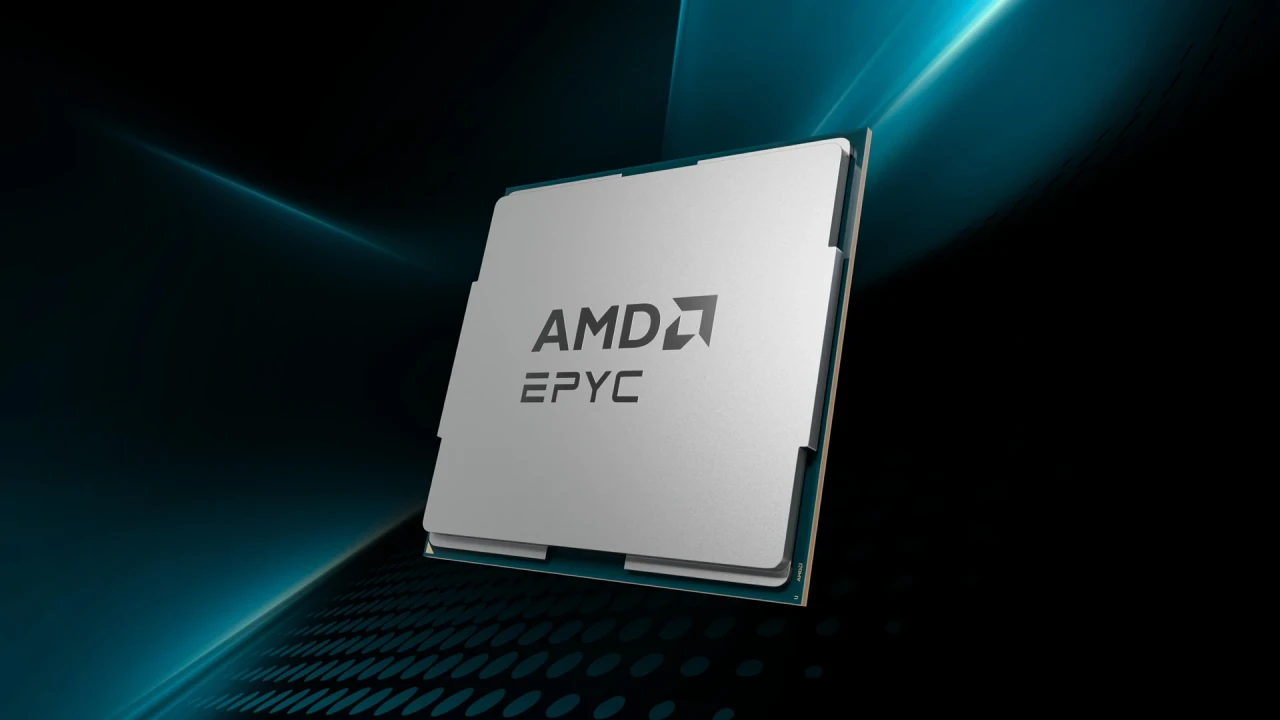
AMD is expanding the role of its EPYC server processors in artificial intelligence infrastructure through an expanded collaboration with Google Cloud.
Announced on November 9, 2026, the deployment combines AMD’s fifth-generation EPYC host processors with Google’s eighth-generation Tensor Processing Unit (TPU) architecture.
The goal is to help enterprises run sensitive AI workloads, including inference, fine-tuning and reinforcement learning, while strengthening protection for their data and models during processing.
The announcement also highlights the importance of host CPUs in AI systems increasingly built around specialised accelerators.
AMD EPYC Processors Power Google Cloud TPU 8tx
The latest collaboration places 5th Gen AMD EPYC server CPUs at the centre of Google’s TPU 8tx host infrastructure.
According to AMD, TPU 8tx is the first cloud TPU system to deliver hardware-enforced confidential computing.
It combines Google’s eighth-generation TPU architecture with AMD’s host processing and security capabilities to support sensitive AI workloads.
In this arrangement, AMD processors handle several important responsibilities.
They manage workload orchestration, prepare data for processing, and maintain high-throughput communication with Google’s TPU accelerators.
Google’s TPU technology handles the specialised AI computation, while AMD EPYC provides the host processing foundation.
The combination is intended to support demanding enterprise applications without treating performance and data protection as separate priorities.
Google has been developing different TPU systems for training and inference.
TechGenYZ previously covered the company’s Google TPU 8i and TPU 8t architecture, which highlights the different requirements of large-scale training, low-latency inference and agentic AI.
TPU 8tx extends Google’s eighth-generation TPU portfolio with a particular focus on protecting sensitive information during AI processing.
How AMD and Google Protect Sensitive AI Workloads
Google Cloud TPU 8tx introduces hardware-enforced confidential computing protections designed to reduce the exposure of sensitive information during processing.
The system uses AMD Secure Encrypted Virtualization (SEV) capabilities alongside Google’s TPU security architecture to extend confidential computing protections beyond the host CPU to connected accelerators.
According to AMD, the system verifies an accelerator’s identity and security configuration before allowing it direct access to protected memory.
This helps keep customer prompts, model weights, and intermediate data encrypted in CPU memory and while moving between the host and accelerators.
Hardware isolation is also used during accelerator execution.
These measures are intended to help enterprises protect proprietary AI models and sensitive information while running workloads in cloud infrastructure.
However, confidential computing should not be interpreted as protection against every possible security threat.
Its effectiveness depends on the supported hardware, security configuration, software stack, and the threat scenarios the architecture is designed to address.
AMD’s Infinity Guard technologies also support Google’s broader confidential computing portfolio.
AMD says its security capabilities are used across Google Cloud services, including:
- Confidential VMs.
- Confidential GKE.
- Confidential Space.
- Confidential Managed Service for Apache Spark.
- Confidential Dataflow.
The company notes that Infinity Guard features vary by processor generation and series. Relevant protections must also be supported and enabled by the server manufacturer or cloud provider.
Organisations should therefore confirm which security features are available in their chosen deployment.
Hardware-based protection is becoming increasingly important across AI infrastructure.
For example, TechGenYZ’s coverage of NVIDIA Blackwell confidential computing examines how accelerator architectures are also incorporating protections for sensitive models and customer data.
AMD and Google’s approach reflects the same wider requirement: protecting information not only when it is stored or transferred but also while it is being processed.
Why EPYC CPUs Matter Beyond AI Accelerators
The announcement highlights a part of AI infrastructure that can be overlooked when attention focuses on GPUs and specialised accelerators.
These processors perform much of the intensive AI computation, but they still depend on host CPUs to manage the surrounding infrastructure.
EPYC processors handle tasks such as preparing information, scheduling workloads, and connecting accelerators with enterprise applications and services.
As AI systems become more complex, these responsibilities become increasingly important.
For example, agentic AI applications may involve several interconnected operations, including retrieving information, processing requests, coordinating services, and running model inference.

A powerful accelerator alone does not handle every part of that workflow.
AMD says its EPYC processors are now the host CPU of choice across more than 10 leading hyperscalers and frontier AI labs.
The company’s processors support infrastructure built around AMD Instinct GPUs, NVIDIA GPUs and custom accelerator ASICs.
That figure comes from AMD’s announcement and should be understood as the company’s own assessment of its industry adoption.
AMD’s broader AI infrastructure strategy is also evident in the AMD Helios rack-scale AI platform, which combines EPYC processors, Instinct GPUs, networking and software in an integrated system.
Unlike TPU 8tx, which uses Google’s proprietary AI accelerators, Helios centres on AMD’s own accelerator technology.
Both approaches demonstrate the continuing importance of host CPUs in systems designed for specialised AI computation.
The company is also expanding the software used to coordinate complex AI tasks.
TechGenYZ’s analysis of AMD ROSS agentic AI explains how orchestration, data processing and developer tools fit into AMD’s wider AI computing strategy.
Long-Term AMD and Google Cloud Collaboration
The TPU 8tx deployment builds on several generations of cooperation between AMD and Google Cloud.
AMD EPYC processors have supported different Google Cloud Compute Engine workloads, including general-purpose, compute-intensive, storage-intensive and accelerated applications.
The companies have also worked together on security technology.
AMD says Google security experts have conducted detailed reviews of its security processor firmware as part of their wider collaboration.
The new TPU 8tx system extends that relationship into confidential AI acceleration.
This could become increasingly important as businesses move AI agents, proprietary models and other sensitive workloads into production.
For AMD, the announcement reinforces the role of EPYC processors in a data-centre market increasingly shaped by specialised AI accelerators.
For Google Cloud, the collaboration combines AMD’s host CPU and security capabilities with Google’s TPU architecture.
AMD has also been expanding its relationships with other major cloud and AI infrastructure providers.
For example, its partnership with Microsoft Azure includes EPYC processors, Instinct GPUs and other components designed for large-scale AI workloads.
The company has also reported progress in its AMD and Meta AI infrastructure partnership, demonstrating its involvement in AI systems built around different accelerator architectures.
The Google Cloud announcement adds another example of how AMD is positioning EPYC as a processing foundation for increasingly specialised AI infrastructure.
However, AMD’s November 9 announcement does not disclose TPU 8tx customer pricing, general availability dates or independent performance benchmark results.
Those details will be important for enterprises evaluating potential deployments.
Frequently Asked Questions
What is Google Cloud TPU 8tx?
TPU 8tx is Google’s eighth-generation cloud TPU system designed to support hardware-enforced confidential computing for AI workloads. It combines Google’s TPU acceleration technology with fifth-generation AMD EPYC host processors to help protect sensitive information during processing.
Which AMD processors power TPU 8tx?
The system uses 5th Gen AMD EPYC server processors for host processing, workload orchestration, data preparation, and communication with TPU accelerators.
What is AMD Secure Encrypted Virtualization?
AMD Secure Encrypted Virtualization (SEV) is a security technology that helps protect virtualised workloads through memory encryption and hardware-supported isolation.
In TPU 8tx, SEV works alongside Google’s security architecture to extend confidential computing protections to connected accelerators.
Does AMD EPYC perform the AI acceleration in TPU 8tx?
No. Google’s TPU accelerators handle the specialised AI computation.
AMD EPYC processors provide the host infrastructure that coordinates workloads, prepares data, and manages communication with those accelerators.
The Bottom Line
AMD’s expanded collaboration with Google Cloud demonstrates how important host processors remain in modern AI infrastructure.
The fifth-generation EPYC processors powering TPU 8tx help manage workloads while contributing hardware-based protection for sensitive data and models.
The partnership also illustrates how confidential computing is moving beyond general-purpose virtual machines to specialised AI accelerator systems.
For AMD, the deployment strengthens its position as a host CPU supplier across different AI computing architectures.
For Google Cloud, TPU 8tx introduces hardware-enforced confidential computing capabilities intended for enterprises running sensitive AI workloads.
As businesses adopt AI for increasingly confidential tasks, systems that combine specialised accelerators with secure host processing could become an important part of cloud infrastructure.
However, actual customer benefits will depend on availability, supported configurations, performance and deployment requirements.
(Source)