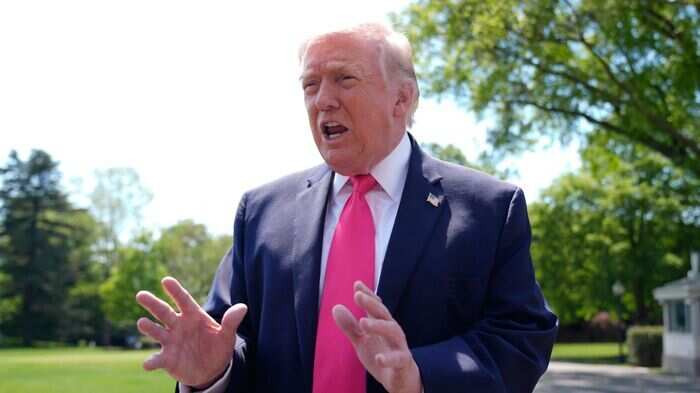
The biggest and shocking news of this time is coming out from the smoldering geopolitical corridors of international politics and the Middle East. America's newly elected President Donald Trump has given a very aggressive and clear statement regarding the 'Strait of Hormuz', which is counted among the world's most sensitive and strategic waterways. After the recent US military attacks on Iranian targets, Donald Trump has bluntly said that now the United States has completely established control over this important oil route and in the current circumstances he has no interest in any kind of diplomatic talks with Tehran. This statement of Trump has brought a new and dangerous turn in the global energy markets, crude oil prices and the decades-long tension between America and Iran. Let us understand each and every aspect of this high-voltage diplomatic drama and its global consequences in detail and in-depth. The meaning of this strong statement of Donald Trump and the strategic importance of the Strait of Hormuz. The Strait of Hormuz is one of the most important arteries of the world in terms of global economy and energy security, because a large part of the world's crude oil passes through this narrow sea route. Whenever tension increases in the Middle East, the clouds of crisis first begin to loom over this waterway. The way Donald Trump has claimed America's direct control and military dominance in his recent statement, it has given Iran's strategists sleepless nights. This stance of Trump clearly shows that Washington is now moving beyond traditional methods of diplomacy and relying on direct show of power and strategic maneuvering. In response to earlier threats by Iran to close this route or disrupt shipping, the US military has strengthened its naval presence so much that now every commercial vessel and oil tanker movement is under US security. The recent US attacks on Iran and the deepening bloody conflict between the two countries. In the last few weeks, the military confrontation between America and Iran has reached such a point from where the path of return seems almost closed. Based on reports from US intelligence agencies and the Pentagon, President Donald Trump ordered a series of precision airstrikes against Iran-backed militia groups and strategic targets. The main objective of these attacks was to break Tehran's military backbone and cripple its missile capabilities. In response to this, sharp reactions have also come from Iran's side, but in the face of American military power and state-of-the-art defense system, Tehran's aggressive strategies seem to be under control. This tough stance of the Trump administration proves that America is now in no mood to tolerate any kind of adventurism by Iran and wants to restore security and trade routes in the region on its own terms. The doors of negotiations are closed and a new threat is looming on the global economy. Donald Trump's statement that "No longer interested in our conversation" This is a clear indication that the hope for a solution through diplomatic dialogue in the coming days has almost ended. When the world's two biggest opposing sides come face to face without any mediation, it has a direct impact on global markets. The biggest and immediate impact of this military and political turmoil is on crude oil prices. Due to expensive crude oil, there is a danger of rising inflation in all the developing countries of the world including India. Apart from this, millions of migrants living in Gulf countries and the fear of global supply chain being affected have increased the concerns of the international community. The coming times may prove to be the most sensitive period in the history of the Middle East, where even a small spark can throw the entire continent into the fire of war.