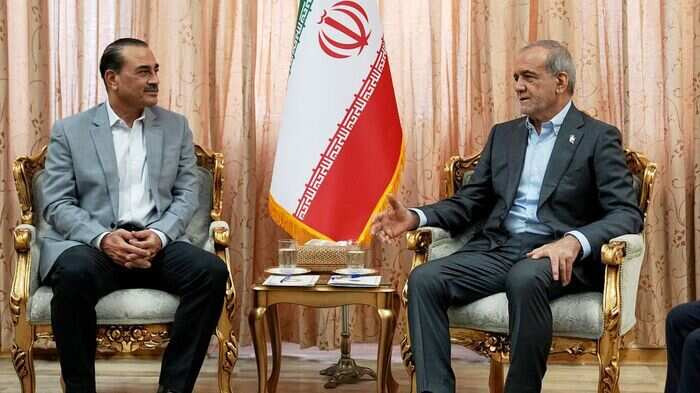
A very sensational and shocking news has emerged from the smoldering geopolitical scenario of international politics and West Asia. Amidst the ongoing turmoil on the front of regional diplomacy, when Pakistan Army Chief Asim Munir reached Iran's capital Tehran on an official visit, he heard sharp and blunt words from Iran's top leadership. Iranian officials made it clear to Pakistan in no uncertain terms that America should first improve its aggressive and unilateral attitude, only then regional stability and any meaningful outcome of diplomatic talks can be expected. On one hand, while Pakistan is trying to mediate or maintain diplomatic balance between West Asia and America, on the other hand, a senior minister associated with the administration of newly elected US President Donald Trump has shown a very aggressive attitude and has openly warned that if any step is taken against Washington's interests, then a major military attack can be launched on Tehran again. The simultaneous statements on both these fronts have raised the temperature of global diplomacy to the seventh sky and everyone's eyes are fixed on what impact this tension will have on the energy markets and regional security around the world in the future. The hidden political and strategic intentions behind Asim Munir's visit to Tehran: Pakistan Army Chief General Asim Munir's visit to Tehran has taken place at a time when tension between America, Israel and Iran in the Middle East is at its peak. Pakistan has always been trying to maintain its economic relations with America and Western countries by pretending to be a diplomatic balance, but at the same time, it does not want to completely displease Tehran due to its border and trade constraints with neighboring countries like Iran. When Munir met senior Tehran officials, he wanted to discuss traditional issues such as regional security and elimination of terrorism, but Iranian diplomacy immediately turned the tables and directly attacked America's double standards policies. Iran made it clear that the countries which decide their own policies at the behest of America should not pretend to be the leaders of peace and security in West Asia. Tehran made it clear to Munir that unless Washington changes its imperialist policies and sanctions stance, no external mediation can exist. The return of the Trump administration and the dark clouds of new military attacks looming over Iran. On the other hand, the news coming from the political circles of Washington is very scary for the peace of West Asia. Ever since Donald Trump assumed power again in America, his old and fanatical policy of 'Maximum Pressure' has returned. An influential minister of the Trump administration recently gave a very aggressive statement in front of the media, saying that America will not hesitate to go to any extent to protect the strategic interests of itself and its allies. He openly warned that if Iran did not stop its nuclear programs and regional proxy wars, the US and its allies would not shy away from launching a devastating military attack on Tehran once again. This type of war-mongering rhetoric has created a stir in the Gulf countries, because everyone knows that if there is a direct military conflict between the US and Iran, the entire world will have to suffer the biggest consequences in the form of increased crude oil prices and economic recession. Changing equations and geopolitical challenges between Iran and Pakistan The borders of Iran and Pakistan are connected to each other and there is often a state of tension between the two countries regarding cross-border terrorism and movement of security forces in sensitive areas like Balochistan. This visit of the Pakistan Army Chief proves that Rawalpindi (Pakistan Army Headquarters) wants to maintain its influence in the developments in West Asia to overcome its internal economic crisis and external pressures. However, such a blunt reply to the Pakistani general by a regional superpower like Iran shows that Islamabad's diplomatic status is continuously weakening on international forums. Iran understands very well that Pakistan's military cannot take any independent decisions completely free from American influence, hence Tehran made its position crystal-clear in front of Munir that it is not going to bow down to any external pressure or American threats. The looming threat to global peace and the keen eye of other countries including India, the impact of this entire geopolitical drama is not limited only to Central Asia or South Asia, but it has the power to affect the entire global economy and security. For a country like India, which has strategically important relations with both Iran (in terms of the Chabahar port) and the US, this situation is extremely sensitive. Millions of Indian expatriates work in the Gulf countries and the country's energy needs are largely met from that sector. If a situation of war arises between America and Iran after the warnings of the ministers of Trump administration, then India will also face a big challenge of maintaining diplomatic balance. Countries around the world are appealing for restraint at this time, but Washington's aggressive attitude and Tehran's blunt reply have proved that in the coming days, a big geopolitical explosion can be seen on the soil of West Asia, due to which all the equations of international peace can be completely overturned.