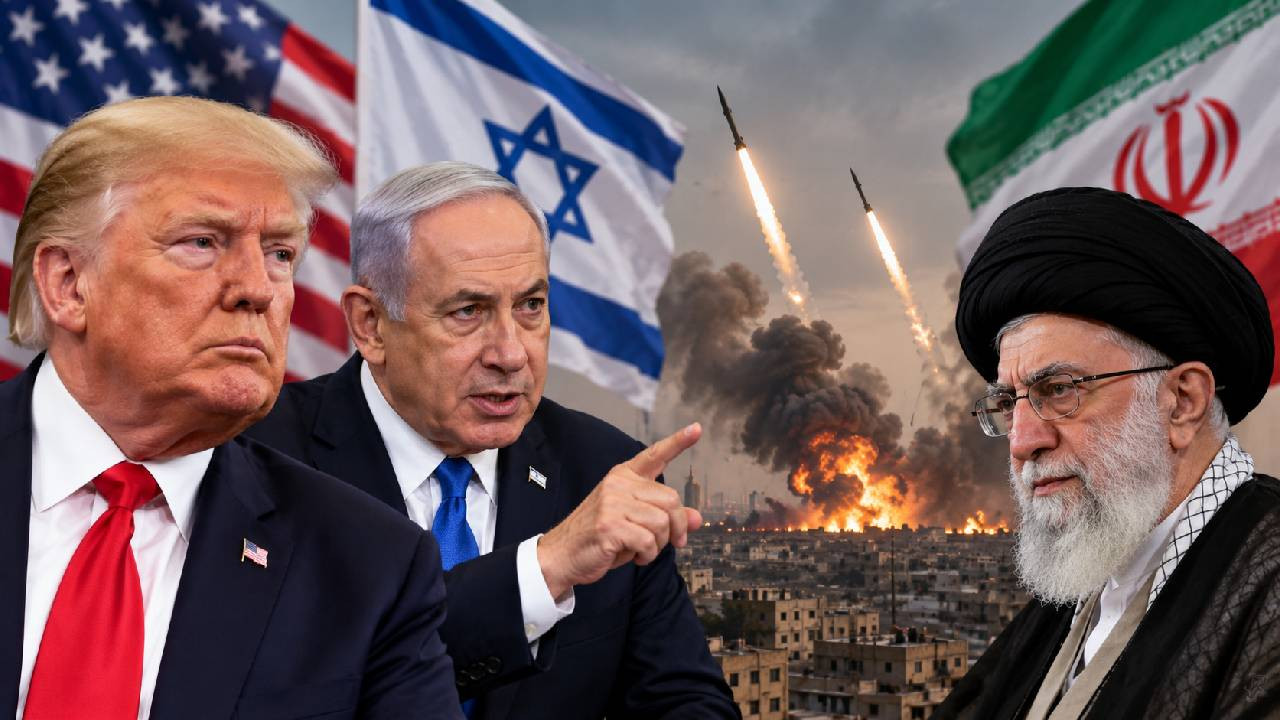
After the recent statements of US President Donald Trump, a new debate has started regarding the security of Iran and its surrounding countries. Some analysts predict that Washington and Tel Aviv may increase military pressure against Tehran in the coming times. However, different claims are emerging regarding the date of the possible attack. Some reports have expressed fear of action before Israel's elections, while others have expressed the possibility of the situation worsening after the US midterm elections.
At present there has been no official confirmation of any new attack. Meanwhile, Gulf countries fear that if the conflict resumes, its impact will not be limited to military bases, but could also cause serious damage to oil supplies, digital communication systems, trade and the regional economy.
Trump's statement increases speculation of military action
According to the report, Trump has not ruled out the possibility of escalating the conflict with Iran further. Looking at their stance, the question is arising whether America will further increase economic and diplomatic pressure or will choose the path of military action.
However, no specific date or final decision on any new attack has been made public yet. Therefore, it would not be appropriate to consider the ongoing discussions regarding possible action as confirmed information. Announcements from the US administration in the coming days may be important in this matter.
Iran's strength and growing concern of Gulf countries
Some analysts fear that in the event of a new conflict, Iran may try to strengthen its role in West Asia. This period is also considered important for the Iranian leadership, but it is difficult to predict what kind of change will take place in the regional balance of power.
The biggest concern of the Gulf countries is that their oil installations, ports and other vital facilities could be targeted if the war spreads. Such an attack could disrupt energy supplies and take a long time for business and infrastructure to return to normal.
Along with military bases, energy establishments are also under threat.
The report claimed that US military bases had been targeted during previous confrontations. After this, America is making changes in its security system. However, each claim regarding evacuation of military bases or preparation for upcoming attacks requires independent verification.
Meanwhile, questions are also being raised about the safety of oil refineries, pipelines, oil fields and other energy facilities. If these installations are damaged, the supply of crude oil in the international market may be affected. This is likely to cause fluctuations in energy prices and additional pressure on regional economies.
Data center and undersea cables also kept an eye on
Some reports have claimed that undersea communication cables, data centers and artificial intelligence-related facilities could also be at risk in the next phase of the possible conflict. These systems are important for internet services, banking, digital trade and international communications.
A statement attributed to former Iranian official Mohsen Razai also described the potential conflict as an existential threat and warned of retaliation. However, merely identifying these facilities as potential targets does not prove that any official plan is in place to attack them.
Discussion on Iran's drone preparations also
According to the report, Iran's Islamic Revolutionary Guard Corps or IRGC has released photos or videos related to underground drone facilities. This is being seen as an attempt to demonstrate its military preparedness and production capacity.
The role of drones in modern warfare has continuously increased. They are used for everything from surveillance to attack. However, independent technical information is necessary to assess Iran's actual production capacity and the state of its military resources.
Non-aggression agreement discussed in Gulf countries meeting
The report also mentions the meeting of foreign ministers of Turkey, Egypt, Pakistan and Saudi Arabia in Istanbul. It mentions the participation of representatives of Britain, France and Germany. The objective of the meeting is said to be focused on stopping military confrontation and finding solutions through dialogue.
In this context, the proposal of Non-Aggression Pact has also come up for discussion. Under this, the concerned countries can give a commitment not to launch missiles, drones or air attacks in each other's territory. According to the report, Qatar had put forth such an idea in the Gulf Cooperation Council meeting.
Question of trust in America and possibility of regional agreement
Some reports claim that many Gulf countries, including Saudi Arabia, are considering options with regional and European allies for their security. The United Arab Emirates, Bahrain, Kuwait and Oman have also been counted among potential supporters of such proposals.
A report in Israeli newspaper Haaretz also speculates that if trust in America decreases, some Arab countries may move towards a security agreement with Iran. However, no final agreement has been confirmed yet.
Overall, the further situation in West Asia will depend on whether the countries concerned increase military pressure or adopt the path of dialogue. If diplomatic efforts are successful, there may be an opportunity to reduce tensions. On the contrary, a new war could pose a serious challenge to the security, energy supply and economy of the entire Gulf region.